
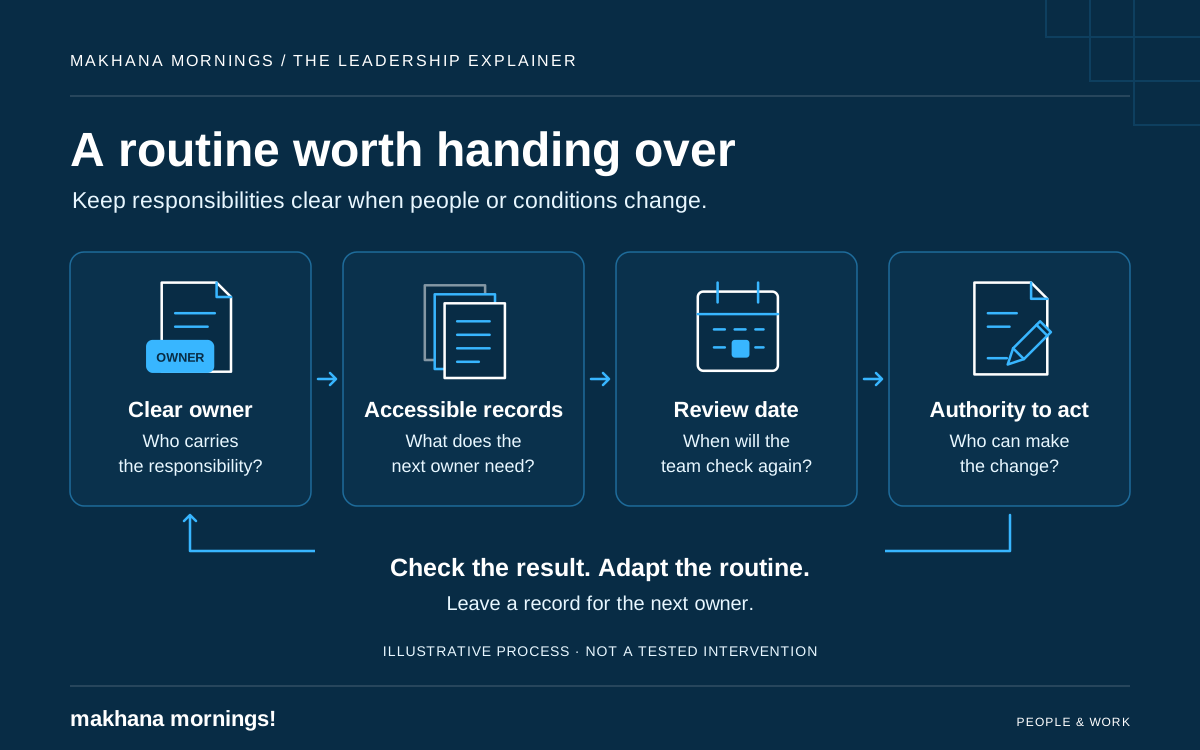
If the manager who introduced a quality check leaves, does anyone keep doing it? If the business changes, does anyone ask whether the check still helps? Those questions give accountability a more practical meaning than simply demanding greater effort.
In an October 15 essay, Michael Schreibmann described how running helps him keep promises to himself and persist through discomfort. It is a personal account. Research in Indian workplaces offers a different way to examine follow-through: look at the routines a team can sustain and the conditions under which they work.
The Breakdown
Between 2008 and 2010, researchers studied a management intervention involving 28 textile plants across 17 family-owned firms near Mumbai. Firms were randomly assigned to treatment or comparison groups, with consulting delivered at selected plants.
Both groups’ experimental plants received a month of diagnosis and recommendations. Treatment plants also received four months of help implementing practices covering operations, quality, inventory, staffing and sales. The study tracked 38 practices.
Researchers returned in 2017. Their follow-up, described in a 2018 working paper, found that some improvements had faded, while treatment plants still retained a significant advantage in management practices. Some practices had also spread to other plants within the same firms.
Managers and directors frequently cited changes of plant manager and limited director time as reasons for abandoning practices. Those explanations were reported after the event; turnover itself was not randomly assigned. The small manufacturing sample also cannot establish what every business should do.
Consistency needs room for judgement
A separate study published in a 2026 journal issue examined 585 employees across 146 branches of one Indian nonprofit microfinance institution. It combined administrative performance records from October 2019 to January 2021 with employee surveys.
Researchers compared managers rated relatively more transformational, including providing direction and encouragement, with those rated relatively more transactional. They used employees’ pre-crisis assessments and the institution’s broadly rule-based staff allocation to support a quasi-experimental comparison.
Before the pandemic, employees under more transactional managers performed better financially. During the disruption, employees under more transformational managers caught up on loan-repayment performance and reported better well-being. The existing incentive scheme had been paused, and normal client-facing work was disrupted.
This was not a trial that trained managers into different styles. It depended on assumptions about employee allocation, and leadership ratings reflected staff perceptions. Its contribution is a bounded finding: the relative benefits of leadership styles varied with the operating environment.
What a business can take from this
The two studies address different questions. One examines whether management practices endure. The other examines leadership under changing conditions. Together, they suggest a useful test for a new process: define what must be repeatable and what needs judgement.
Consider a routine for reviewing recurring customer complaints. A clear owner, accessible records, a review date and authority to fix a problem make the task easier to hand over. Recording whether the fix worked gives the next manager something more useful than an instruction to keep holding the meeting.
That is an illustrative application, rather than an intervention tested in either study. It also needs a way to change. If the customer problem disappears or a new risk emerges, the team should be able to revise the check rather than preserve a ritual.
For a growing Indian business, the relevant question is therefore specific: which responsibilities depend on one person remembering, persuading or finding spare time? Addressing that dependence makes accountability something the organisation can inspect, instead of a virtue it merely asks leaders to display.
The Crunch
Accountability becomes useful when a team knows what to check, who can act and how to learn from the result. Personal discipline can support that work. The organisational test is whether the process survives a change of manager and remains sensible when the conditions around it change.