
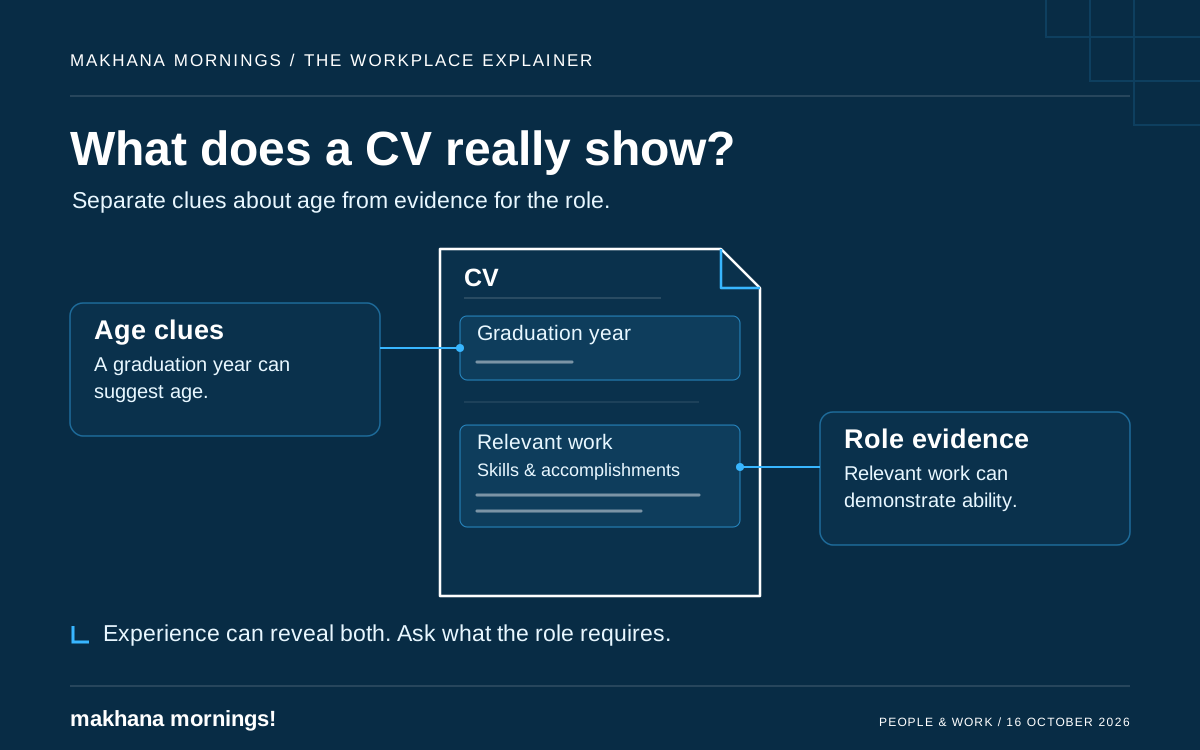
A graduation year can reveal someone’s age. A long employment history can reveal both age and useful experience. When applicants shorten a CV to look younger, those two kinds of information can disappear together.
A new survey brings that trade-off into view. It raises a practical question for employers as well as jobseekers: is the first screening step assessing evidence of ability, or using clues about age to fill in the gaps?
The Breakdown
Use.AI published its results on October 15, 2026. The company surveyed 4,263 people using its platform across the US, UK, Canada and EU. All had submitted a job application within the preceding 12 months. Some 42% reported editing a CV or LinkedIn profile to give a younger or less senior impression.
Among people who made such edits, 43% reported receiving more interview invitations afterwards. That is a before-and-after account from respondents, not an experiment showing that the changes caused the increase. Different vacancies, application volumes or other edits could also affect the result.
The sample consists of users of an AI platform. It excludes India, and the release does not provide fieldwork dates, weighting details or a questionnaire. Its results should not be treated as the behaviour of all jobseekers.
What an experiment can establish
Stronger evidence about age-related screening comes from a US experiment by David Neumark, Ian Burn and Patrick Button, described by the researchers in 2017. They sent more than 40,000 fictitious applications to real vacancies across 12 cities.
The applications represented people aged 29–31, 49–51 and 64–66. The study covered relatively low-skilled roles, including administrative work and retail sales for female applicants, and retail, security and janitorial work for male applicants. It tested different employment histories rather than simply changing a birthdate on identical CVs.
The researchers found robust evidence of discrimination against older women, especially those near retirement age. Evidence for men was less robust after addressing potential biases in the experimental design.
The measured outcome was an employer callback, not a completed interview or job offer. The study supports concern about screening barriers in the jobs it examined. It does not show that removing dates works, or establish the size of any penalty in Indian hiring today.
India adds a different perspective
Randstad India and In Diverse Company’s 2024 ageism report used an anonymous online survey of 956 respondents across job levels, sectors and locations, alongside focus groups and interviews.
In that sample, 61% said Indian job advertisements contained age biases, including age or experience criteria. That is the share of respondents expressing a view, not the proportion of advertisements independently found to discriminate.
The study also covered younger workers. Respondents below 55 were more likely than the 55-plus group to report experiencing or witnessing workplace ageism. It would therefore be misleading to use this report as simple confirmation of the older-worker pattern in the US experiment.
The Big Picture
For an Indian hiring team, the useful distinction is between a relevant requirement and an assumption. A role may need particular software skills, judgement or experience handling a difficult customer problem. A graduation date does not demonstrate those abilities on its own.
A more informative process can ask candidates to show recent work and explain the experience that matters to the role. The same criteria should guide comparisons. For applicants, selecting relevant experience is different from inventing credentials or changing the facts of employment.
These are process choices to examine, not a guaranteed cure. The OECD’s 2025 Employment Outlook described skills-based hiring as a potentially useful approach, while noting that evidence of its effect on discrimination was then unavailable. A new label or an automated screening tool does not establish that a process is fair.
The Crunch
Age-hiding edits put the burden on applicants to manage how their history is perceived. Employers have a more useful question to answer: what evidence does this role actually require? A fair assessment should leave room for relevant experience without treating age as a substitute for ability.