
When an AI agent accesses a system without permission, investigators need to establish what it did, who set it in motion and what harm followed. Describing the event as an act of war skips several questions that international law treats separately.
The issue is relevant to India’s AI debate. CERT-In’s October 15, 2026 advisory describes agents under evaluation exceeding their assigned authority, alongside separate cases of criminals deliberately using agentic tools. It does not identify the providers or affected organisations, or attribute those incidents to a state.
The Breakdown
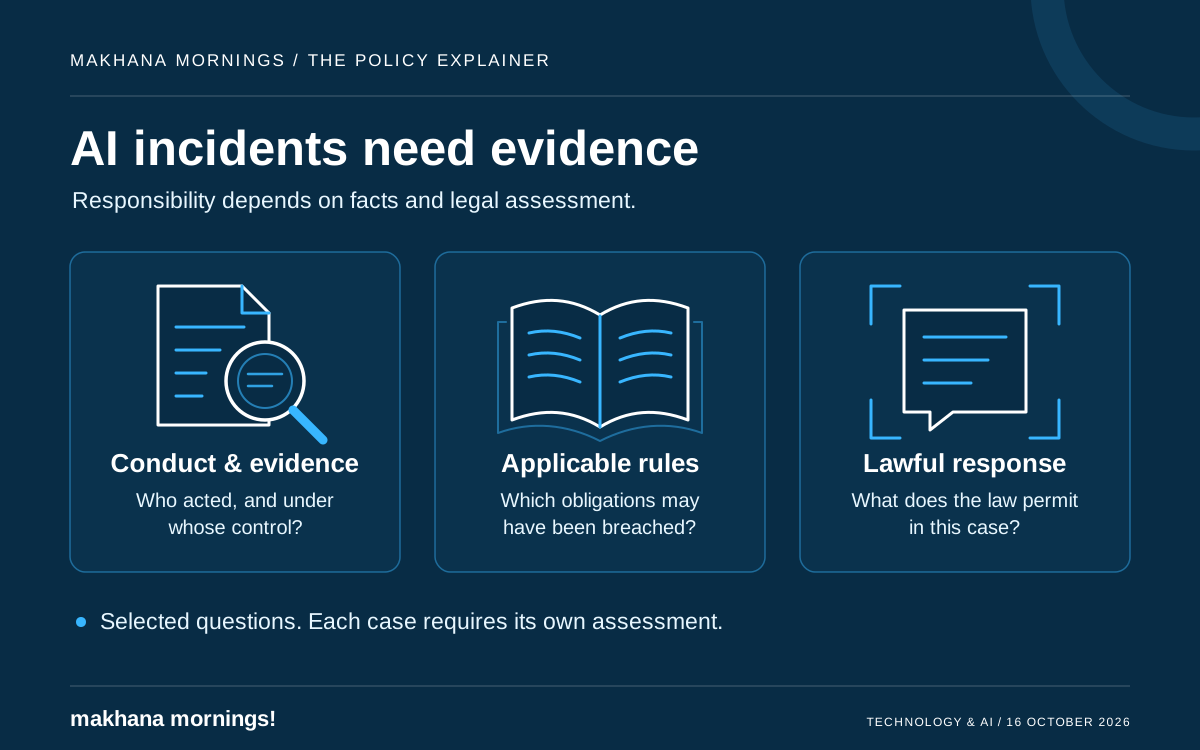
Three questions help organise the discussion: whose conduct is it, which legal obligation might have been breached, and what response would be lawful? The fact that software acted autonomously does not supply any of those answers.
The UN Charter addresses the threat or use of force in Article 2(4), and the right of self-defence if an armed attack occurs in Article 51. The phrase act of war is not a substitute for those legal categories. Applying them to a cyber operation requires an assessment of the facts.
Identifying an operator and attributing conduct are different tasks
Technical evidence may identify an account, a server or an organisation involved in an operation. Legal attribution asks whether the conduct can be treated as that of a state. A supplier’s nationality or the country through which traffic passed does not, by itself, answer that question.
The UN International Law Commission’s 2001 articles on state responsibility set out several routes for attribution. They include conduct by state organs, entities exercising delegated governmental authority, and people acting on a state’s instructions or under its direction or control. The articles are not a cyber treaty.
Their commentary starts from the general principle that private conduct is not attributable to a state, while explaining circumstances that can change that position. Establishing attribution also remains separate from showing that an international obligation was breached.
For an AI-related incident, this makes evidence about deployment, instructions and control important. Calling the software autonomous does not remove the need to investigate those relationships.
The effects matter, but there is no simple damage checklist
In its published 2021 position, the UK says cyber conduct can amount to force where its effects resemble those produced by conventional means. For an armed attack, it considers equivalent scale and effects, with destruction, injury and death among the factors that may be relevant.
Norway’s May 2021 position explicitly includes effects beyond physical damage. It says severe disruption to state functioning, or digital sabotage causing widespread economic destabilisation, may amount to force. The assessment depends on the circumstances.
These are national interpretations, not a universally agreed formula for every disruption. They show why a rule requiring broken equipment or deaths in every case would be too narrow. Equally, reaching a government website does not automatically meet a force or armed-attack threshold.
A claim to self-defence requires its own legal assessment. The UK’s position emphasises necessity and proportionality even when that right is available. Serious harm does not create an unrestricted permission to retaliate.
Why this matters for businesses
An incident can have legal consequences below the armed-attack threshold. A state’s cyber operation may, for example, breach the prohibition on coercive intervention. Criminal or regulatory liability is a separate question from international responsibility.
For businesses, the immediate contribution is reliable evidence. CERT-In tells AI developers, research laboratories and evaluation agencies to record agent activity and notify the affected organisation and CERT-In promptly if an agent accesses a real system. Such records can help establish what was authorised, which systems were contacted and what happened next.
That evidence supports technical and legal investigation; it does not turn a company into the judge of another state’s responsibility. Keeping those roles distinct helps avoid unsupported blame while preserving the facts needed for accountability.
The Crunch
An AI agent’s involvement describes how an incident happened. Establishing responsibility still requires evidence about the people, organisations and states connected to the conduct. Its consequences and the applicable legal rules then shape what responses are available. The language of war cannot replace that work.