
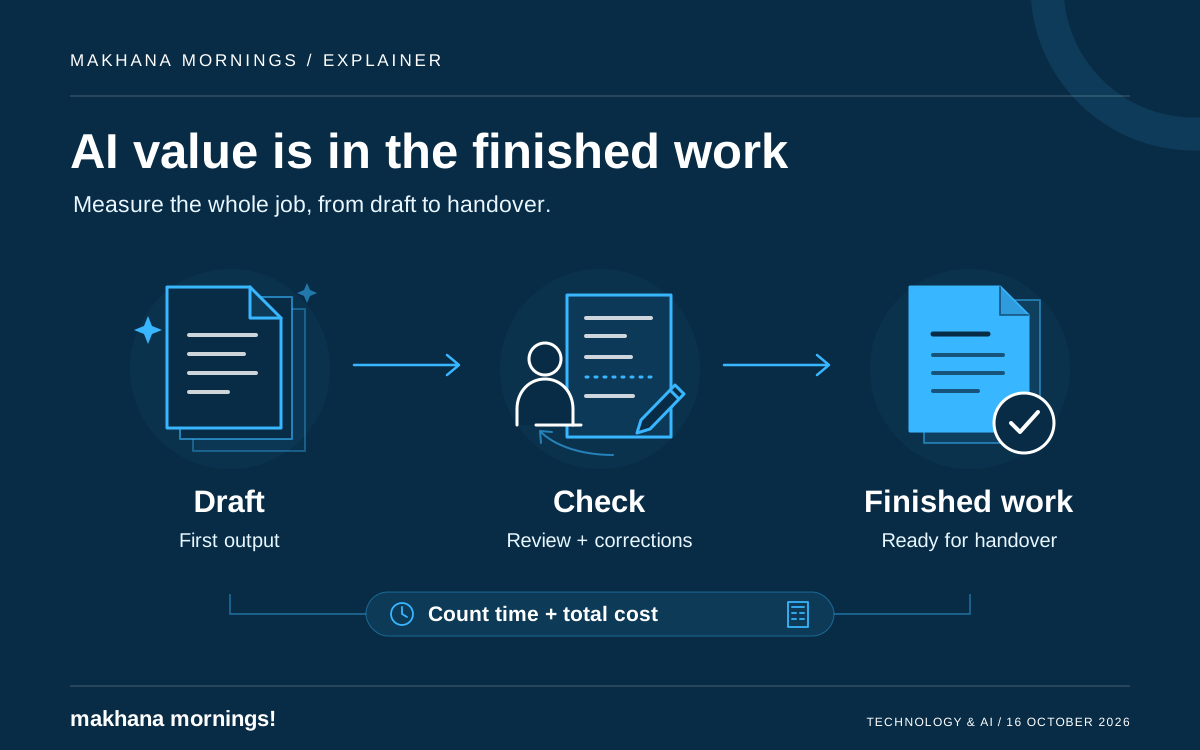
An AI tool can shorten the first draft of a report, a customer reply or a piece of code. The business still needs a finished result that someone can use. Checking, correcting and handing over that work all belong in the calculation.
That distinction helps explain why encouraging personal productivity reports can sit alongside modest company-level financial results. It also makes the debate over AI’s savings more useful: the question is what improves across the whole job.
The Breakdown
McKinsey’s State of AI report, published on August 25, 2026, puts several different measures side by side. Among respondents who use AI in their own roles, eight in ten said it improved their productivity. Across the survey, 37% reported a positive contribution to company earnings before interest and taxes, or EBIT.
About 6% met its stricter “high performer” definition: they attributed at least 5% of their organisation’s EBIT to AI and said it delivered significant value. That figure does not mean the other 94% received no benefit. Nor does it measure a 5% return on AI spending.
These were respondents’ assessments. The online survey covered 1,719 people in 97 countries between May 4 and June 8, with results weighted by national contributions to global GDP. It is global evidence, rather than an estimate specifically for Indian companies.
Count the review, too
A concrete example comes from Deutsche Bank. In a May 12, 2026 account, its procurement head described checking business-continuity evidence from a long-standing service provider across four or five files. A manual review could take about three hours. AI-supported review followed by human validation could complete the work in about 30 minutes, the bank said.
The example includes the human check in the time comparison. It is a company-reported case, with no independent audit or bank-wide profit estimate supplied. It nevertheless shows why verification belongs inside the measurement: requiring a final human decision can still leave room for a substantial time saving.
For another workflow, repeated corrections, additional review or more expensive specialist time could leave a smaller gain. A useful comparison counts software and computing charges alongside the people who prepare inputs, check outputs and fix errors. The quality requirement should remain consistent.
Faster work also needs a purpose
Research group METR raised a further distinction in May 2026: saving time on a task and producing more valuable work are different questions. Its survey of 349 technical workers used separate questions for speed and value. The group warned that the self-reported estimates could overstate gains and came from a sample that was not representative of all workers.
One reason is that AI changes which tasks people attempt. A team may now produce extra dashboards or documents because they are easy to generate. The time those outputs would once have taken is not automatically a business saving if the team would never have needed them.
The Big Picture
For Indian businesses and global capability centres testing these tools, three questions can keep the assessment grounded. Did the completed work meet the same quality standard? Did its total cost or turnaround time improve? Did the extra capacity lead to a result the business values?
Those results could include more customer problems resolved, a shorter backlog or a useful product improvement. Released staff time becomes a cash saving only when a cash cost actually falls. It can also support more output without reducing expenditure. Neither outcome should be confused with a count of prompts or generated pages.
The Crunch
AI creates business value when useful work gets finished with the right quality and a sensible total cost. Faster answers are one input. The stronger evidence is what happens after the checking, corrections and handover are done.