
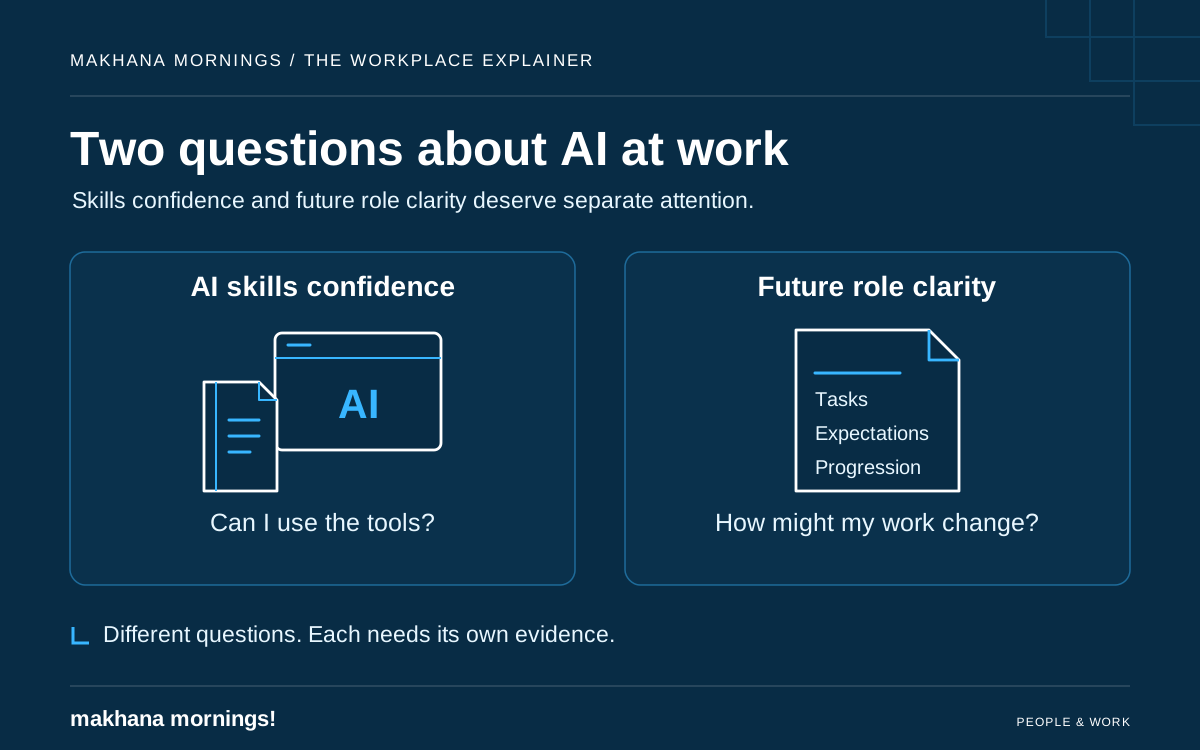
An employee can learn an AI tool and still wonder what their profession will look like in five years. A training course may answer how to use the software. It leaves a harder question open: what experience and judgement will employers value as the work changes?
Research highlighted this week brings that question into focus. Its useful finding concerns uncertainty about an occupation’s future, and the care needed when interpreting what that uncertainty means for behaviour at work.
The Breakdown
A study published on September 9, 2026, and highlighted by Washington State University on October 14 examined three waves of survey responses from workers across 18 industries. It studied occupation insecurity: concern that technology could alter the future viability or nature of someone’s line of work.
The researchers found an association between greater occupation insecurity and moral disengagement, the process of justifying conduct someone would otherwise consider inappropriate. Moral disengagement was, in turn, associated with more self-reported counterproductive workplace behaviour. The statistical relationship was stronger in industries with higher measured exposure to AI.
The university’s account gives examples such as arriving late or spending work time browsing the web. These were workers’ reports, rather than independently observed incidents. The survey design does not establish that AI anxiety caused those actions.
The public abstract and university account do not provide the sample size, survey country or fieldwork dates. Those gaps limit how confidently the findings can be generalised, particularly to India. They also leave no basis for estimating how common these behaviours are across the workforce.
What AI exposure actually measures
The university identifies the study’s measure as the AI Industry Exposure index. The paper cites a 2021 framework developed by Edward Felten, Manav Raj and Robert Seamans, which connects AI applications with occupational abilities and aggregates occupational exposure scores within each industry. The public material does not specify whether the researchers modified it.
The original framework’s authors explicitly separate exposure from predictions of replacement. A high score can reflect work that AI may assist as well as work it may automate. It does not establish that an employer has adopted AI, cut jobs or made a particular occupation obsolete.
India’s confidence-and-concern pattern
ACCA’s India Talent Trends report, dated May 2026, offers a different perspective. Among the employed respondents to its workplace questions, 86% expressed confidence in learning and applying AI skills, while 57% had concerns about AI’s impact on their own role. Half said their organisation offered opportunities to learn AI-related skills.
The overall India sample comprised 1,077 people, of whom 83% were ACCA students and 75% were Gen Z. Only the employed portion, 57% of the sample, answered questions about workplace trends. These figures describe a particular accountancy and finance sample, rather than India’s workforce as a whole.
The published results do not cross-tabulate confidence and concern for individual respondents. Nor does concern about a current role measure exactly the same thing as insecurity about an entire occupation. The useful point is that high skills confidence and substantial concern appear together in the survey’s overall results.
The Big Picture
For an Indian employer or a global capability centre, the practical implication is to ask separate questions. Can people use the tools? Do they understand how tasks, performance expectations and routes to progression may change? Which decisions about future roles are settled, and which remain uncertain?
This is an implication to consider, rather than a tested remedy from either study. Training participation alone cannot answer all those questions. Equally, expressing concern about AI is no evidence that an employee will behave badly. Performance issues still require their own facts and a fair assessment.
The Crunch
Knowing how to use AI and knowing where a career is heading are different forms of confidence. Employers need to understand both. Research on workplace behaviour is a reason to examine those uncertainties carefully, while avoiding assumptions about how any individual employee will act.