
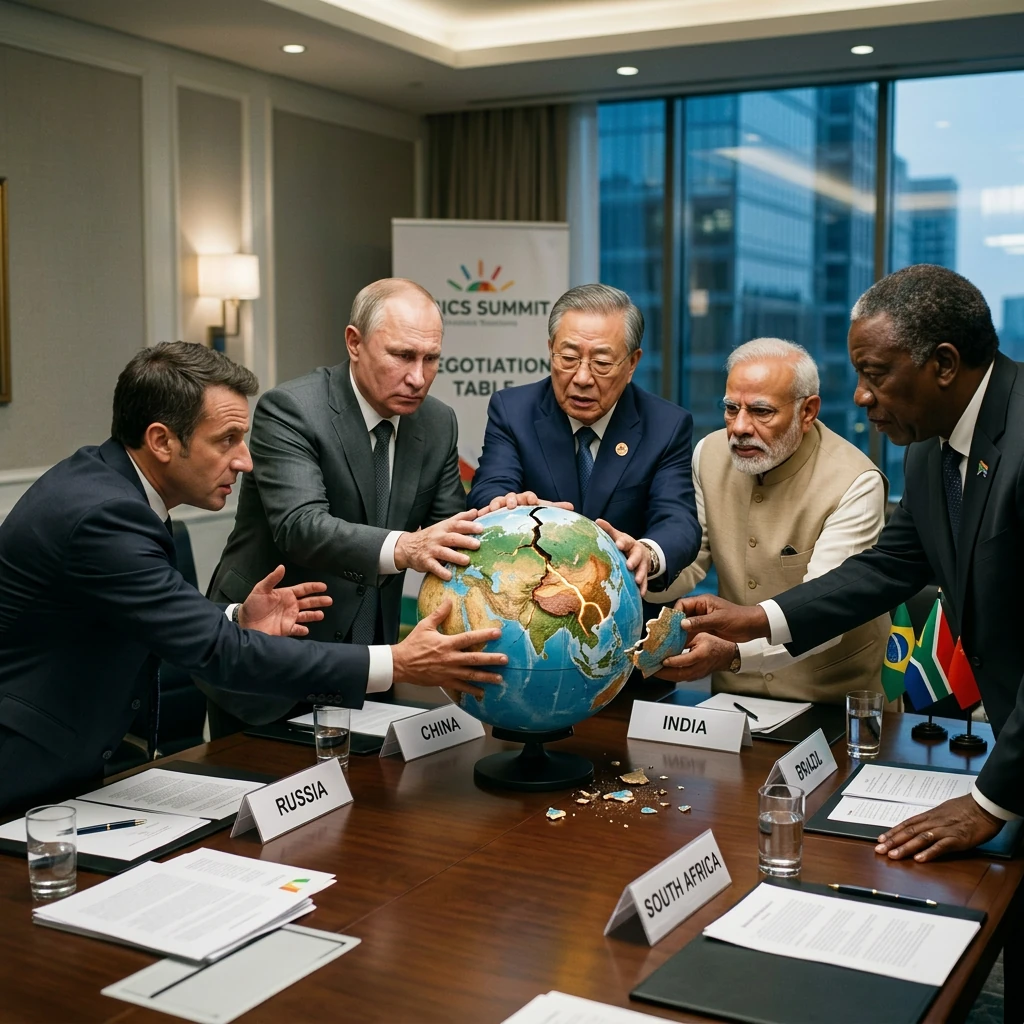
BRICS has spent the last few years positioning itself as a stronger collective voice for the Global South. The bloc expanded rapidly, added new members, and pushed for a more multipolar world less dependent on Western influence. However, its latest meeting in New Delhi revealed a growing challenge beneath that expansion. The bigger BRICS becomes, the harder it may be to keep everyone aligned. As a result, the Iran conflict exposed not only geopolitical tensions in West Asia, but also the internal contradictions emerging inside the bloc itself.
Breakdown:
The two-day BRICS foreign ministers’ meeting in Delhi ended without a joint statement after member countries failed to agree on language around the ongoing Iran conflict. Iran had pushed the bloc to formally condemn the United States and Israel over the war. At the same time, Tehran also accused fellow BRICS member UAE of direct involvement in military operations against Iran. The UAE strongly rejected those allegations, leaving India, as chair, to release only a summary statement acknowledging “differing views” among members.
This matters because BRICS increasingly presents itself as an alternative global power structure. The bloc originally emerged around economic cooperation between Brazil, Russia, India, China, and South Africa. However, recent expansion added countries such as Iran, UAE, Egypt, Ethiopia, and others into the grouping. While this expansion strengthened BRICS numerically and geographically, it also introduced members with competing regional interests, security concerns, and geopolitical alignments.
The Iran conflict brought those contradictions into full view. Iran wanted stronger anti-Western positioning and direct condemnation of military actions against it. Meanwhile, countries such as the UAE have close strategic and economic relationships with the United States and broader Gulf security networks. India itself remains deeply tied to both Gulf economies and global Western markets while also maintaining strategic autonomy. Consequently, achieving consensus inside BRICS becomes far more complicated once economic cooperation expands into active geopolitical conflict.
At the same time, the crisis directly affects many BRICS members economically. Iran’s effective blockade of the Strait of Hormuz has disrupted one of the world’s most critical maritime energy routes. India, one of the world’s largest oil importers, has already faced shipping disruptions and attacks involving Indian-linked vessels and personnel. Safe maritime trade routes and stable energy flows are now becoming urgent economic priorities rather than distant geopolitical discussions.
The meeting also highlighted another reality. BRICS members broadly agree on reducing Western dominance in global institutions, expanding Global South representation, and reforming international governance structures. However, agreeing on broad principles is much easier than aligning on real-world conflicts where national interests diverge sharply. The more BRICS expands, the more difficult internal coordination may become.
Why this matters:
This marks an important test for BRICS as it evolves from an economic grouping into a broader geopolitical platform. Expansion increases influence and global relevance, but it also introduces more competing priorities inside the alliance. Over time, the bloc’s biggest challenge may not be attracting new members, but maintaining enough strategic cohesion to act collectively during crises.
The Big Picture:
More broadly, the BRICS tensions reflect the changing nature of global power itself. The world is moving away from a simple West-versus-rest structure toward a far more fragmented multipolar system. In that environment, countries increasingly participate in overlapping alliances shaped by economics, energy, security, and regional politics simultaneously. As these networks become more interconnected, managing internal contradictions may become one of the defining challenges of modern diplomacy.
The Crunch:
BRICS is becoming larger, louder, and more influential. However, the Iran conflict showed that expansion also makes unity much harder to maintain.