
India’s electric mobility push has just received a major policy boost. The government has released operational guidelines for the rollout of 72,300 public EV charging stations under the PM E-DRIVE scheme. Backed by a ₹2,000 crore allocation, the guidelines aim to bring uniformity, speed, and accessibility to EV infrastructure. From offices to hospitals, public access charging is now set to expand rapidly, making EV adoption easier for millions of drivers.
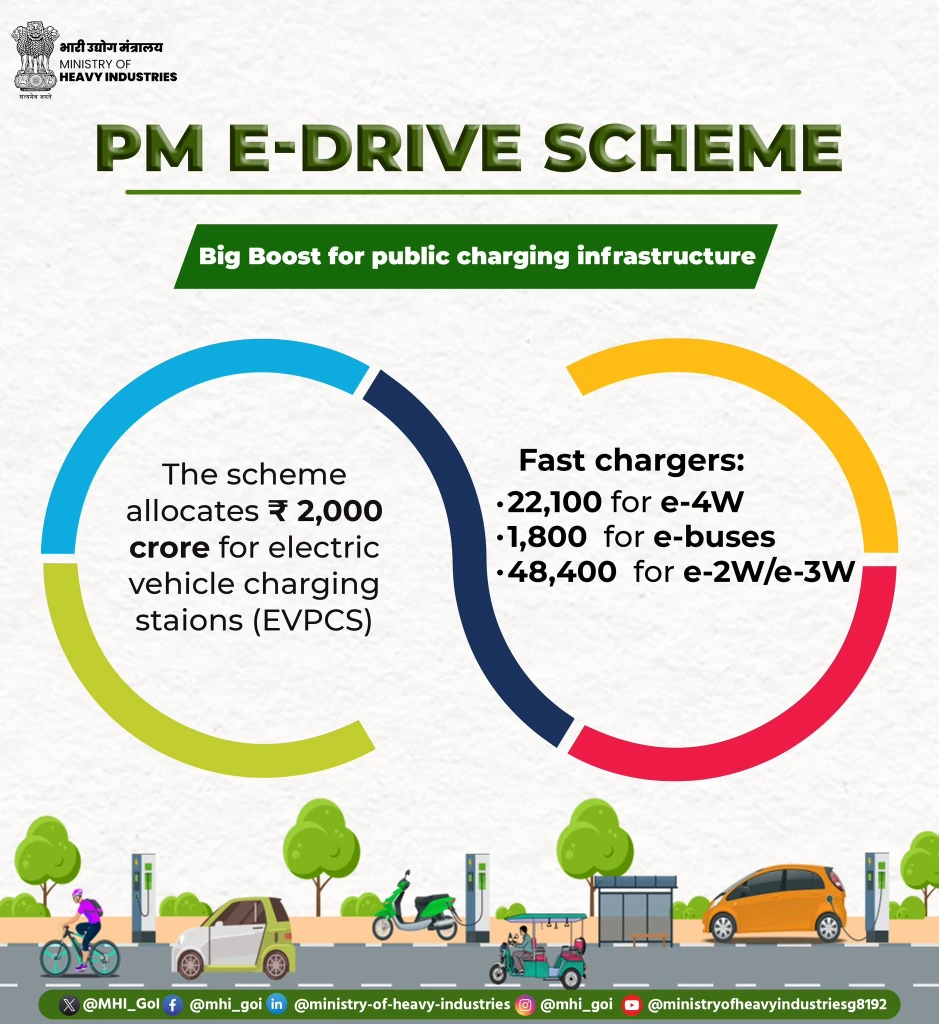
Breakdown:
The ₹10,900 crore PM E-DRIVE scheme earmarks ₹2,000 crore specifically for building public charging networks. The new guidelines outline a tiered subsidy structure designed to support installations across a wide spectrum of use cases. Government premises like offices, residential complexes, hospitals, and educational institutions are eligible for a 100 per cent subsidy on upstream infrastructure and charging equipment, provided that the facilities remain open to the public free of cost.
Private and commercial spaces are also expected to benefit from targeted subsidies that incentivize broader participation. By standardizing operational norms, the Centre seeks to ensure reliability and encourage both public and private players to expand the network. With 72,300 stations planned, this push could address one of the biggest adoption barriers for EVs: range anxiety.
Why this matters:
The guidelines create a structured roadmap for India’s EV charging ecosystem, ensuring a balanced mix of public, institutional, and private participation. The scale of the planned rollout is critical for building trust among consumers and accelerating EV adoption in urban and semi-urban markets.
The Big Picture:
India’s EV transition hinges not just on vehicle manufacturing but on supporting infrastructure. By coupling subsidies with operational clarity, the government is betting on scale, accessibility, and speed to catch up with global leaders in EV infrastructure. This move also positions India to align with its carbon reduction commitments while fostering investment in clean energy and mobility.
The Crunch:
The real test will be execution. While subsidies are attractive, ensuring uptime, interoperability, and affordability of these charging points will determine success. If rolled out effectively, this initiative could not only reduce EV hesitation but also create new revenue models around energy distribution and mobility services.