
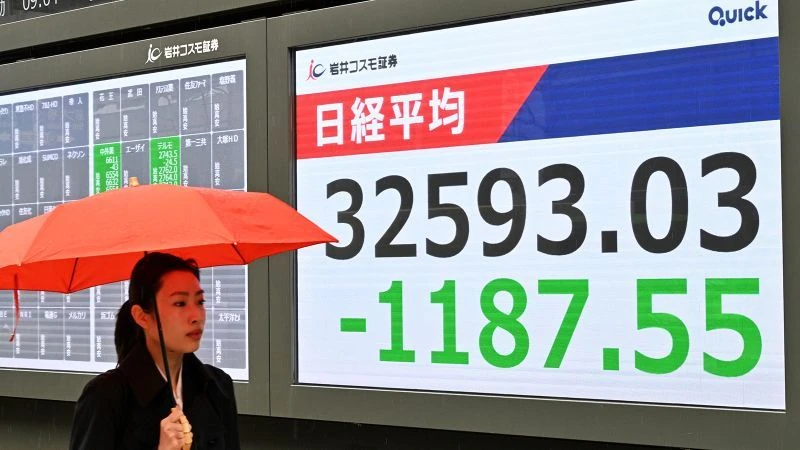
A single warning from Wall Street was all it took to rattle Asia’s record-breaking rally. On Wednesday, Asian markets witnessed their steepest selloff in seven months as investors reacted to cautionary remarks from top Wall Street executives about overheated valuations. Japan’s Nikkei 225 dropped 4.4 percent and South Korea’s KOSPI fell 4.5 percent, both retreating from all-time highs reached just a day earlier. The MSCI Asia-Pacific Index excluding Japan sank 2.1 percent, its biggest one-day decline since April. The sudden reversal suggests that euphoria around artificial intelligence and semiconductor stocks may be giving way to anxiety about just how long the boom can last.
Breakdown:
Technology stocks led the slide across the region. In Tokyo, SoftBank Group shares collapsed by over 14 percent, wiping out more than 30 billion dollars in market value. Chip-testing equipment maker Advantest plunged nearly 10 percent. In Seoul, Samsung Electronics and SK Hynix dropped between 5 and 7 percent, both still sharply higher for the year but no longer immune to profit-taking.
The selloff followed losses on Wall Street, where the S&P 500 fell 1.2 percent and the Nasdaq declined 2 percent. Speaking at the Global Financial Leaders Investment Summit in Hong Kong, Morgan Stanley CEO Ted Pick and Goldman Sachs CEO David Solomon warned that markets could face a drawdown of 10 to 15 percent. Their remarks echoed earlier concerns from JPMorgan Chase CEO Jamie Dimon, who has repeatedly cautioned that the AI-driven rally resembles the exuberance of the dot-com era.
Market analysts say investors are finally pausing to question whether AI optimism can continue to justify sky-high valuations. The synchronized warnings from Wall Street’s top bankers acted as a trigger for global profit-taking.
Why This Matters:
The market reaction highlights how tightly global sentiment is wired together. A few words from New York can erase billions from Tokyo and Seoul within hours. The correction is a reminder that tech-led rallies are often fragile when built on expectations rather than earnings. For export-heavy economies like Japan and South Korea, which rely on semiconductors and hardware manufacturing, any extended slump could hit corporate profits and investor inflows.
The Big Picture:
Global equity markets have spent much of the year basking in AI optimism and strong technology earnings. But the warning signs from Wall Street point to a cooling phase where investors will need to separate innovation from speculation. Corrections like this can serve as a healthy reset, allowing fundamentals to catch up with valuations. Still, the episode underscores how the world’s dependence on the AI narrative has made markets more reactive than rational.
The Crunch:
The selloff does not mark the end of the AI era, it marks a reality check. Market cycles are built on confidence, but sustained growth is built on performance. For leaders and investors, this is a moment to reassess rather than retreat. The question is not whether the bubble burst, but how prepared everyone is when it does.