
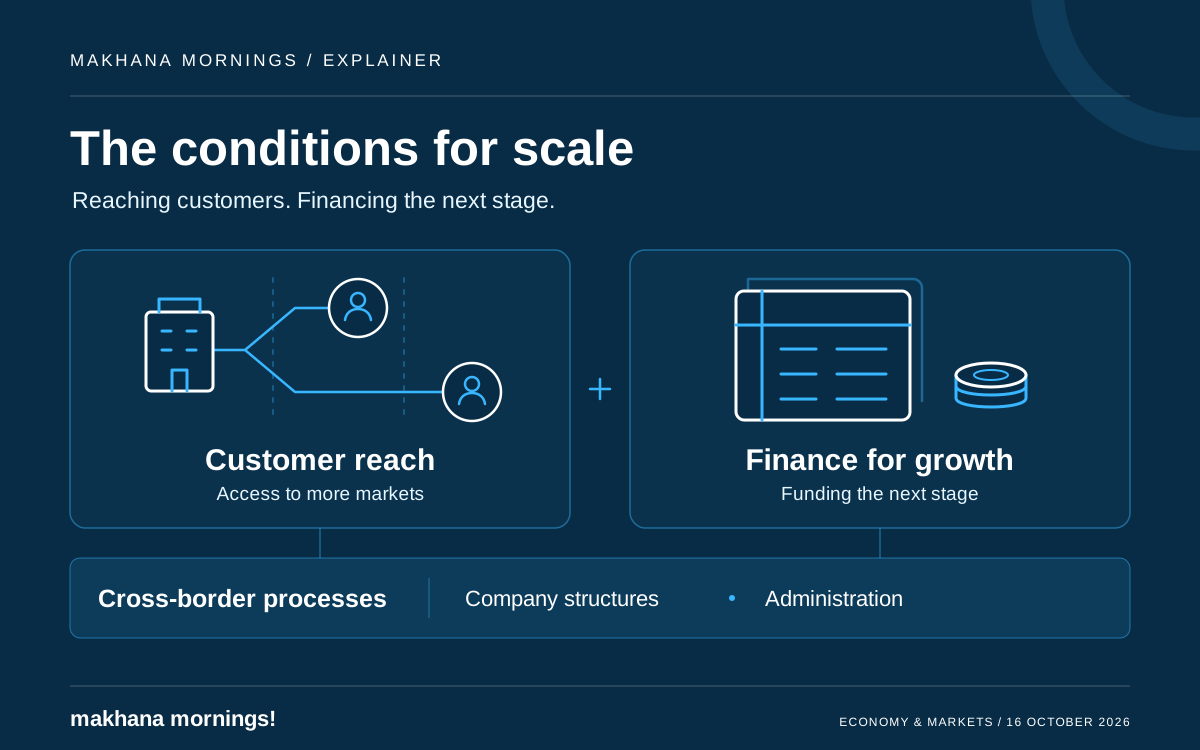
Why does a large economy sometimes struggle to produce companies of comparable scale? Europe’s widening stock-market value gap with the US raises a practical business question: how easily can a promising firm reach more customers and finance its expansion?
The Breakdown
An October 1, 2026 account from Northwestern University’s Kellogg School describes research by Bo Becker, Efraim Benmelech and Joao Monteiro covering 2008–2023. It reports that the US stock market’s value exceeded Europe’s by about $3 trillion at the start and $34 trillion at the end.
The comparison adds the Nasdaq and New York Stock Exchange for the US. Its European group includes EU countries, the UK, Norway, Iceland and Switzerland. This is a comparison of aggregate market capitalisation, not the returns from buying a particular fund.
According to Kellogg’s account, the gap persisted when the largest 1% of companies were excluded. It was wider in industries where growing larger brings greater economic benefits. That points to a broader question about business expansion, beyond the success of a few American technology giants.
Customers and capital are connected
Mario Draghi’s separate 2024 report on EU competitiveness explains why access to finance and access to customers need to be considered together. It argues that fragmented markets can limit the growth prospects of innovative companies, reducing their demand for expansion funding.
That is an important qualification. A small financing market can constrain companies, but weaker opportunities to expand can also mean less finance is sought. Simply making more money available may leave the underlying business obstacles in place.
The report describes regulatory and jurisdictional hurdles as companies grow, and says some high-potential EU firms seek both venture funding and market reach in the US. This is a policy diagnosis of interacting barriers, rather than proof that one reform would close the stock-market gap.
What Europe is trying to change
Two policy initiatives address different parts of that problem. On March 18, 2026, the European Commission proposed EU Inc., an optional set of common corporate rules with digital procedures intended to make it easier to establish and grow businesses across the EU.
The proposal concerns the way companies are organised and administered. The Commission said national employment and social laws would remain applicable. It should not be read as a promise that every operating requirement would disappear.
On October 9, the Council of the EU agreed key elements of its negotiating position on a separate capital-market integration package. The measures aim to reduce cross-border barriers in trading, the processes that follow a trade, and asset management.
That announcement was a political agreement: the Council said its position still had to be finalised for formal adoption, with negotiations dependent on the European Parliament adopting its own position. It was a step in making legislation, rather than a completed change in the rules.
These initiatives concern the EU. They do not cover the entire, wider European group used in the historical stock-market comparison.
The Big Picture
For an Indian business assessing expansion abroad, the useful questions are concrete. How easily can a product reach customers across countries? What extra company structures or processes are needed? Can finance support the next stage of growth?
The study does not answer those questions for India, which lies outside its sample. Nor does a gap measured through 2023 predict future US or European investment returns. Its value is in drawing attention to the conditions that help businesses grow, while the policy proposals show where governments are trying to act.
The Crunch
A large economy is more useful to a growing business when customers and finance are accessible across it. Europe’s reform debate puts those two needs together. The important test is whether firms can expand with fewer cross-border obstacles, rather than how large the combined economy looks on paper.