
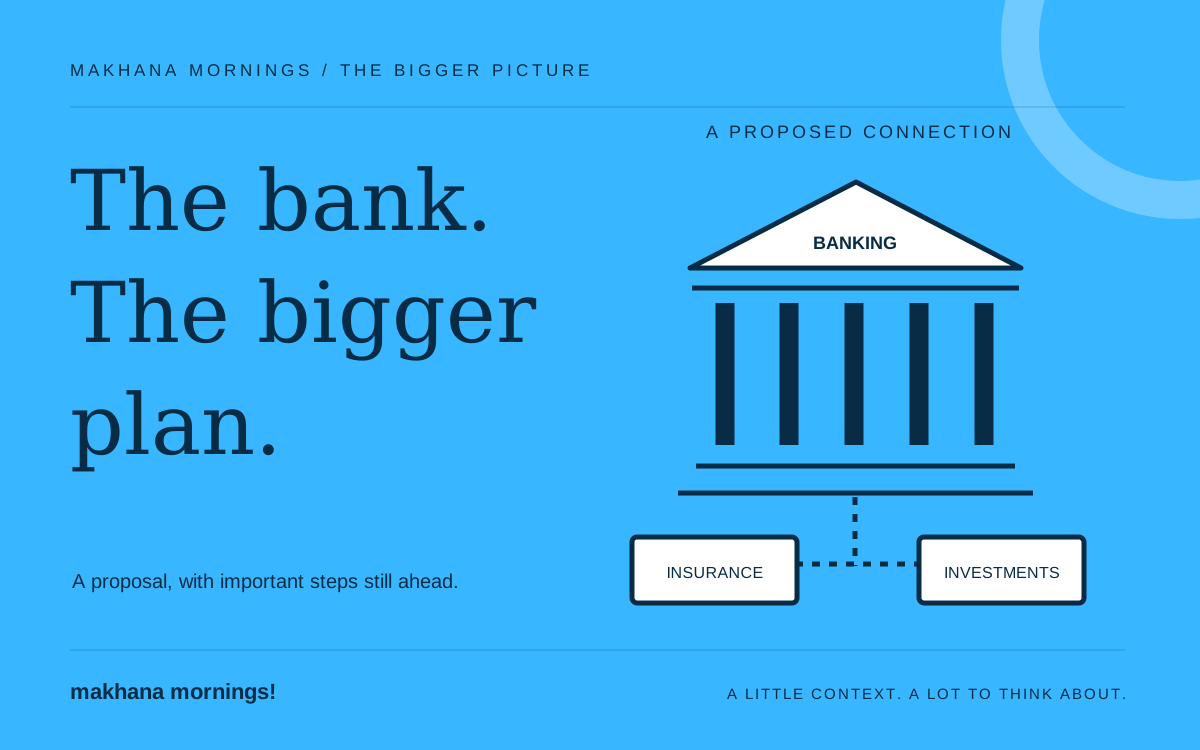
A bank branch helps a business build lasting ties with its customers. Fairfax’s plan for IDBI Bank shows why those ties matter. Someone who uses the bank to save or borrow could also buy insurance or use its investment services.
On October 14, the government chose a company controlled by Fairfax Financial Holdings as the buyer for a proposed stake sale. The plan is to sell 60.72% of IDBI Bank for about ₹52,878 crore. Fairfax then set out a wider plan that involves its insurance interests and IIFL Capital Services.
These are separate steps. Choosing a buyer does not mean the bank sale is complete. Building a wider group of financial businesses would take more work still.
The Breakdown
The government and Life Insurance Corporation of India (LIC) are the two proposed sellers. The government would sell 30.48% of the bank and keep 15%. LIC would sell 30.24% and keep 19%.
The money would go to both sellers. About ₹26,543 crore would go to the government and ₹26,335 crore to LIC. So the full ₹52,878 crore should not be counted as money raised for the Union budget.
Fairfax also wants to transfer its stakes in Go Digit Life Insurance and Go Digit General Insurance to IDBI Bank. The plan includes Fairfax India’s stake in IIFL Capital Services too. These are proposed transfers of shares. They do not mean the businesses have already combined their day-to-day work.
The October 14 plan still has conditions to meet. At the time of the announcement, no final, binding deals had been signed for the bank purchase or the share transfers. The bank purchase could also go ahead without one or both of those transfers.
Why This Matters
The idea is to reach more customers through the bank. Someone who already visits a branch could be interested in an insurance policy or help managing their wealth. That gives these businesses a way to build on an existing link with the customer.
Making this work would take care. Customers would need to know what they are buying, how much it costs and which company is responsible. A wider choice helps only if people can understand and compare the products.
For the bank, a common shareholder would be just the start. Staff would need training, and products would need to suit the people buying them. Customer support and links between technology systems would also matter. A change of owner cannot show whether all this will work well.
The proposed share transfers need to be reviewed by regulators. These include the Reserve Bank of India (RBI) and the Securities and Exchange Board of India. The insurance plan also needs approval from the Insurance Regulatory and Development Authority of India. The final structure depends on the required permissions and signed deals.
The Big Picture
IDBI has taken a long path to this point. In 2017, it entered the RBI’s corrective-action framework, a process to address problems at the bank. LIC bought a controlling stake in 2019, and the bank left that framework in 2021. The sale process began in 2022, followed by years of work on approvals and bids.
The proposed price is ₹81 a share. The government compared that with a ₹75.99 benchmark, based on two ways of valuing the bank. That explains how it assessed the bid. It does not tell us what the bank will earn under a new owner.
The next stage is about closing the deals and running the bank. More lending would need sound decisions about who can repay. The wider range of products would need proper checks. Any gains from reaching more customers would have to justify the costs of linking and managing the businesses.
The Crunch
Watch for signed deals, the final terms of the share transfers and decisions from regulators. Then look at service quality, how many customers use the services and the financial results.
Fairfax has set out a big plan for IDBI Bank. Follow each deal on its own, then judge the results as they arrive.