
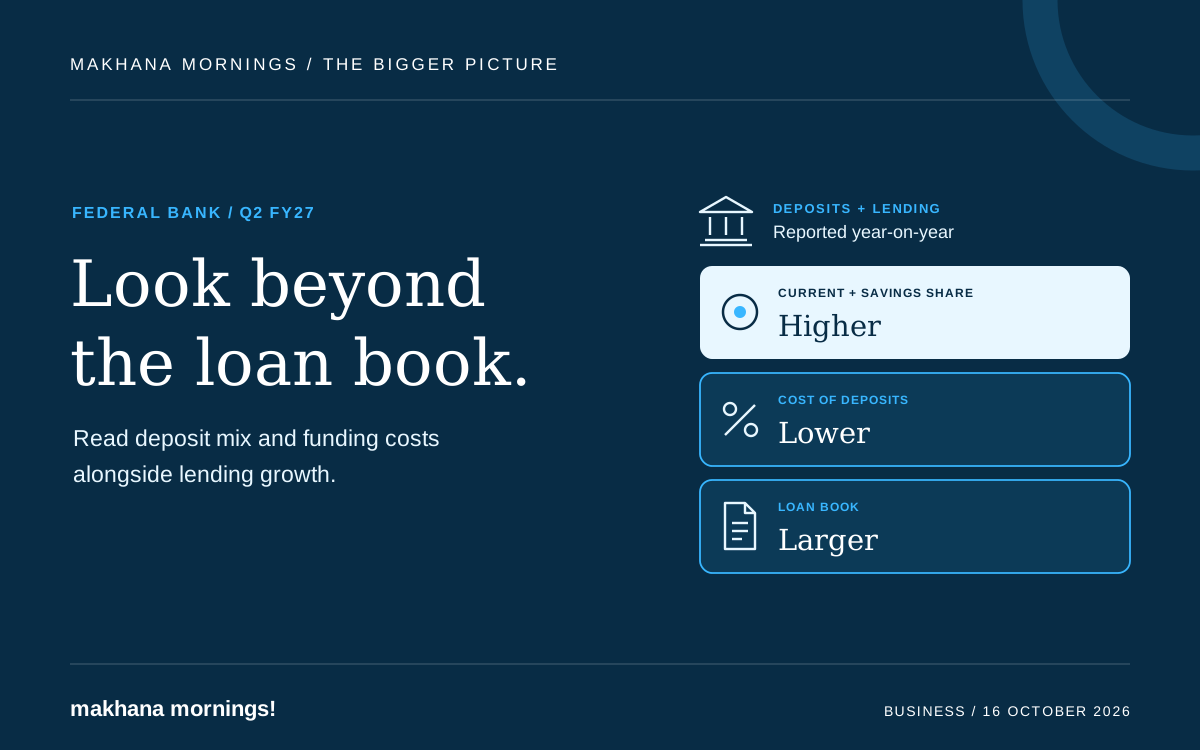
Federal Bank’s September-quarter results show why loan growth is only one part of a bank’s story. Lending expanded, but so did its pool of current and savings deposits, while the cost of deposits fell.
The standalone bank reported net profit of ₹1,386.09 crore for the quarter ended September 30, 2026, up 45.10% from a year earlier. The results were released on October 16.
The Breakdown
Total deposits reached ₹3,42,693.56 crore, up 18.61% year on year. Within that, current-account and savings-account balances, known as CASA, grew faster at 22.56% to ₹1,09,803.15 crore.
CASA therefore made up 32.04% of deposits, an increase of 1.03 percentage points from a year earlier. This ratio describes the deposit mix; it is different from the growth rate of CASA balances.
The bank’s cost of deposits fell by 0.39 percentage points to 5.18%. Its net interest margin, or NIM, rose by 0.26 percentage points to 3.32%. NIM measures net interest income relative to average interest-earning assets.
Why the funding side matters
Banks earn interest on loans and investments and pay interest on their funding. Current and savings accounts typically provide cheaper funding than term deposits, making their share worth tracking alongside loan growth.
Federal Bank’s net interest income rose 26.38% to ₹3,153.40 crore. The stronger CASA mix and lower deposit costs accompanied the margin improvement, but the release does not isolate how much each factor contributed. Lending rates, asset mix and other funding costs also matter.
Gross advances grew 21.66% to ₹3,01,687.80 crore, faster than deposits. Those growth rates alone do not establish a liquidity problem; they show why the pace and cost of funding deserve attention as lending expands.
The checks beyond growth
The gross bad-loan ratio fell to 1.32% from 1.83% a year earlier, while the net ratio declined to 0.17% from 0.48%. These measure current reported asset quality, rather than guaranteeing the performance of new loans.
There is also an accounting qualification: a switch to fair-value accounting for all employee stock options, effective April 1, reduced the quarter’s reported profit by ₹24.49 crore. It did not boost the profit increase.
The Crunch
Federal Bank grew loans while increasing the share of current and savings deposits and lowering deposit costs. The next test is whether that funding profile and credit quality can hold as the loan book expands.