
Proving an identity, receiving a payment and sharing financial records are basic steps in doing business. When common digital systems can handle those steps, firms and public agencies have less need to build each process from scratch.
That is the economic question behind CareEdge Global Ratings’ October 2026 assessment of India’s digital public infrastructure, or DPI. It places the Indian case among ten reforms classified as “Highly Effective” in a study of 43 selected reform cases across 38 countries.
This is a category within a set of case studies. It is not a ranking of the world’s ten best countries or all reforms. CareEdge explicitly describes its selection as illustrative rather than exhaustive.
The Breakdown
CareEdge defines a highly effective reform as one that has substantially met its objectives and produced clear, sustained evidence of impact. Its India case brings together Aadhaar-based identity services, the Unified Payments Interface and the Account Aggregator framework for consent-based financial-data sharing.
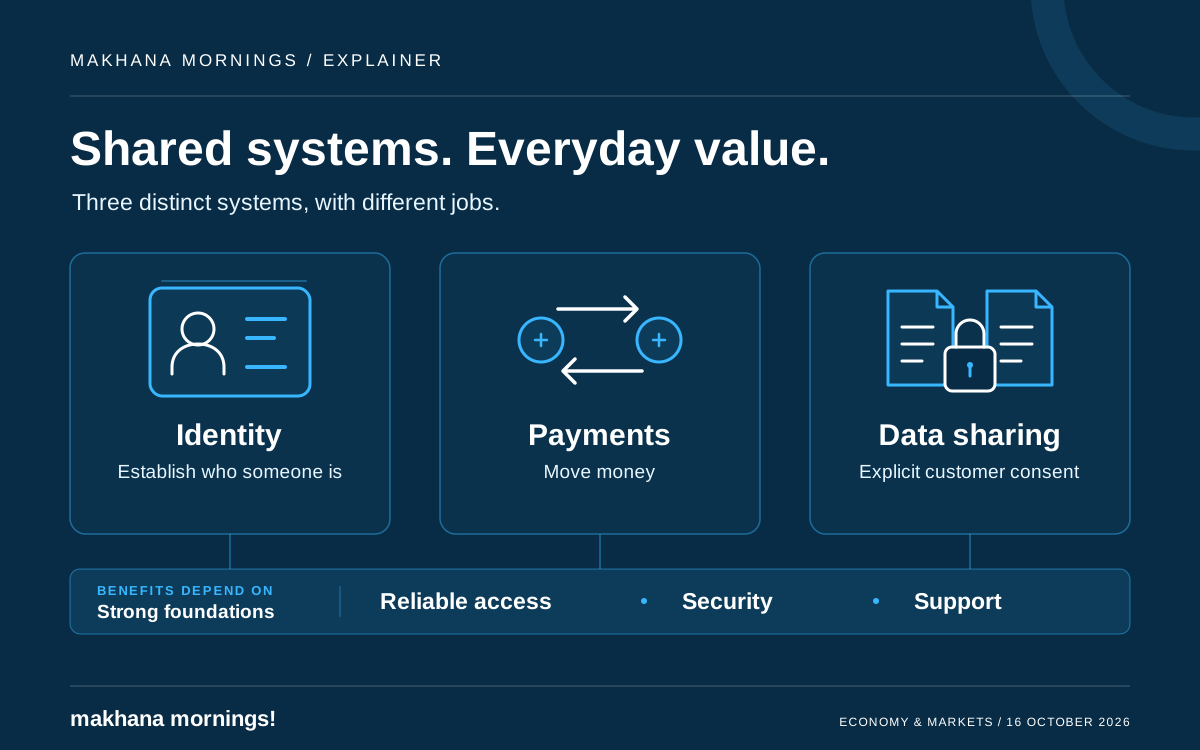
Each has a different job. Digital identity helps establish who a person is. UPI is an interoperable payments system. Account Aggregators help financial information move with the customer’s permission. They are separate systems, rather than one application that automatically performs every step.
The World Bank describes the wider DPI model as shared foundations that public and private services can reuse. The economic advantage is reduced duplication: businesses can build services around common systems instead of recreating every underlying function.
Sharing data has boundaries
The Account Aggregator framework illustrates why rules are part of the infrastructure. RBI’s directions require explicit customer consent for retrieving or sharing financial information. The consent record identifies the requested information, its purpose, recipients and expiry. Customers must also be able to revoke consent.
Account Aggregators do not support customer transactions such as moving money. Sharing a record is a different function from making a payment or deciding whether to approve a loan. A better data connection can assist a process without determining its outcome.
Access and operating costs still matter
Common infrastructure still needs working connections and capable users. UIDAI notes that online electronic know-your-customer verification needs reliable connectivity and technical infrastructure at the agency using it. Online e-KYC is also not available to every agency.
Its paperless offline e-KYC option allows an Aadhaar holder to share a digitally signed identity document voluntarily for verification. The different routes illustrate a practical design issue: a single online process may not suit every user or organisation.
The World Bank’s guidance on digital identity warns that weak connectivity and limited literacy can exclude people from services. It calls for exception-handling arrangements, accessible complaints processes and privacy and security protections built into system design.
These are continuing responsibilities. Integration, staff training, maintenance and support need resources even when a shared service lowers some transaction costs. A large registration count alone cannot show whether people can reliably use a service when they need it.
The Big Picture
For businesses, the useful test is whether a customer can complete a task with less time and effort while retaining control over their information. For public services, it also includes whether people facing connectivity, literacy or documentation barriers can still get help.
The lesson travels beyond India: copying software is only part of building a usable system. Institutions need clear responsibilities, compatible processes and the capacity to resolve problems. That is what turns a digital connection into dependable economic infrastructure.
The Crunch
India’s digital infrastructure matters because shared systems can make everyday transactions easier to complete. CareEdge’s assessment recognises that economic role. Keeping the benefits broad requires continued investment in reliable access, clear consent, security and help when a service fails.