
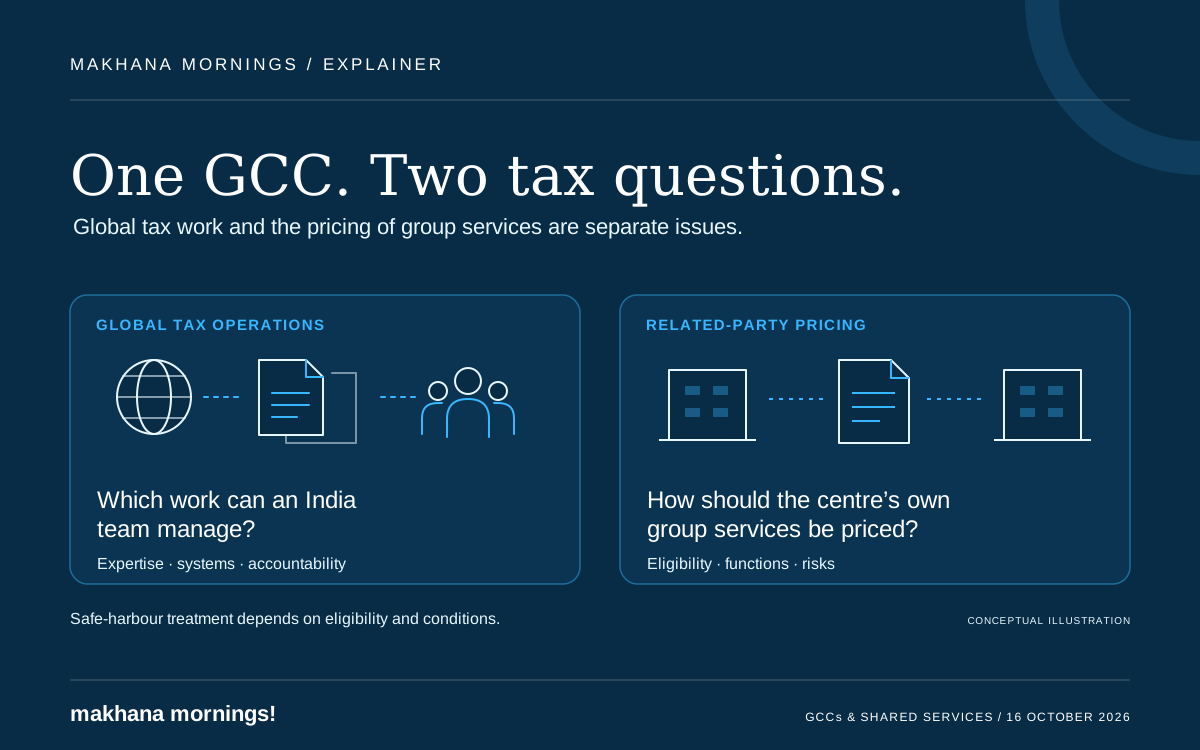
For a global capability centre in India, tax raises two different questions. Which parts of a multinational’s tax work could its India team manage? And how should that centre’s own transactions with the group be priced for tax purposes?
Both questions matter as companies consider giving India teams more responsibility. Simpler transfer-pricing rules can provide certainty for eligible services. They do not, by themselves, establish demand for more tax professionals or move commercial decisions to India.
The Breakdown
Global tax work involves much more than preparing returns. Teams need to gather data from business units, reconcile transactions, maintain documentation and update systems as rules change across countries. A specialist India team can coordinate these tasks while working with local tax experts.
Deloitte’s April 2025 whitepaper on tax-focused GCCs describes this centralised model, including its difficulties: connecting existing systems, integrating processes and balancing business objectives with local requirements. It provides context for the opportunity, rather than a fresh measure of hiring in 2026.
There are concrete examples of this work. SC&H describes its Gurugram office as supporting tax, audit and technology-advisory services alongside its US operations. The firm’s stated reasons include expanding specialist capacity and meeting client demand.
What India’s safe harbour covers
Transfer pricing concerns the prices charged in transactions between related businesses. A safe harbour allows the tax authorities to accept a declared transfer price when specified conditions are met.
India’s final Income-tax Rules, 2026, notified on March 20 and effective from April 1, set a minimum operating profit margin of 15.5% of operating expense for eligible IT-services transactions. This is a cost-based markup used for transfer pricing, rather than a corporate income-tax rate.
The ₹2,000 crore limit applies to aggregate operating revenue from eligible transactions and is tested in the first year of the five-year option. The category includes specified software development, IT-enabled services, knowledge-process outsourcing and software-related contract research and development.
Eligibility also requires the Indian provider to supply specified services to a non-resident associated enterprise while bearing insignificant risk. Conditions address who controls significant functions and risks and who owns the resulting intellectual property. Being called a GCC, or handling compliance work, does not automatically qualify a centre.
Electronic verification also leaves continuing obligations. The rules require annual tax returns for all five years, plus transaction and margin statements for each of the four years after the first. Tax certainty still requires records and accountability.
Why responsibility matters
For an India team seeking a larger tax role, the practical challenge is to combine specialist knowledge with dependable data and systems. Automation can process routine information, but exceptions still need people who understand the relevant rules and know when to escalate an issue.
The commercial opportunity remains conditional. Multinationals may centralise more work, strengthen local teams or automate parts of the process. Greater regulatory complexity creates tasks; the quality and control of delivery will help determine where those tasks go.
The Crunch
India’s GCCs have room to take on more global tax work. Winning that responsibility depends on expertise, reliable systems and clear accountability, while safe-harbour eligibility remains a separate question about the services they provide and the risks they carry.