
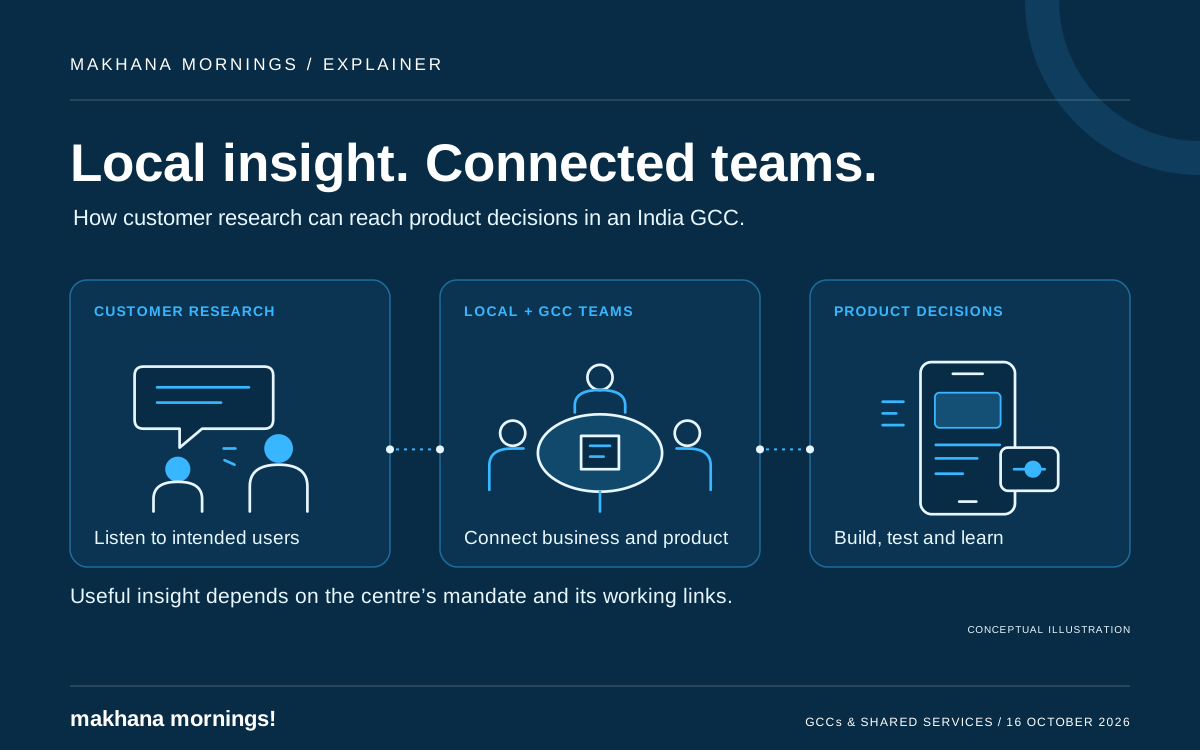
For a multinational, India can be both a place to build products and a market in which to sell them. A global capability centre can help connect those two roles, if its engineers and analysts work closely with people who understand local customers.
The useful question is how that connection works. Documented examples from Uber and Samsung show local needs reaching product decisions. American Express provides a reminder that sophisticated work done in India can also serve customers elsewhere.
The Breakdown
GCCs are in-house centres that perform functions for their wider company. Their responsibilities can include technology, analytics and operations. A local sales office has a different purpose, and having both in the same country does not automatically connect their work.
The cases below are historical examples of that connection, rather than new product launches. They show a practical mechanism, not a measured guarantee of market growth.
Uber: local payment habits changed the engineering
When Uber opened its Bengaluru engineering centre in March 2016, it explicitly said the team would develop solutions for Indian riders and drivers alongside local operations and global product teams.
A June 2017 engineering account shows what that meant. India’s cash-payment practices varied across cities, including collection amounts, timing and channels. Engineers working with the Bengaluru team redesigned the system so local operations teams could change collection rules without requiring fresh backend code for each change.
The lesson is specific: customer and driver behaviour changed how the system was built. The work involved India and overseas colleagues; it was not a standalone invention by one office.
Samsung: research and product teams worked together
Samsung’s January 2017 account of its Make for India programme describes a team drawn from R&D, innovation, product and marketing. Consumer research informed features such as Ultra Data Saving and S bike mode, which its Noida R&D teams helped plan and build.
A more recent example is language. In June 2024, Samsung described its Bengaluru R&D institute working with Vellore Institute of Technology on speech data for Galaxy AI’s Hindi model. Dialects, colloquial speech and conversations mixing Hindi and English shaped the development work.
These examples show why access to local users, researchers and commercial teams can matter. They do not establish how much any individual feature contributed to sales.
American Express: check whose customers are being served
American Express describes its India Center of Excellence working on customer targeting, transaction approvals, credit limits and fraud prevention for its global business. That puts India-based teams close to important commercial decisions.
The company also serves Indian customers. But those two facts alone do not identify an Indian product created from the centre’s insights. A global customer-analytics mandate and a specific Indian-market product role need to be assessed separately.
What makes the connection useful
Three questions help distinguish a real market-insight role: does the team study the intended customers, can it influence product priorities, and does it test whether the resulting changes work? An employee’s own experience of India is a starting point, not a substitute for research across different users.
For companies expanding in India, the opportunity is to connect capability teams with local business knowledge and decision-makers. The evidence to look for is a changed product, service or customer experience, followed by results that can be evaluated.
The Crunch
An India GCC can help a global company understand Indian customers when local research reaches the people who shape products. The advantage comes from that working connection, rather than the office address alone.