
External Affairs Minister S Jaishankar met Ras Al Khaimah ruler Sheikh Saud bin Saqr Al Qasimi on October 16, 2026, to discuss India–UAE ties and the Gulf situation. Two days earlier, his talks with UAE Foreign Minister Sheikh Abdullah bin Zayed Al Nahyan covered economic, trade and investment cooperation.
Those meetings sit on top of a substantial commercial relationship. Bilateral goods trade reached $101.25 billion in the financial year ended March 2026, according to Indian government data. The two countries have set a $200 billion bilateral trade target for 2032.
For Indian businesses, the useful question is how that relationship works in practice: which rules make trade easier, which systems are running, and which connections still represent a larger ambition?
The Breakdown
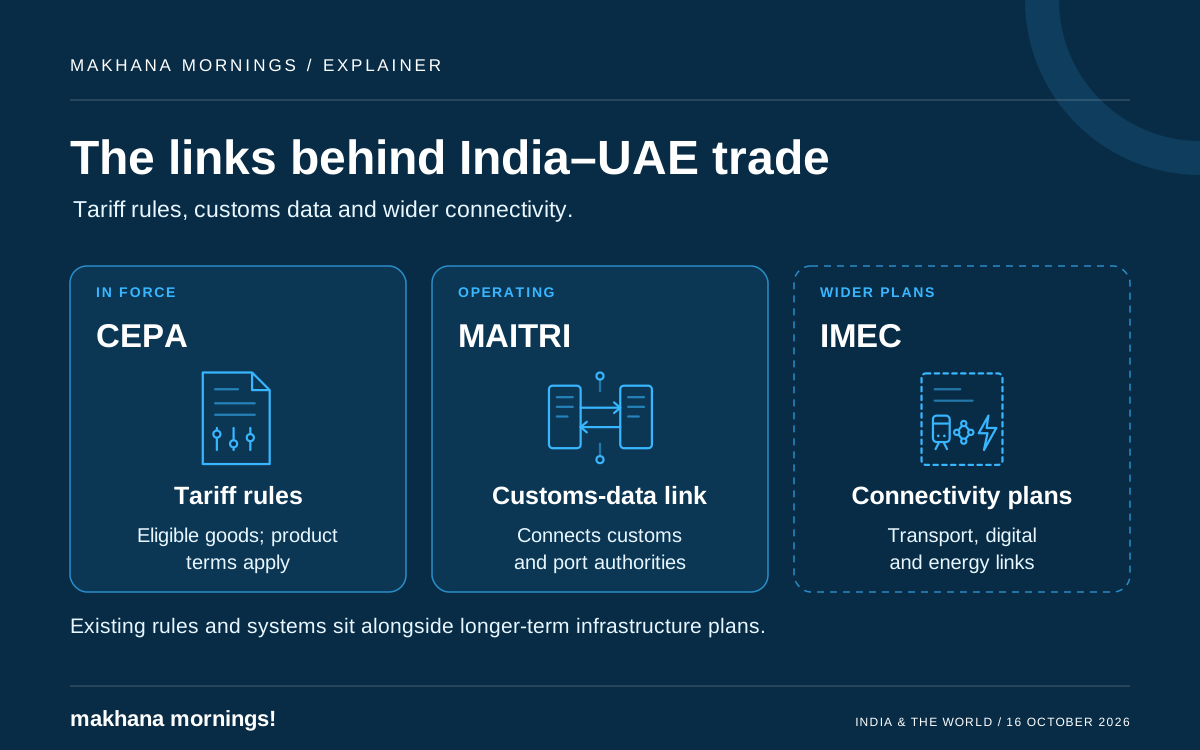
The first layer is the Comprehensive Economic Partnership Agreement, or CEPA, which took effect on May 1, 2022. It provides preferential access through lower or zero tariffs on eligible goods, alongside arrangements for customs procedures, standards and services trade.
Eligibility matters. Rules of origin determine whether a product qualifies for a tariff concession. The applicable tariff also depends on the product and the agreement’s reduction schedule. A trade agreement does not give every shipment an automatic exemption from duties or border checks.
The paperwork connection is already operating
The second layer is digital coordination. India’s Ports Ministry says the Virtual Trade Corridor powered by MAITRI became operational on May 15, 2026. The platform connects customs and port authorities in the two countries.
Its purpose is to make cargo movement more efficient by improving how trade information moves between those authorities. Reduced costs and transit times are stated goals; the launch announcement does not establish how much every exporter has saved.
This helps distinguish a digital trade corridor from physical transport infrastructure. Better information can support clearance, while goods still need shipping services, ports and onward connections.
A wider corridor remains a different undertaking
The India–Middle East–Europe Economic Corridor, known as IMEC, aims to develop transport, digital and energy links across a much wider geography. The UAE is one of its founding participants. An operating India–UAE customs link does not, by itself, demonstrate delivery of that entire network.
There is also work beyond infrastructure. At their September 28 investment taskforce meeting, the two governments reviewed CEPA implementation, payment-system cooperation and outstanding problems faced by investors through a bilateral fast-track mechanism. These are practical channels for addressing business obstacles; they are not guarantees that every issue has been resolved.
Why the diplomacy matters
The October meetings bring the economic relationship and regional conditions into the same conversation. Their public summaries do not announce a new trade agreement or a completed transport corridor.
For firms trading across the Arabian Sea, progress is better judged through usable tariff preferences, reliable clearance and transport, and investment problems actually resolved. Those outcomes matter more than treating every diplomatic meeting as a fresh commercial deal.
The Crunch
India–UAE trade already has scale. Its next gains depend on making the existing agreement and operating systems work better, while turning wider connectivity plans into usable links. The latest diplomacy matters as part of that continuing work.