
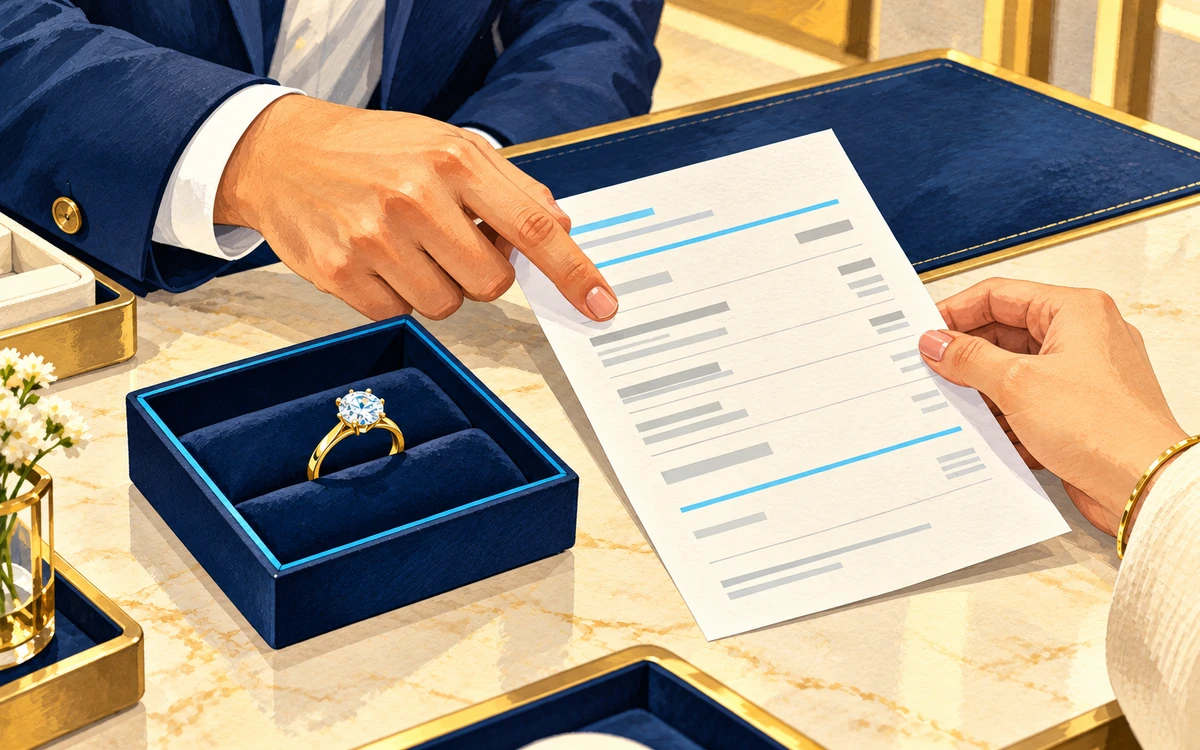
An 80% buyback offer on lab-grown diamond jewellery needs a second question: 80% of which value? The answer affects how much cash a buyer could receive later. The metal, stones, making charges and taxes on a purchase bill can receive different treatment when the piece goes back to the jeweller.
The question has a timely retail backdrop. In a company announcement dated 19 October, Limelight said it had crossed 100 stores across 45 Indian cities. Its website also describes that footprint. Store access makes it easier to inspect jewellery and ask about after-sales terms; it does not establish what a future payout will be.
The Breakdown
Limelight’s published cash-buyback formula uses 100% of prevailing metal value plus 80% of the prevailing value of the relevant lab-grown diamonds. Original discounts are deducted from the diamond value; purchase taxes are excluded, and a ₹1,500 logistics deduction applies. The formula contains no reimbursement line for making charges.
Its exchange policy instead describes replacement goods equivalent to the original selling price, with no cash refund and a ₹1,500 logistics deduction. Both schemes cover India sales and require quality approval; the policy specifies jewellery free of damage, wear, alteration or resizing. The product, invoice, certificate and warranty card must accompany the request, with identification. Buyback is paid by bank transfer to the invoice-named person or entity within 21 business days of receipt at Limelight’s registered office. The exchange wording does not separately explain treatment of making charges and taxes, so a written component-level quote would help.
Jewelbox also calculates cash buyback using current gold value plus 80% of current diamond value. Its exchange calculation uses 100% of both components at current values, credited to a Jewelbox account. Making charges, taxes and a ₹1,000 processing fee are deducted; purchase discounts, free gifts, rewards and unpaid instalments can also reduce recovery. Buyback payment is due within 15 business days of receipt.
Jewelbox restricts buyback to pieces originally purchased for up to ₹4,99,999. Loose diamonds, baguettes, tapered diamonds, polkis, pearls and coloured stones are excluded from both schemes. Purchases outside its stores or website and jewellery altered elsewhere are ineligible. Inspection applies, and invoice and certificate documentation matter: a lost certificate attracts the higher of ₹2,000 or ₹800 per carat. These conditions deserve as much attention as the headline percentage.
Why This Matters
A simple hypothetical isolates the percentage: if an eligible diamond component is valued at ₹20,000 when it is returned, 80% of that component is ₹16,000 before other adjustments. This is neither a jewellery-price forecast nor a complete refund calculation. The original bill might use a different diamond value, and the metal and deductions still need their own calculation.
The exchange comparison is equally important. Limelight’s wording refers to original selling price; Jewelbox’s refers to current component values. A promise of 100% exchange therefore needs its valuation basis spelled out. Cash recovery and credit towards another purchase also serve different purposes for a household.
Before the purchase
Ask the retailer to put five things in writing: which value the percentage applies to; how metal and stones are assessed; treatment of making charges, taxes and discounts; cash versus store credit; and eligibility, paperwork and payment timing. Keep that answer with the invoice. A quality report is useful documentation, but it does not supply a future resale price.
These are the policies available online when checked on 20 October, not newly announced changes. Both retailers reserve the right to revise their terms. Buyers should confirm the applicable wording for their specific purchase and again before requesting an exchange or buyback.
The Crunch
The useful number is the amount recoverable after valuation and deductions. Reading the full formula turns a headline percentage into a clearer question about the jewellery being bought and the options available later.