
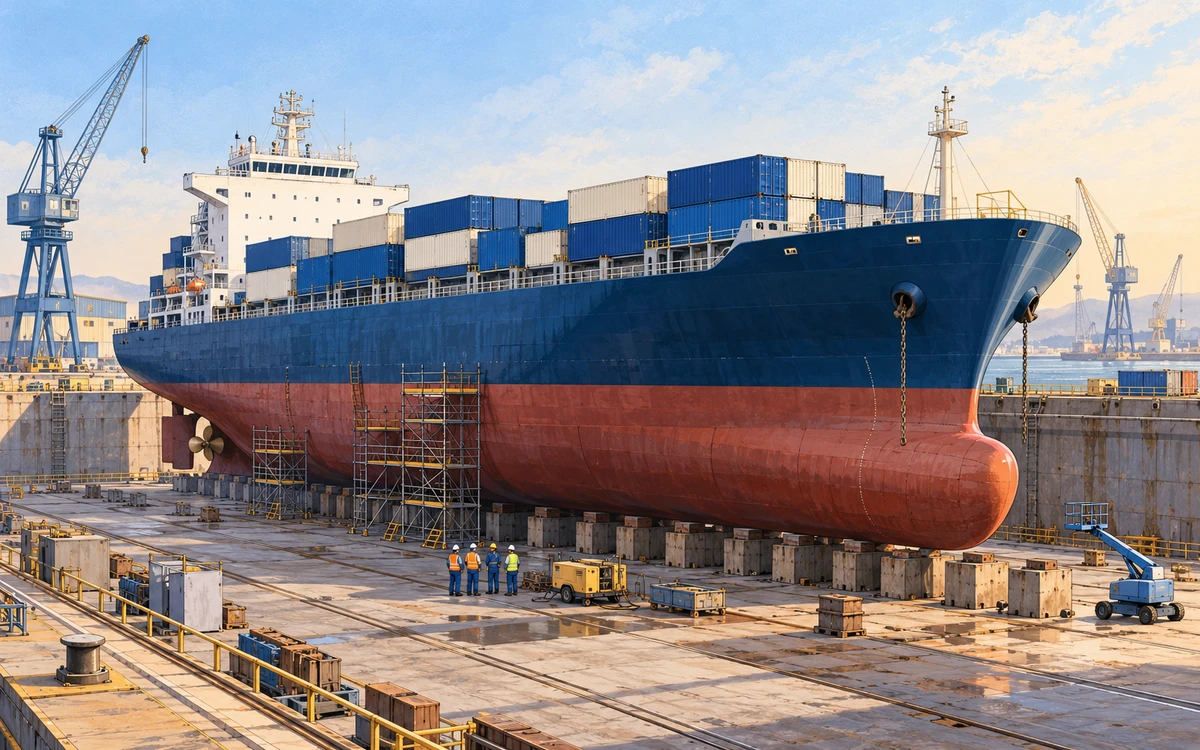
Getting a ship out of the water is a feat of engineering. Getting its maintenance finished requires parts, specialists and inspections to come together on the same schedule.
On 20 October, Maersk announced its first planned drydocking in India, for the Singapore-flagged container vessel Maersk Chattogram at L&T Shipbuilding’s Kattupalli yard near Chennai. Arrival was expected on 20 October, subject to operational and weather conditions; the announcement does not confirm that it has arrived.
The programme includes a scheduled special survey and work on the hull, machinery, equipment and propulsion. Maersk says the vessel will be lifted out using the yard’s shiplift. The companies signed a memorandum of understanding during India Maritime Week 2025.
The Breakdown
Drydocking makes normally submerged areas accessible for inspection and maintenance. The industrial task is then to turn a list of jobs into a sequence that teams can execute safely.
L&T describes a yard equipped with a shiplift and transfer system, dry and wet berths, and dedicated repair shops. Its listed services range from hull treatment and engine overhauls to propeller, electrical and control-system repairs. These are the provider’s stated capabilities, rather than a report of work completed on this vessel.
The company also identifies timely spare-parts availability as a central requirement, with procurement covering both Indian and imported components. That detail matters: a workshop’s ability to perform a repair and its readiness to start are different questions.
The schedule is part of the service
Lloyd’s Register’s general drydocking training covers specification preparation, tender evaluation, planning, repairs and preparation for departure. It also emphasises contingencies and classification rules. The sequence helps explain why a yard’s offer involves more than access to heavy equipment.
Consider a hypothetical replacement part found to be unsuitable after delivery. The component may be small compared with the vessel, yet resolving the mismatch could disrupt the planned sequence. Clear specifications, checking what has arrived and knowing who can approve a change become commercially useful disciplines.
A similar coordination question arises when several teams need access to the same area. An efficient plan has to decide which work can happen together and which must wait. Counting the number of available specialists says little about how effectively their time will be used.
Inspection is a separate requirement
The UK Maritime and Coastguard Agency’s explanation of the international SOLAS framework says cargo ships generally require at least two inspections of the outside of their bottom within five years, subject to specified exceptions. It distinguishes those inspections from an automatic requirement to drydock for both.
That is general context, not a statement about this vessel’s individual survey programme. For a shipowner, completing physical repairs and satisfying the applicable inspection requirements are related parts of the handover. A repair schedule therefore needs room for checks as well as workshop activity.
What India can build around the job
For Indian industrial suppliers, the opportunity worth examining is the ability to contribute reliably to a wider service. A component maker, specialist workshop or service contractor can be technically capable and still struggle if its delivery does not fit the vessel’s maintenance window.
Useful evidence of progress would include completion against the agreed scope, how additional work was handled, and whether the same coordination can be repeated on later assignments. Those are measures to watch, rather than outcomes established by the announcement.
The Crunch
India’s ship-repair opportunity rests on connecting infrastructure with dependable execution. The planned Kattupalli job provides a concrete case to follow: the lasting industrial value would come from turning a demanding one-off assignment into a service that customers can use again.