
Meta released Muse Spark Open on October 15, 2026, giving developers access to the trained model weights used to generate its responses. The business question is how to turn that access into a useful, affordable system.
The Breakdown
The model is designed for coding and AI agents that work through multi-step tasks. Meta lists 816 billion parameters in total, with 42 billion active at a time, and a context window of one million tokens. The context window describes how much material the model can work with in a request; it is not a guarantee that every detail will be handled correctly.
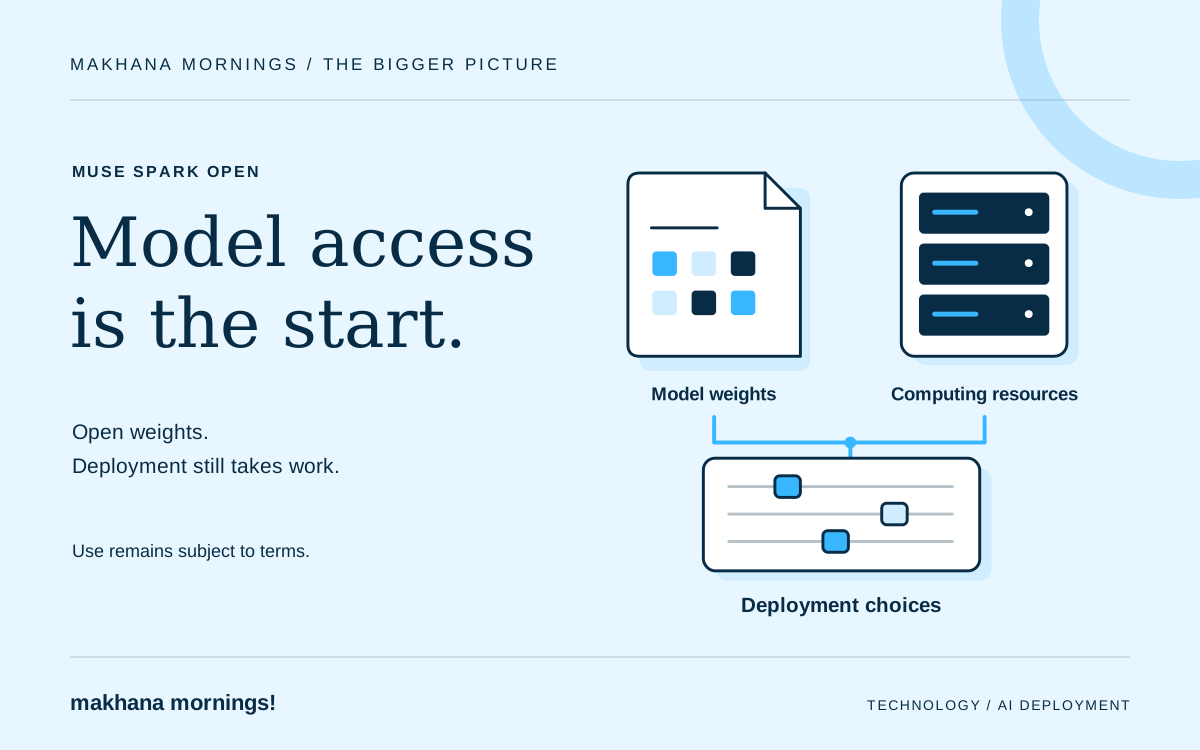
Developers can access the model through third-party services or obtain its weights to run and adapt it themselves. Weights are the numerical settings learned during training. Having them gives teams a choice beyond sending every request to a model provider’s hosted service.
Local Deployment Still Needs Substantial Hardware
Meta’s model card lists at least 700GB of graphics memory for the NVFP4 version and 2TB for BF16, two numerical formats. It separately describes an optimised setup using two M5 Ultra Mac Studios and Apple’s MLX framework. These are substantial computing requirements, rather than ordinary laptop specifications.
Running the model internally can give a business more control over its deployment. It also brings responsibility for infrastructure, access controls, maintenance and testing. Downloadable weights alone do not establish that self-hosting will be cheaper than a hosted service.
Read the Commercial Condition Carefully
The Muse Model License permits use and modification subject to conditions, including attribution and a usage policy. Open weights therefore do not mean unrestricted use.
For qualifying model-as-a-service businesses, the licence requires notice to Meta and a separate written agreement before offering this model or its derivatives as part of that service. The condition applies when third parties receive model access through an API or similar interface and the licence holder’s aggregate gross revenue with affiliates exceeds US$20 million in any consecutive 12 months. It is not limited to revenue from this model.
That clause expressly excludes internal use, research and other non-model-as-a-service activity, including model-powered features within a business’s own non-model-as-a-service product. It is not a blanket revenue ceiling for every company using the model.
The Business Choice
For an Indian software team evaluating the release, the comparison is between deployment options, operating costs and the intended service. A model used for internal work and one offered to outside customers as a service may involve different obligations.
The Crunch
Muse Spark Open gives developers more choice over where and how to run an AI model. Its practical value depends on computing resources, the licence terms and the work required to deploy it reliably.