
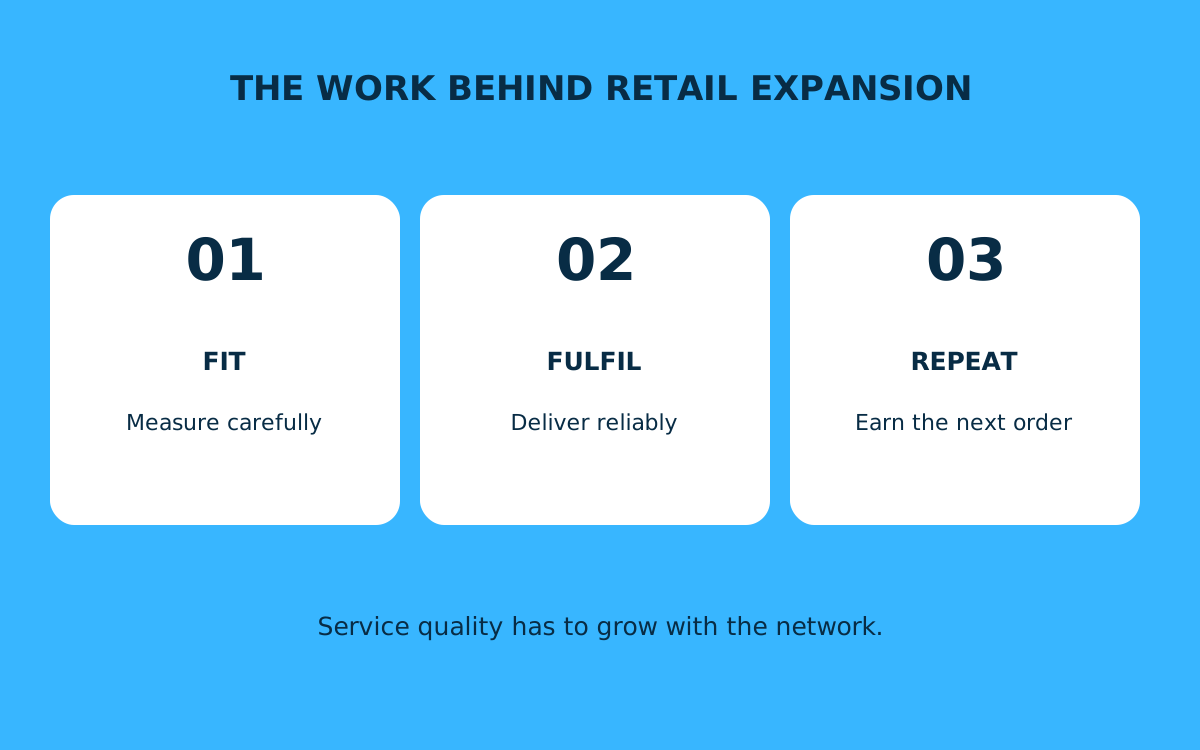
A trouser brand can win a customer online and still have a problem at delivery: the fit. A shop gives it somewhere to resolve that uncertainty before the order is placed. Scaling that service consistently is a different challenge from adding a store to a map.
The Pant Project’s founder has announced a ₹109 crore Series B round led by Mirae Asset Venture Fund India, with participation from existing investor Sorin Investments and others. The company aims to expand from more than 20 stores to over 150 across Tier 1 and Tier 2 cities, including malls and high streets.
That makes its next phase a useful test of how a digital-first clothing brand turns a product proposition into a repeatable retail operation.
Breakdown
The funding is intended for products, retail expansion, technology, the team and brand building. The proposed store network is an ambition, rather than a count of shops already operating.
The company sells both custom-made and ready-to-wear trousers. Those are different fulfilment models. Its published FAQ says custom orders use body measurements, which can be retained for subsequent purchases. Its stores offer custom-fitting services.
Its stated policies also distinguish the two ranges. Custom-made trousers do not have ordinary returns or refunds, although alterations are offered subject to conditions. Ready-to-wear items have a separate, conditional return and exchange window. Customers therefore need to understand which service they are buying before treating the two as interchangeable.
Why This Matters
For a fit-focused brand, a store can be a place to measure, explain and establish confidence, as well as sell. That gives physical retail a job beyond displaying products already available on a website.
It also creates an operating requirement. The value of a fitting appointment depends on the quality of the measurement, the explanation of available options and the accuracy of the eventual order. A larger footprint needs those steps to work consistently across teams and locations.
There is no verified evidence here that the expansion has already reduced returns or improved profits. Those would be outcomes to establish, rather than benefits to assume from the fundraising announcement.
The Big Picture
The useful commercial question is what happens after the first visit. If a customer’s measurements are reusable and the first order fits, a later purchase could require less assistance. But repeat demand still depends on the product, price and service experience. A saved measurement is an opportunity to simplify buying, not a guarantee of another sale.
For this kind of business, a sensible operating review would look beyond store count. It would track how many appointments become fulfilled orders, how often alterations are needed, the cost of providing that service and whether customers return. These are proposed measures, not disclosed company results.
Ready-to-wear stock creates a separate challenge: keeping the appropriate sizes and styles available at each location. Custom orders may follow a different production path, but still require reliable delivery and after-sales coordination. A brand offering both needs the customer experience and its internal processes to distinguish them clearly.
The Crunch
The expansion can bring fitting advice closer to more shoppers. Its lasting value will depend on whether the brand can deliver that service reliably as the network grows.