
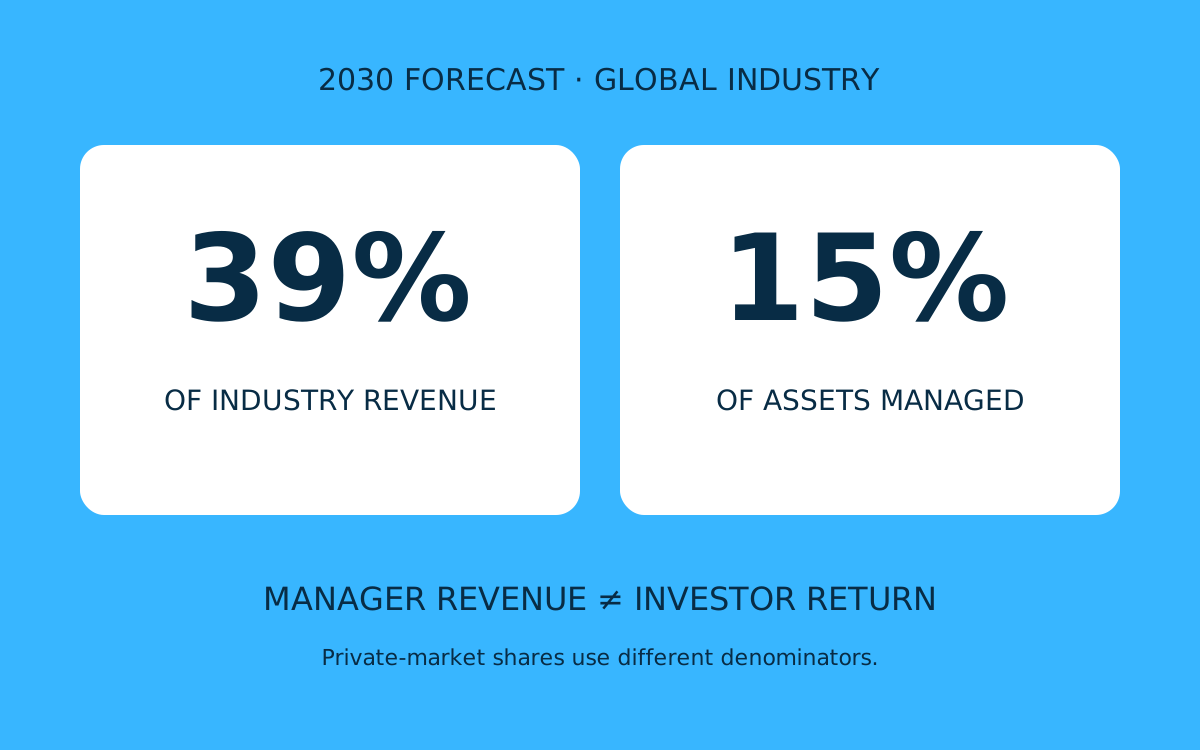
Private markets could command a much larger share of asset-management revenue than of the money being managed. That is a forecast about the fund-management business, with a separate question for investors: what do they receive after costs and risks?
The Breakdown
Morgan Stanley and Oliver Wyman’s September 2026 report projects that private markets will account for 39% of global industry revenue by 2030, while representing 15% of assets under management. The report expects overall managed assets to grow faster than industry revenue as average fees decline.
Assets under management, or AUM, measure the assets a firm manages. Revenue measures what the firm earns from its business. Neither is the same as an investor’s return. A higher-revenue product can be attractive to a manager without automatically being the best choice for every client.
The forecast also distinguishes different sources of demand. It points to insurers and wealth investors, alongside products designed around their servicing, regulatory and liquidity needs. These are the report authors’ expectations, rather than confirmed outcomes for 2030.
The India connection
India’s alternative investment fund data show why the choice of measure matters. At June 30, 2026, SEBI reported Category II AIF commitments of roughly ₹13.03 lakh crore, net funds raised of ₹4.78 lakh crore and net investments made of ₹4.28 lakh crore. These cumulative figures come from registered funds’ quarterly submissions.
A commitment is not necessarily money already collected or invested. Nor are these Indian regulatory categories directly interchangeable with the global report’s private-market universe. The figures establish local relevance, not proof that India will follow the same revenue forecast.
The Big Picture
For asset-management businesses, product mix, distribution and servicing costs all affect how growth reaches earnings. For clients, the useful checks remain the strategy, fees, valuation process and terms governing access to their money. A global revenue projection cannot answer those product-specific questions.
The Crunch
Keep three measures separate: assets managed, revenue earned by the manager and returns received by the investor. Confusing them turns an industry forecast into an investment promise it never made.