
For a property near a centrally protected monument, a boundary measurement can shape the next step in a building proposal. A recent Karnataka High Court ruling shows why the legal restriction and the evidence placing a plot within it both matter.
In an October 9, 2026 judgment concerning proposed residential construction near Madhugiri Fort, Justice M.G.S. Kamal rejected a challenge to Sections 20A, 20B and 20C of the Ancient Monuments and Archaeological Sites and Remains Act, 1958.
The court also required a fresh inspection and survey, followed by reconsideration of the homeowner's request. Building permission remained for the authorities to decide.
The Breakdown
The dispute concerned construction on a vacant part of a residential property. The authorities had placed the proposed site 59 metres from the protected monument. The court found that the survey report did not explain the basis for that measurement.
It directed the authorities to establish the site's position and reconsider the representation, with the exercise to be undertaken within three months of receiving a certified copy of the order.
The ruling therefore leaves two distinct findings: the statutory provisions survived the challenge, while the particular property's measurement required further examination.
How the boundary works
The National Monuments Authority's guidance explains the usual arrangement around centrally protected monuments and sites. A prohibited area extends 100 metres from the protected boundary. A regulated area extends a further 200 metres beyond the prohibited area. These limits can be extended through the statutory process.
The starting point matters. Describing the regulated area simply as being “within 200 metres of a monument” loses the additional belt and the boundary from which it is measured.
New private building construction is prohibited in the prohibited area. Permission for repair or renovation may be sought for buildings that existed before June 16, 1992, or were subsequently constructed with the Director-General’s approval. Renovation does not permit demolition and rebuilding. Construction, reconstruction, repair and renovation in the regulated area require the relevant permission process. These rules concern centrally protected monuments and sites, rather than every heritage property.
The permission sequence
Official guidance makes this a question for local planning authorities too.
In a July 11, 2025 letter to states and Union territories, NMA said the proposed site's distance from the protected boundary should be accurately verified, with confirmation from the relevant Archaeological Survey of India Circle. Where heritage permission is required, the designated competent authority's clearance must precede local approval.
The filing route also needs attention. A September 17, 2025 NMA memorandum reaffirmed online applications through its NOAPS portal, while retaining offline submission for areas whose colour-coded zonal maps had not yet been approved by ASI. It also allowed offline applications for repair and renovation of pre-existing buildings in prohibited areas until further instructions.
The Crunch
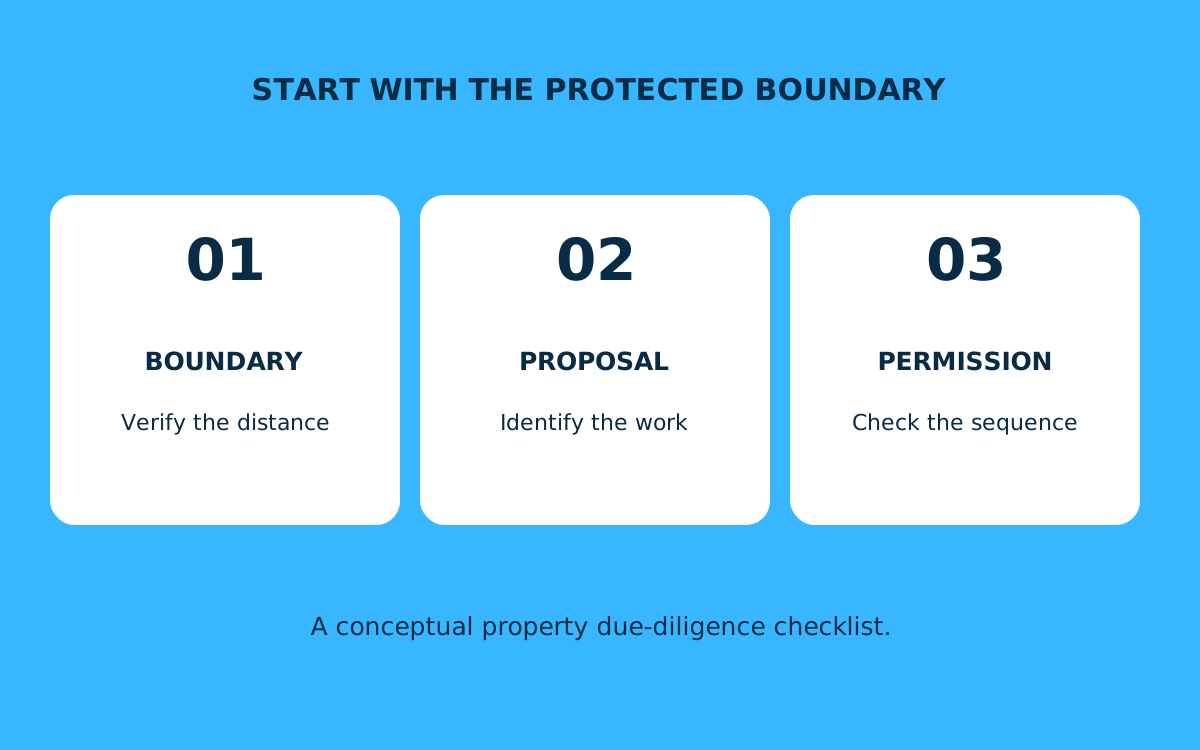
For people assessing a property's development potential, the practical lesson is to bring the protected boundary, the proposed work and the required permissions into the same review. Each answers a different question about the project.
The Madhugiri ruling illustrates the importance of that evidence. The construction restrictions remained in place, and the authorities still had to establish where this proposal sat within them.