
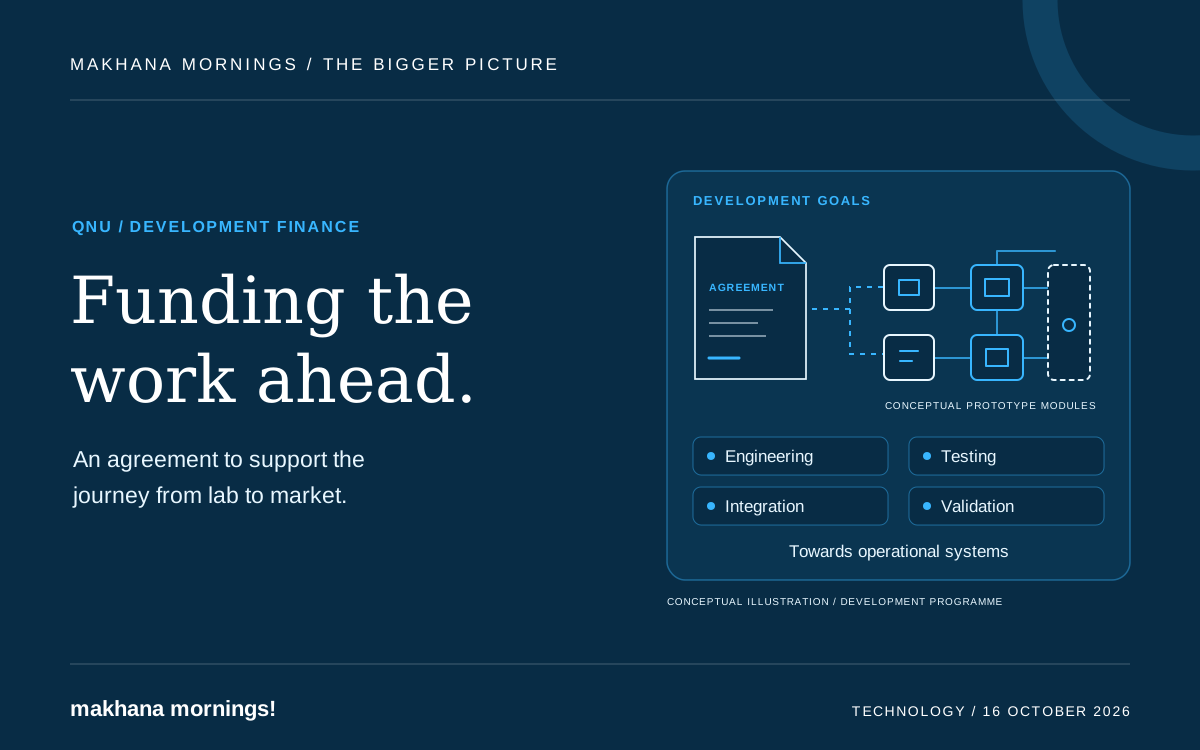
Turning a working prototype into a dependable product requires engineering, testing and integration. QNu Labs’ latest government agreement brings that stage of deep-tech development into focus.
On October 16, 2026, the Technology Development Board, under the Department of Science and Technology, announced a signed agreement to support the Bengaluru company with ₹150 crore through the Research Development and Innovation Fund.
The Breakdown
The support is optionally convertible debt: financing that can become equity under the applicable terms. It covers half the stated ₹300 crore cost of a project for India’s Quantum Secure and Sensing Networks.
This follows earlier funding plans. QNu’s September 9 announcement of a separate ₹200 crore equity round said some of that money would meet its contribution to the already approved RDI project. The ₹150 crore debt facility was also reported then. Today’s milestone is the agreement, rather than an additional ₹150 crore round.
The government announcement does not disclose disbursement, interest, maturity or conversion terms. It also gives no completion date. Signing therefore cannot establish how much money has reached the company or when each part of the programme will be ready.
What the project aims to build
The programme spans four connected needs: verifying device identity, checking navigation integrity, securing communications and maintaining trustworthy timing. Proposed work includes chip- and satellite-based quantum key distribution and high-precision clocks. These are development objectives, with potential uses across telecoms, financial systems and other critical infrastructure.
The stated aim is to move the funded technology portfolio from technology readiness levels 4–5 towards level 9. Readiness levels describe maturity. India’s framework places levels 4–6 in prototype development and levels 7–9 in operational deployment.
Why the financing stage matters
The RDI Fund’s own guidance focuses on commercialisation-oriented projects that have at least reached laboratory prototypes. It explicitly recognises uncertainty in performance, production and adoption. Financial backing helps fund the work needed to address those risks; it does not demonstrate that they have been resolved.
For QNu, the practical test will be whether the planned components can be integrated and validated for their intended uses. The announcement provides a development roadmap, without establishing the funded systems’ security performance or operational deployment.
The Crunch
QNu’s agreement formalises support for a development programme. Its significance will depend on the engineering, validation and operating results that follow, with the funding terms and technology milestones kept distinct.