
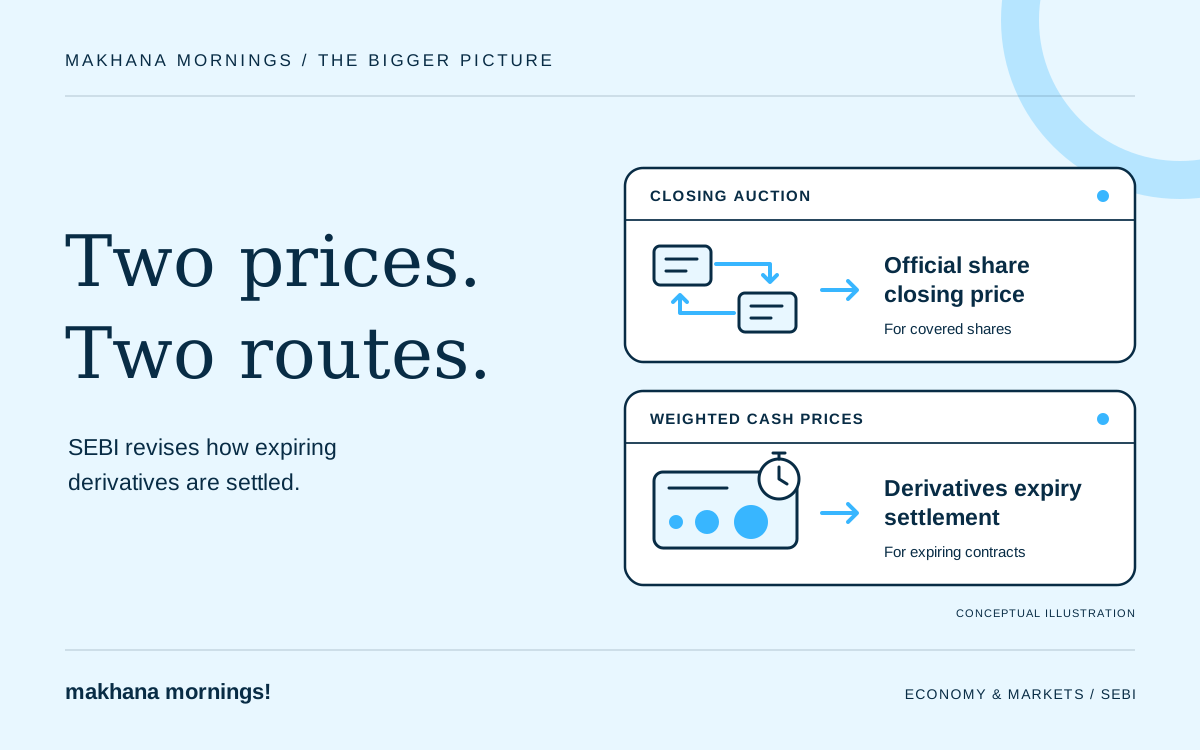
For shares covered by the closing-auction system, official closing prices and derivatives expiry settlement prices will follow different calculations under SEBI’s revised rules.
The regulator’s October 15, 2026 circular changes the pricing reference for expiring stock and index derivatives. It also revises the timetable for the closing auction and derivatives trading, with most provisions taking effect on December 7, 2026.
For market participants, the distinction matters: the end of trading, a share’s closing price and a contract’s expiry settlement price serve different purposes.
The Breakdown
For expiring stock derivatives, the settlement price will use the underlying share’s volume-weighted average price, or VWAP, during the last 30 minutes of regular cash-market trading across exchanges. This average gives more weight to prices at which larger quantities of shares changed hands.
For expiring index derivatives, the settlement calculation will use an index value built from the constituent shares’ VWAPs during that same final 30-minute cash-trading window. Exchanges must also publish indicative values during the window.
These provisions apply on expiry day to the contracts expiring that day. SEBI’s earlier closing-auction framework had linked their settlement prices to auction closing prices.
The closing auction itself will continue to determine the official closing price for shares covered by that system. The revised timetable on ordinary trading days is as follows. All times are Indian Standard Time.
- The closing-auction session runs from 3:30 pm to 3:40 pm. Order entry closes at a randomly selected time between 3:38 pm and 3:40 pm, followed by matching.
- Index derivatives trade until 3:45 pm, except contracts expiring that day, which stop trading at 3:30 pm.
- Stock derivatives trade until 3:45 pm, including contracts expiring that day.
- The cash market’s post-close session runs from 3:50 pm to 4 pm, with trades executed at the securities’ closing prices.
Why This Matters
The circular separates two prices that can easily be confused. The cash-market auction establishes an official share closing price. The revised expiry calculation uses a broader window of completed cash-market trades to establish the settlement reference for expiring derivatives.
Those calculations can produce different figures for the same underlying share. The rules do not establish that one will always be higher, or guarantee lower volatility.
Trading time is a separate question. An expiring stock derivative can continue trading until 3:45 pm under the revised timetable, even though its settlement reference comes from the earlier cash-trading window. The final moment at which a contract can trade therefore does not, by itself, identify how its settlement price is calculated.
The Big Picture
A second set of changes follows on February 8, 2027, covering how pending orders move from regular trading into the closing auction.
Unfilled limit orders will generally carry over, except stop-loss orders and orders priced outside the auction’s permitted bands. Eligible iceberg orders, which normally display only part of their quantity, will carry over as fully disclosed limit orders unless the participant opted out when placing the original order.
SEBI has directed exchanges and clearing corporations to update their procedures and systems. The two implementation dates give the market separate deadlines for the pricing and timetable changes, and for the pending-order transition rules.
The Crunch
From December 7, the closing auction and derivatives expiry settlement will use different pricing mechanisms. The useful distinction is between when a contract stops trading and which cash-market prices determine its settlement. Changes to pending-order transfers follow on February 8, 2027.