
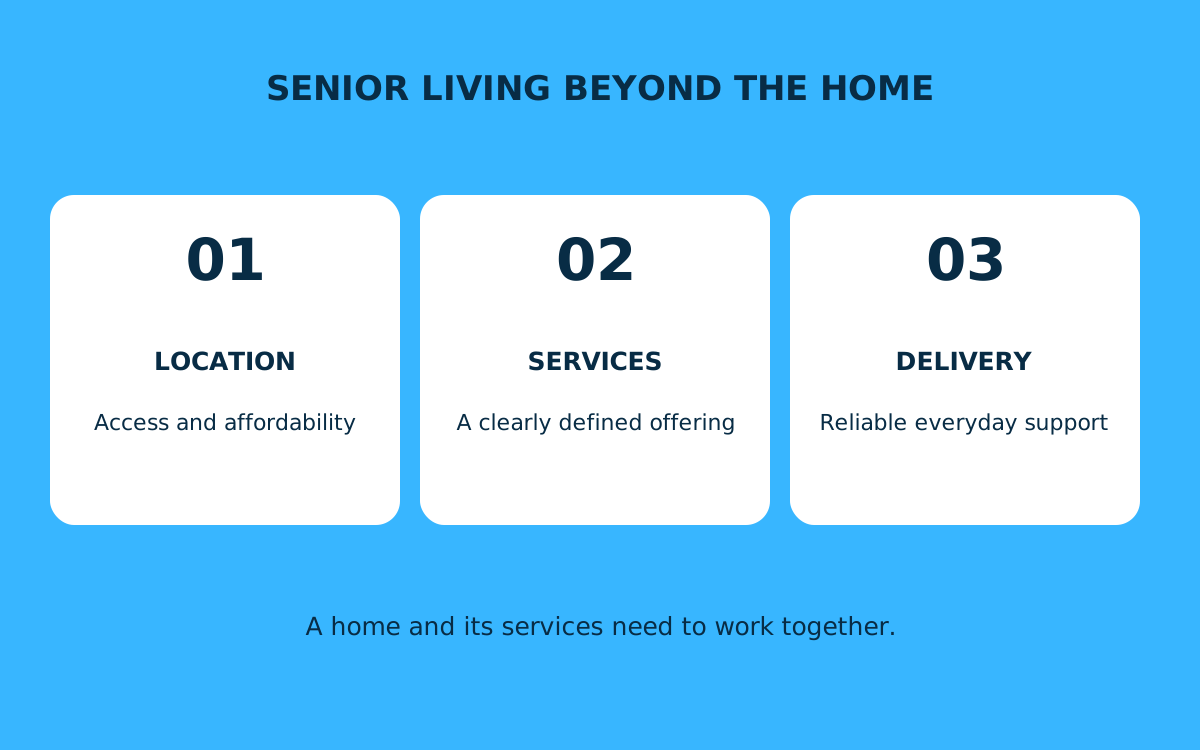
A retirement community has to work after the homes are sold. That makes India’s senior-living expansion a question about reliable daily services as much as a property-development opportunity.
The Breakdown
Square Yards’ October 15 research identifies 15 potential growth markets, assessing healthcare, connectivity, affordability and social infrastructure. Alongside established metros, it highlights cities such as Coimbatore, Mysuru, Kochi and Nashik, plus spiritual destinations including Haridwar and Varanasi. This is an industry assessment of potential, rather than evidence that each location already has a mature senior-living market.
In its August 18 assessment, Colliers projected that Tier II and III cities and spiritual hubs could account for 30%–40% of anticipated new senior-living launches. It identified places including Coimbatore, Puducherry, Dehradun, Vadodara, Tirupati, Vrindavan and Ayodhya as emerging destinations.
The consultancy estimated organised inventory at around 25,000 units and projected about one lakh by 2030. Its forecast of a market exceeding ₹1 lakh crore is based on the value of supply-side inventory. It should not be read as annual operating revenue, confirmed sales or a guaranteed investment return.
These are forecasts published in August, rather than newly completed developments. The opportunity they describe still requires developers and operators to turn planned projects into homes with services residents can use.
Look beyond the apartment
An existing example shows the operational scope. Ashiana’s Bhiwadi care-home page lists caregivers, a doctor on call, hospital tie-ups, housekeeping, dining and updates to next of kin. Those are the company’s stated facilities, not an independent assessment of care quality. Its website also directs buyers to the contractual documents for the actual offering.
That distinction matters. A service described in marketing needs a clear scope: who provides it, when it is available, what is included in the fee and what happens when a resident’s needs change.
Independent living and assistance with everyday activities should not be assumed to offer the same level of support. Buyers need to establish the actual service model rather than rely on the broad senior-living label.
The business question
A smaller-city location may appeal to residents for several reasons. The operating test is local: can the project sustain the staffing, maintenance, emergency arrangements and community activities it offers? A national demand estimate cannot establish whether a particular development will attract enough residents at its chosen price.
The Crunch
Assess the home and the ongoing service agreement together. For this segment, occupancy and recurring delivery will reveal more about a project’s strength than a launch announcement alone.