
An audio button is only useful if it can read the language on the screen. For languages with relatively little digital material, building that capability starts with recordings and written transcripts, well before a finished app reaches users.
On October 16, 2026, the electronics ministry announced that BHASHINI and the Indian Institute of Science, Bengaluru, had developed text-to-speech models for Sourashtra, spoken mainly by the Sourashtra community in Tamil Nadu. The work offers a concrete example of the data and design choices behind local-language AI.
The Breakdown
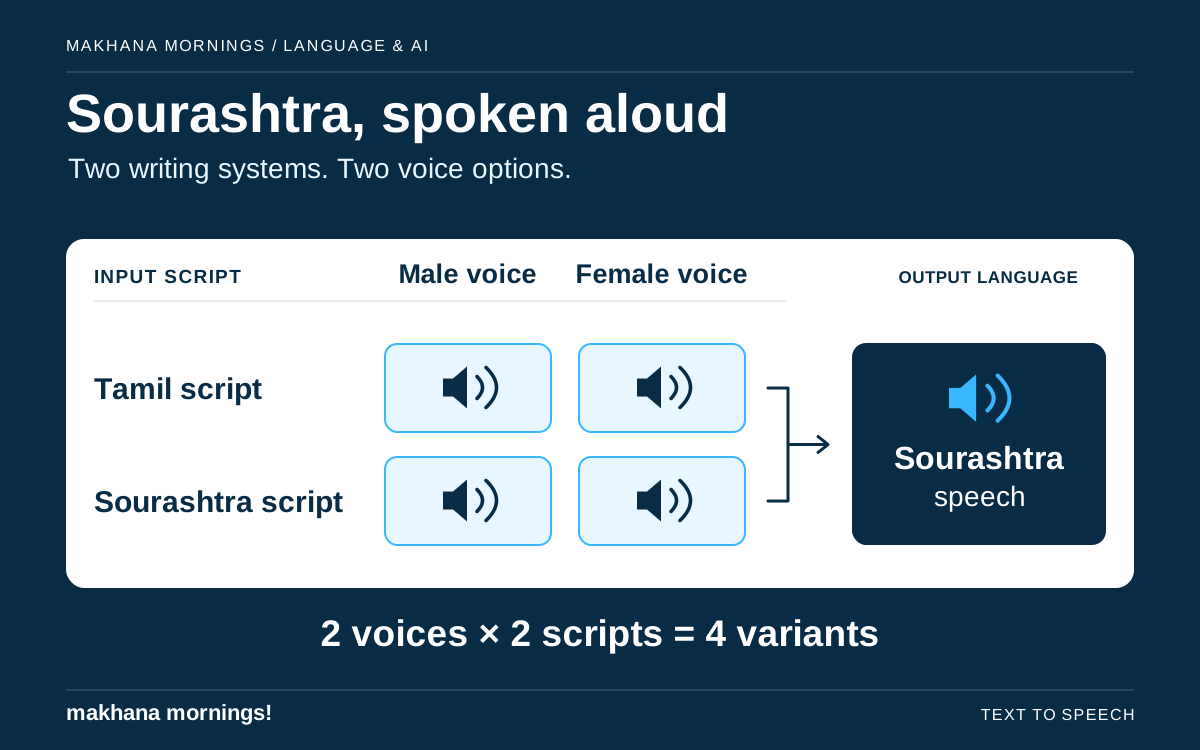
There are four model variants: a male voice and a female voice, each accepting text in either Tamil script or Sourashtra script. The output language remains Sourashtra. Using Tamil letters to write it does not turn the system into a Tamil-to-Sourashtra translation service.
That distinction matters for people who use different writing systems for the same language. Supporting both gives developers a way to work with either form of text, rather than assuming that every user writes it the same way.
The recordings behind the voice
According to the ministry, IISc’s SPIRE Lab built a corpus, or collection of speech data, containing more than 28 hours of recordings from one male and one female voice artist. The material includes composed sentences and passages from literature, with transcripts in both scripts.
This is a resource for training a system to turn text into speech. Two recorded voices do not establish that every accent, speaking style or real-world use has been tested. Those questions matter when moving from a research resource to a service that people rely on.
What is available
The ministry says the SPICOR TTS 3.0 Sourashtra Corpus is available on AIKOSH. A public SPIRE Lab model repository also documents the four variants and provides instructions for running them. Its model card lists a Creative Commons Attribution 4.0 licence.
The repository’s records date to June 2026. October 16 is therefore the date of the ministry’s announcement, rather than evidence that the models first became available that day.
Model access, training data and a ready-to-use public service are separate things. The model card’s licence label should not be assumed to cover every dataset or software component used alongside it. Developers still need to check those terms and test the system for their intended use.
The Big Picture
The ministry identifies reading aloud, language learning and accessibility as possible applications. These are potential uses, rather than measured adoption or independently verified improvements in learning and access.
For organisations building public-facing tools, the practical questions are specific: can users supply text in the script they know, does the audio pronounce their content correctly, and is the service usable on the devices they have? Releasing language resources helps make that development work possible; answering those questions requires testing with users.
The Crunch
Sourashtra’s speech models show how practical language AI depends on recordings, written forms and usable development resources. The next test is whether those resources become accurate, accessible tools for the people who speak the language. Model availability is a starting point for that work.