
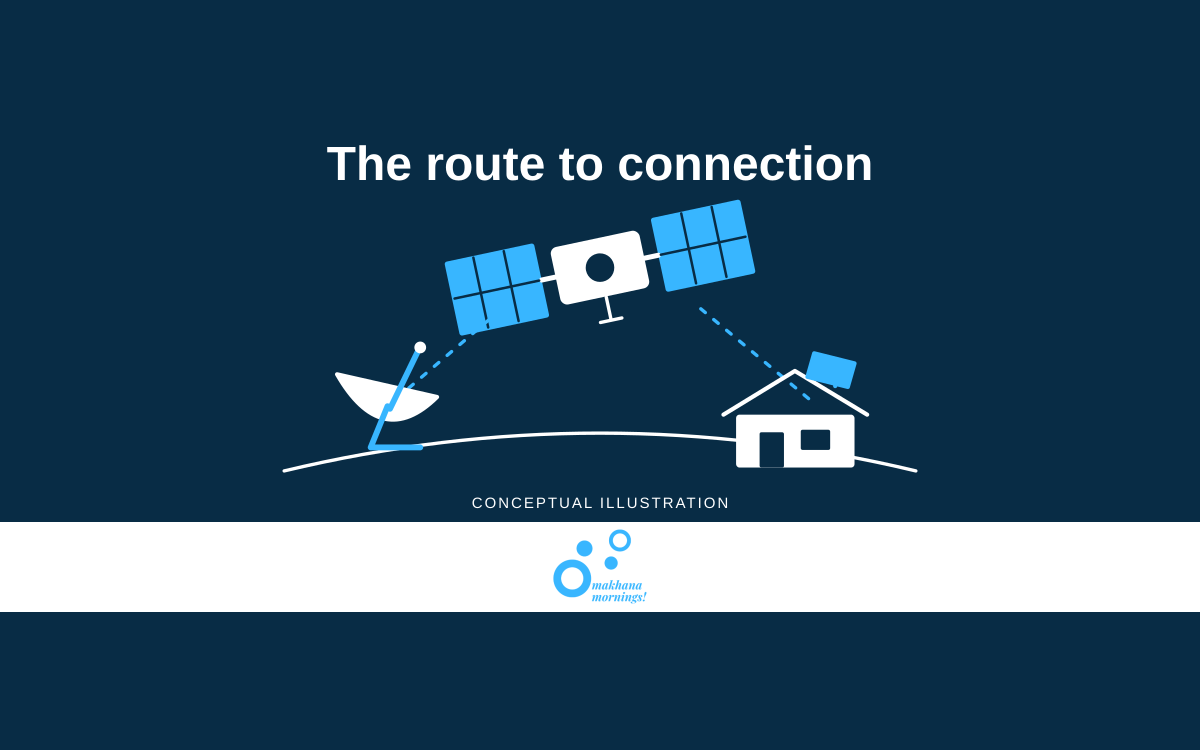
Starlink said on October 16, 2026 that it had built dedicated systems, gateways and other infrastructure in India, with the required government approvals. The company said it was ready to provide high-speed internet. Its statement did not announce a commercial launch date or a customer tariff.
For Indian households and businesses, the practical question is how that network becomes a service they can buy and use. The answer involves regulatory steps, distribution, installation and ongoing support.
What the regulatory steps cover
In a January 29 parliamentary reply, the Communications Ministry identified three companies with telecom licences for satellite services: OneWeb India Communications, Jio Satellite Communications and Starlink Satellite Communications.
The ministry set out a further part of the process on October 8. It said security assessments were underway for all three licensees, which were broadly at the same regulatory stage. Once an operator completed that process, it could seek spectrum assignment.
Spectrum is the radio-frequency resource used to carry communications. Its assignment governs access to that resource. Security assessment has a different purpose: the ministry says licensees must show that their services meet requirements intended to protect users and their data.
On October 9, Communications Minister Jyotiraditya Scindia said spectrum would be assigned on a revenue-sharing basis once the framework was decided. He also said companies could begin services after individually meeting security norms and other regulatory requirements.
The dated government statements describe regulatory requirements. Starlink’s later statement addresses infrastructure readiness. They concern different parts of the route to a customer service.
Jio’s agreement shows the distribution question
A commercial route was outlined much earlier. On March 12, 2025, Jio announced an agreement with SpaceX to offer Starlink to Indian customers, subject to SpaceX receiving its own authorisations.
The announced plan included Jio’s retail outlets and online storefronts, alongside support for installation and activation. Jio described satellite broadband as a complement to JioFiber and JioAirFiber, including in places that are difficult to reach.
That announcement illustrates how a satellite provider could use an established local network to reach customers. It remains an announced distribution plan here; the agreement alone does not establish that those sales channels or installations are operating.
The distinction matters for the customer experience. Buying equipment is one step. Getting it installed, activating a connection and knowing who handles a service problem are separate parts of making it useful.
What Indian customers will need to compare
The Communications Ministry has identified remote, coastal, border and mountainous locations as areas where satellite services can help when terrestrial connections are difficult to provide. That gives the technology a clear potential role alongside ground-based networks.
Consider a business comparing internet options at a remote site. It would need to know whether service is available at that address, the equipment and installation cost, the recurring charge and the support terms. It would also need to judge whether the connection suits its work.
A household would face a similar comparison against the options actually available to it. A claim of high speed leaves other questions open, including reliability, service conditions and the full cost of getting connected.
A clear launch offer would let customers assess those questions using published terms. Until such terms are in hand, infrastructure announcements are useful progress signals, while the customer decision still needs more detail.
The Crunch
Satellite broadband reaches customers through several steps: infrastructure, regulatory compliance and a workable service offer. Starlink’s readiness statement puts attention on how those steps come together in India.