
A customer has agreed to test your product. The order is real, but the cash needed to deliver it may still be missing.
That gap is the useful question behind two recent developments in India’s startup ecosystem: the open GENESIS Pilot 2.0 application call and IBM’s October 13 agreement with MeitY Startup Hub. They address different parts of the journey from a working prototype to an enterprise customer. Neither guarantees a commercial rollout.
Breakdown
GENESIS Pilot 2.0 is aimed at eligible startups incorporated in Tier 2 and Tier 3 cities that already hold a pilot purchase order or work order from an eligible independent partner. Its application portal lists support of up to ₹40 lakh, tied to the verified cost of delivering that pilot, with equity allotted to the implementing agency on behalf of MeitY Startup Hub. The equity is capped at 3% of fully diluted post-money shareholding.
The portal gives October 30, 2026 as the closing date. It also warns that disbursement may take four to five months from the call for applications. An application therefore cannot be treated as cash available to pay next month’s delivery bills.
IBM’s separate agreement with MeitY Startup Hub concerns access to enterprise technology, technical guidance, mentorship and opportunities to engage enterprises and investors. The announced areas include proofs of concept, AI, hybrid cloud and quantum computing, with attention to innovators in smaller cities. These are planned support activities, rather than evidence that participating startups have secured customers or investment.
Why This Matters
A pilot tests more than whether software works in a demonstration. It can require integration with the customer’s systems, staff training, support and a clear way to measure the result. Those tasks consume time and money before a repeat order is certain.
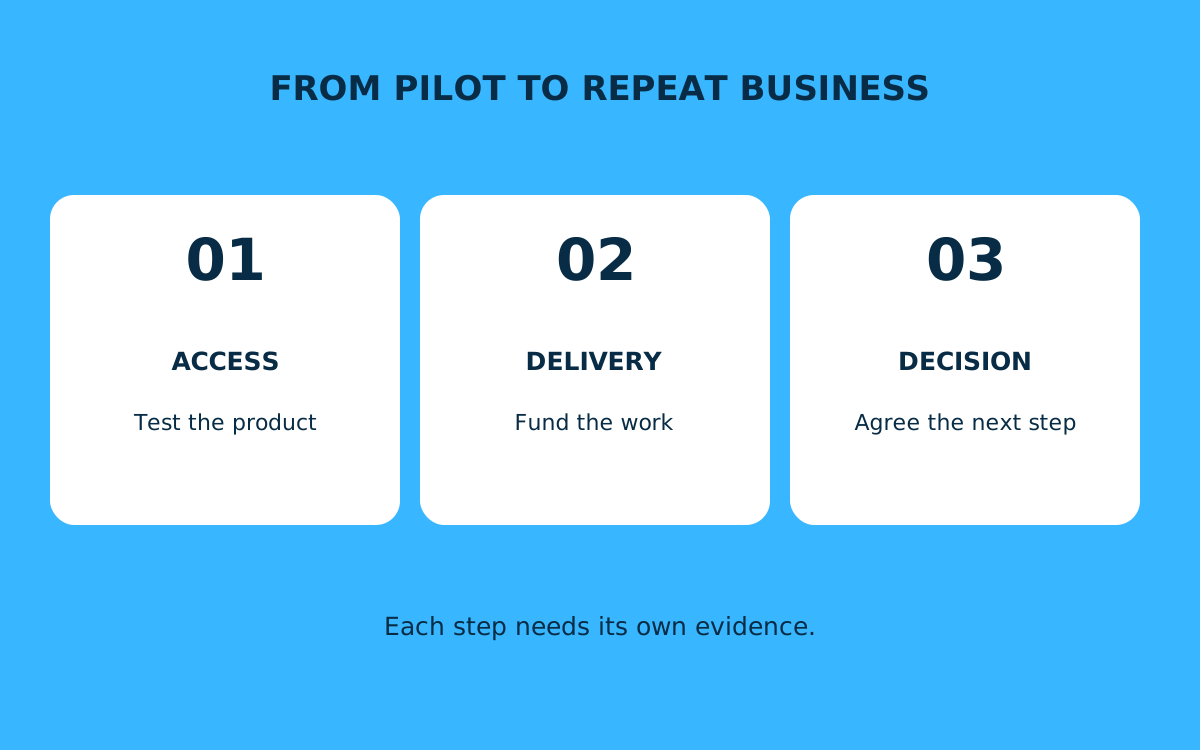
For a founder, three questions belong on separate lines of the plan: who will let us test the product, who will pay for delivery, and who can approve a wider purchase if the test succeeds?
A technology partner may help with the first. Financial support may help with the second. The customer still controls the third. Treating them as one promise makes a sales forecast look more certain than it is.
The Big Picture
The practical opportunity is to design the commercial test alongside the technical one. A hypothetical factory pilot, for example, could agree in advance which production line is in scope, what baseline will be used, who verifies the result and when the buyer will decide on expansion. That is an illustration of useful planning, not a condition stated by either programme.
The funding schedule matters just as much. Founders should compare supplier payments and staff costs with contractual customer receipts and the timing of any approved support. A promising order can still leave a cash shortfall if money arrives after delivery costs fall due.
The Crunch
The strongest pilot produces both usable evidence and a clear purchasing decision. Access, funding and customer commitment each help, but they are separate steps towards a repeatable business.