
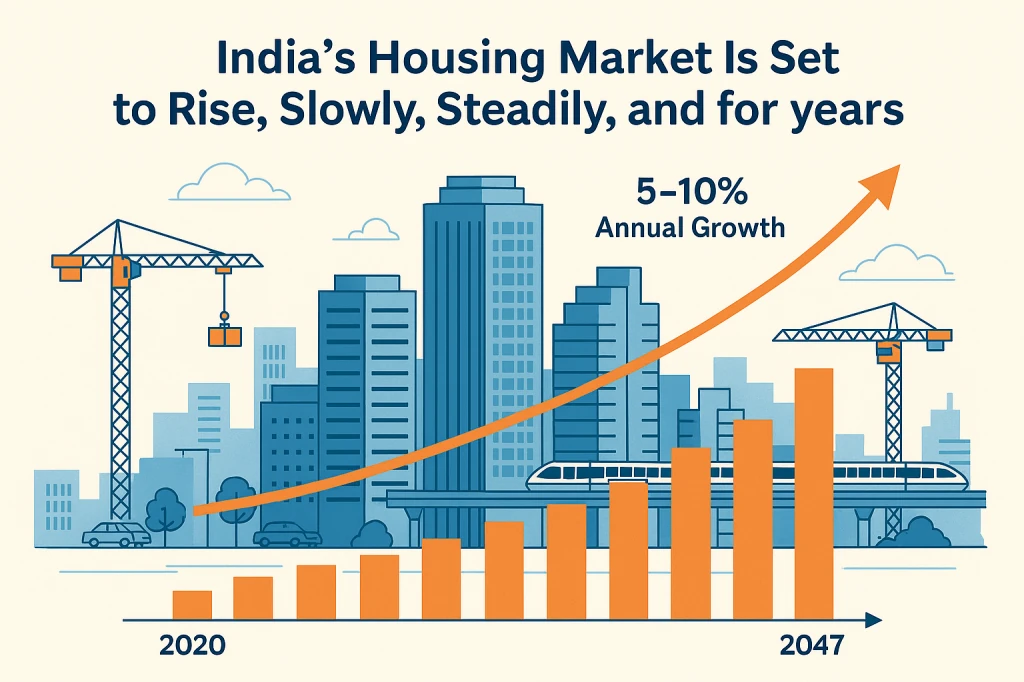
India’s housing market is quietly entering a golden phase. A new report by the Confederation of Indian Industry (CII) and Colliers India predicts that home prices will appreciate between 5 and 10 percent annually over the next few years, backed by strong end-user demand, urban expansion, and sustained economic growth. The findings, part of the study Real Estate @2047: Building India’s Future Growth Corridors, suggest that India’s real estate growth is shifting from a cyclical boom and bust story to a more stable, long-term uptrend.
But beneath the optimism lies a split opinion. Some economists and market observers warn that affordability and credit expansion could be stretching faster than incomes, hinting at early signs of imbalance in an otherwise healthy market.
Breakdown:
The report was released in New Delhi by Harleen Kaur, Deputy Secretary at the Ministry of Road Transport and Highways, during a national real estate conference. It highlights the sector’s potential to serve as a key pillar in India’s journey toward becoming a developed economy by 2047.
According to the report, annual housing sales, currently estimated between 3 and 4 lakh units, could climb to as high as 10 lakh units by 2047. The optimism is driven by consistent demand in both metros and emerging cities, infrastructure development across transport and logistics corridors, and an increasing preference for homeownership among younger working professionals.
Unlike earlier growth phases marked by speculative investments, the report notes that today’s market is grounded in end-user demand. A combination of factors, including rising disposable income, supportive mortgage rates, and a strong employment base, has created a foundation for sustained growth. Developers, meanwhile, are focusing on quality, sustainability, and efficient project delivery, responding to a more discerning homebuyer segment.
At the same time, skeptics point out that income growth has not kept pace with housing inflation in major cities. Mortgage leverage is expanding, and while credit quality remains stable, affordability ratios are tightening. As developers target higher-value segments, the middle-income buyer, the true backbone of India’s housing demand, may soon feel the strain.
The report also points to the role of policy and institutional reforms. Initiatives such as PM Awas Yojana (Urban and Rural), Smart Cities Mission, and Gati Shakti have expanded real estate activity beyond traditional hubs like Mumbai, Delhi-NCR, and Bengaluru into Tier 2 and Tier 3 markets. These smaller cities, once peripheral to India’s real estate story, are now emerging as the new growth corridors.
Why This Matters:
For homeowners and investors, a steady 5 to 10 percent annual appreciation represents predictable, sustainable wealth creation, unlike the sharp but volatile surges of previous real estate cycles. Developers also stand to benefit from healthier demand and price stability, enabling long-term planning and responsible inventory management.
A stable housing market also has macroeconomic benefits. The sector contributes nearly 7 percent to India’s GDP and is a major employment generator across construction, materials, and allied services. Controlled, broad-based growth helps prevent speculative bubbles while strengthening financial institutions linked to the housing credit ecosystem.
But the same stability could conceal growing affordability gaps. If price growth continues to outpace wage increases, India may face a new form of housing stress; less visible than a crash, but equally impactful on accessibility and inclusivity.
The Big Picture:
India’s real estate landscape is evolving in sync with its urban transformation. As highways, metro corridors, and industrial clusters expand, housing demand is expected to follow, supported by rising aspirations and affordability. The focus is shifting from speculative luxury projects to affordable and mid-segment housing, where real demand resides.
The Colliers and CII report positions real estate as a long-term value creator that will support India’s goal of achieving developed economy status by 2047. Yet the challenge lies in ensuring that this growth remains inclusive. Sustainable housing cannot just mean rising prices, it must also mean rising access.
The Crunch:
The message from the latest housing outlook is clear. India’s real estate market is maturing. Growth will be slower but steadier, driven by fundamentals rather than frenzy. But sustainability has two sides: economic stability and social equity. With better planning, robust infrastructure, and a growing middle class, homes in India are set to appreciate not just in value but in meaning.