
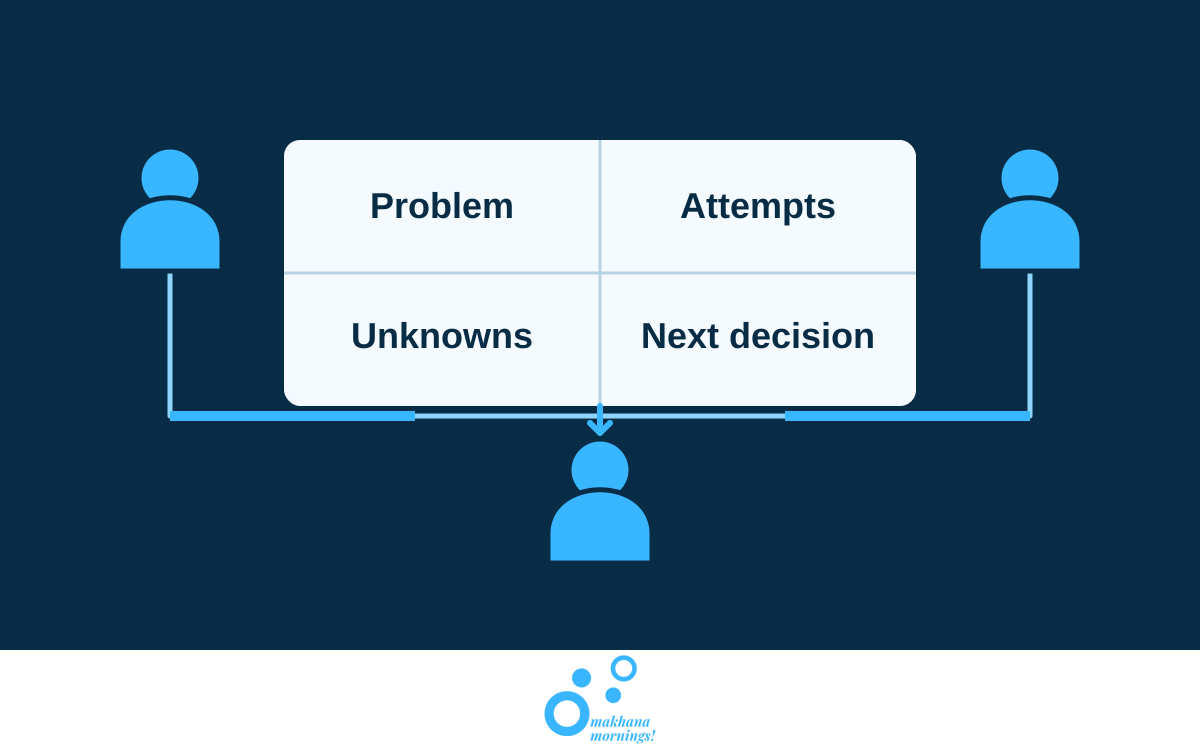
When an urgent problem pulls several colleagues into a call, a useful question is whether each person knows enough to act. Can they explain what has changed, what someone else is already trying and where the next decision sits?
A study first published in June 2025 examined rapport during complex, time-pressured work.
What the researchers observed
Researchers observed 41 pilots in 38 two-person pairings across 203 flight simulations. After sessions modelling takeoffs and landings, pilots rated their liking for their partner, emotional positivity and sense of coordination. Instructors separately assessed performance.
All three aspects of rapport correlated positively with performance. In the controlled regression analysis, according to Kellogg’s research account, only coordination significantly predicted the instructors’ assessments. Feeling good about a colleague and coordinating effectively were therefore worth examining separately.
The research was observational. It did not randomly assign teams to a communication method or establish that changing an office routine would improve results. The specialised sample cannot establish how every workplace should operate.
Look at the information people could use
In an engineering account dated July 14, 2022, Razorpay’s Varun Achar described revising incident reviews after an August 12, 2021 outage. The review examined both technical causes and how the response unfolded.
Its timed sequence covered events, actions, unavailable resources and missed steps. Examples across past incidents included scattered dashboards, absent escalation guidance and late communication; they were not all findings about the August 2021 outage.
This is a first-party account of a review process, not an independently measured improvement in performance.
Google’s published incident-management guidance offers a complementary practice during the response itself. It separates coordination, technical operations and communications responsibilities, maintains a shared incident record, and calls for an explicit, acknowledged transfer when command changes. This is operational guidance, not a test of the flight study’s findings.
A practical review for a working team
Consider an illustrative software-support team in India handing an unresolved problem to colleagues in another time zone. Before the handoff, ask the incoming team to identify the current problem, attempted fixes, remaining uncertainty and person authorised to make the next change. A disagreement is a useful place to clarify the record.
Afterwards, reconstruct one difficult decision. Was the necessary information unavailable, hard to find or available but overlooked? Those explanations point to different follow-up questions: whether access needs fixing, records need reorganising or the team needs to review how it interprets a warning.
A team trying this would still need to check whether it reduces repeated work, missed decisions or handoff confusion in its own setting.
The Crunch
A useful teamwork review follows information through to a decision. It asks what colleagues could act on, beyond whether the meeting felt productive.