
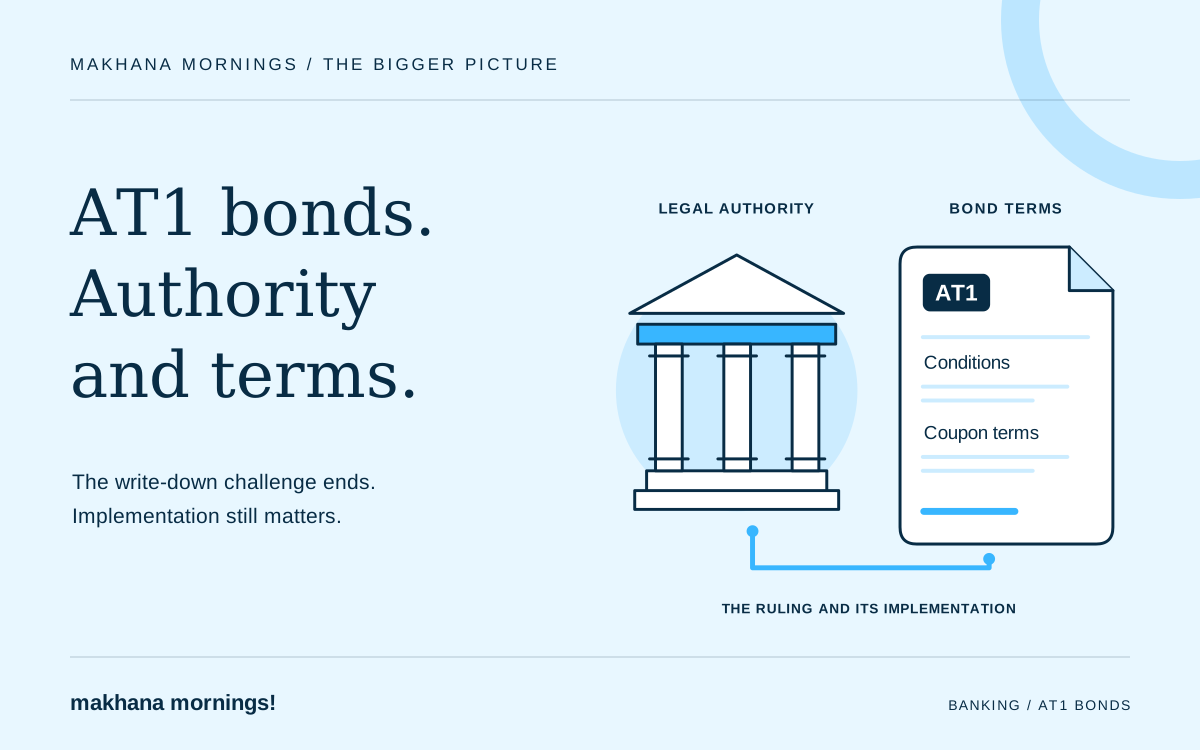
The Supreme Court has dismissed the appeals against a Bombay High Court judgment that set aside YES Bank’s ₹8,415 crore Additional Tier 1 bond write-down. The October 15 decision brings the appeals to an end and vacates any interim orders in them.
For affected bondholders, that is a significant legal result. Understanding the next steps requires separating the decision to erase the bonds from the terms governing payments on them.
The Breakdown
YES Bank issued the bonds in two tranches: ₹3,000 crore in December 2016 and ₹5,415 crore in October 2017. Axis Trustee Services acted as trustee for both.
The dispute arose during the bank’s reconstruction in March 2020. A draft rescue scheme included a provision affecting the AT1 bonds. The final scheme, notified on March 13, omitted it. The administrator nevertheless wrote down the bonds the following day.
The Bombay High Court set that action aside in January 2023. The Supreme Court has now left that judgment undisturbed.
The final scheme was central to its reasoning. The Court concluded that the administrator could not use a general provision preserving existing powers to claim the specific authority to write down the bonds after the bank’s reconstruction.
Why This Matters
AT1 instruments form part of a bank’s regulatory capital. Their terms allow them to absorb losses when specified conditions are met. That feature helps explain why their legal documentation matters so much during a bank rescue.
The Court examined who could exercise the relevant power as well as when it could be exercised. Under the framework it considered, the decision at the point of non-viability belonged to the Reserve Bank of India. The administrator’s appointment to replace the bank’s board did not also give him the regulator’s powers.
The distinction has practical importance: a bond can contain a loss-absorption provision, yet a particular attempt to use it can fail because the required authority or process is missing.
That is the scope of this ruling. It does not remove the loss-absorption features of AT1 instruments generally or establish a guarantee against losses on bonds issued by other banks.
The Big Picture
The judgment also addresses annual coupon payments, the interest payments on the bonds. It says they remain governed by the information memoranda, which set out the conditions of the issues.
The operative directions do not set a universal immediate repayment date or calculate a fresh amount payable to every holder. The ₹8,415 crore figure is the combined value of the two bond issues involved in the case; it should not be presented as a newly announced cash payment due immediately.
The Court also clarified that other pending proceedings should be decided independently of its observations in these appeals. Questions in those proceedings cannot be treated as resolved simply because the write-down challenge has reached this stage.
The Crunch
The March 2020 write-down remains set aside following the Supreme Court’s decision. The next useful information is how the judgment will be implemented and what that means under the bonds’ terms. Any payment timetable or quantified financial effect needs its own confirmation.