

Imagine a family getting its flat repainted. They choose a shade, the painter is ready to begin, and the neighbourhood dealer has to supply the right paint. A large shade card is useful only if the shop can turn that choice into a can of paint.
For the dealer, every choice commits money. Stock enough of everything and cash sits on the shelf. Stock too little and the customer may buy elsewhere. A supplier that helps with this trade-off gives the dealer a reason to choose it beyond the margin on a can.
That is the lens for this Unpacked: how Asian Paints connected colour choice, stock planning and selling support, and why the connections matter more than any single piece.
The idea in eight frames
Follow the visual explanation, or continue below for the full story. All eight frames can be read in order.
Swipe or scroll through the visual summary. The full explanation continues below.

1 of 8 · Makhanas Unpacked / 01 
2 of 8 · The dealer’s problem 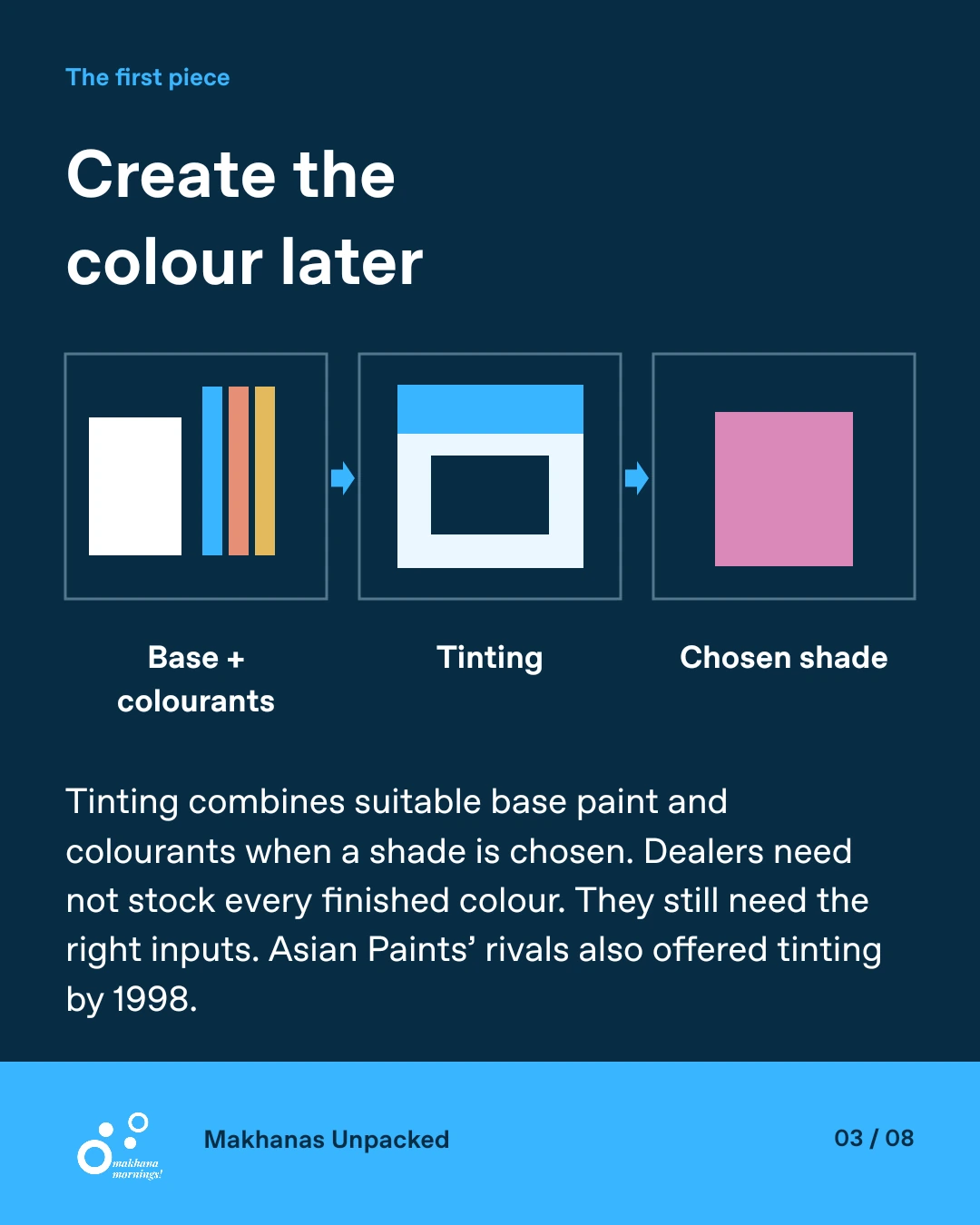
3 of 8 · The first piece 
4 of 8 · The next piece 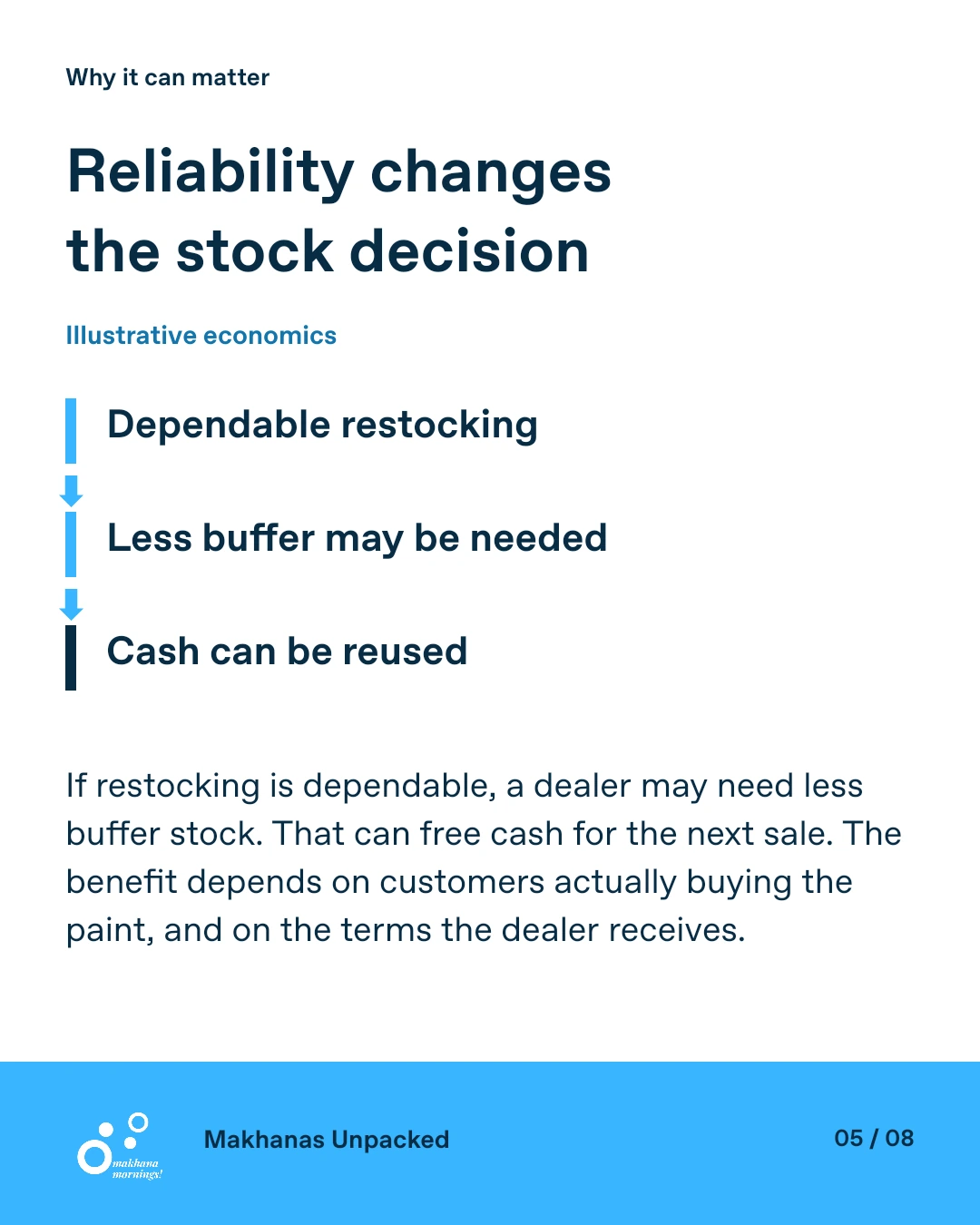
5 of 8 · Why it can matter 
6 of 8 · The piece software cannot replace 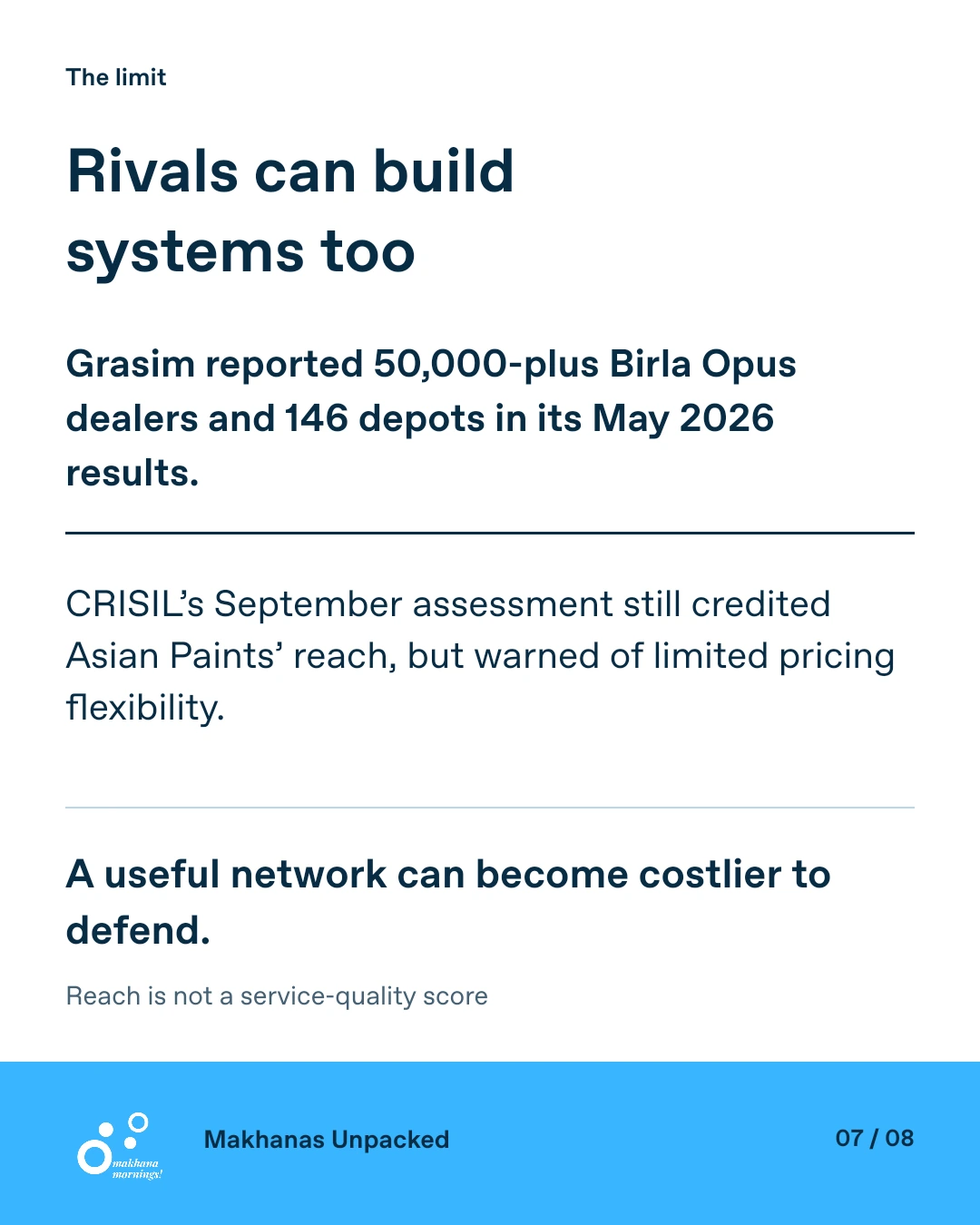
7 of 8 · The limit 
8 of 8 · The Crunch
The first problem is variety
Retail tinting postpones the final colour decision. Suitable base paints and colourants can produce the chosen shade at the counter, reducing the need to hold every colour as finished stock.
By February 1998, Asian Paints’ Colour World operated alongside Jenson & Nicholson’s Instacolour and ICI’s Colour Solutions. Customised colours were already available from competing brands.
The business question shifts from whether the shop has a machine to what it can sell with it. Equipment alone gives little reason for a dealer to favour one supplier.
Bases and colourants still need stocking. A missing input can leave the requested shade unavailable even when the machine works.
The shade card makes a promise
Asian Paints’ FY2023–24 annual report describes forecasting at depot and stock-keeping-unit level, using historical and current information alongside market intelligence. Its planning links demand estimates to production, distribution and procurement.
A stock-keeping unit, or SKU, identifies a particular product variant. Forecasting demand for it at a depot helps decide where stock should be available; it does not mean knowing every homeowner’s next purchase.
The forecast then has to become a physical result. Paint must be made, moved to the appropriate depot, picked and sent to the dealer. A correct estimate is worth little at the counter if stock is stranded elsewhere.
In its FY2025–26 report, Asian Paints says same-day order filling remained high and availability improved for less frequently sold SKUs. Order filling should not be mistaken for a nationwide same-day delivery promise.
This is where planning supports the offer at the counter. Colour choice creates a reason to buy; making the necessary stock available allows the dealer to complete the sale.
Reliability can change the dealer’s economics
Consider two hypothetical suppliers. One offers an attractive margin but requires a large stock buffer against uncertain replenishment. Another offers dependable restocking. The second could be worthwhile even at a lower per-can margin if it lets the dealer sell the same amount with less cash tied up. This illustrates the economics, rather than measuring the returns of Asian Paints dealers.
The distinction is between profit on a sale and the capital needed to make it. Cash locked in an unpopular finish cannot pay for a fast-selling primer. Dependable replenishment can make that allocation easier, provided delivery charges, credit costs and other terms do not consume the benefit.
There is also a cost on the supplier’s side. Supporting a dealer with less buffer stock may require stock elsewhere, more responsive transport or better coordination. The useful question is whether the whole arrangement serves the sale economically, not merely whether the shop holds fewer cans.
The paint still has to sell
By 2009, Asian Paints was training dealers, expanding its Colour Ideas retail format and offering small paint samples to help customers judge colours. These efforts addressed how people chose paint as well as how shops supplied it.
Replenishment is valuable when customers empty the shelf. Advertising can bring someone into a shop; advice helps turn an uncertain choice into an order; availability lets the dealer fulfil it. Without demand, an efficient supply system simply keeps unsold stock close at hand.
For the family repainting its flat, a suitable finish and confidence in the colour matter alongside availability. For the dealer, a sale that goes smoothly creates a reason to stock the brand again. Product performance and advice remain part of the explanation.
Data needs an operating system around it
The company’s Colourworld Tint app listing describes shade libraries, dispenser controls, formula updates and machine calibration. Its MyAwaaz dealer interface combines ordering, tracking, payments and business information.
These tools join different parts of the job. Selecting a formula is useful when the inputs are available; tracking an order helps when someone can resolve a delay. The advantage comes from coordinating those actions repeatedly, rather than simply collecting more information.
A challenger can buy machines and software. It still has to make the service dependable and generate enough demand for dealers to keep using it.
A good system can become more expensive to defend
Grasim’s May 2026 results said Birla Opus had passed 50,000 dealers, served through 146 depots. The expansion illustrates a challenge extending beyond paint factories into routes to market. Those counts do not establish comparable service quality.
CRISIL’s September 2026 assessment credited Asian Paints’ brand, distribution and scale, while identifying limited pricing flexibility amid competition. The operating strengths remained valuable, but they did not insulate the business from pressure.
CRISIL’s January 2026 industry analysis had also linked intensified competition to higher dealer incentives and promotional rebates across the sector, without measuring Asian Paints’ individual spending.
That explains how an advantage can become less profitable without disappearing. A supplier may fill orders effectively while offering larger concessions to retain them. As alternatives improve, dealers and customers can capture more of the value the network creates.
For Birla Opus, the corresponding test is turning access into repeat business at a sustainable cost. A depot count shows a network being built, not the economics of serving it.
Our report on UltraTech’s capacity and utilisation explores a related distinction: national production capacity does not by itself settle local availability. In paint, the colour and product a customer chooses add another layer to that challenge.
The Crunch
Look for the cost, delay or uncertainty a supplier removes for the people selling its product. Then ask who pays to keep that promise. An operating advantage becomes an economic advantage only when the value left over exceeds the cost of delivering it.