
India’s shipbuilding ambitions depend on more than the size of its yards. How reliably steel plates are joined, and how much correction they need afterwards, matters too.
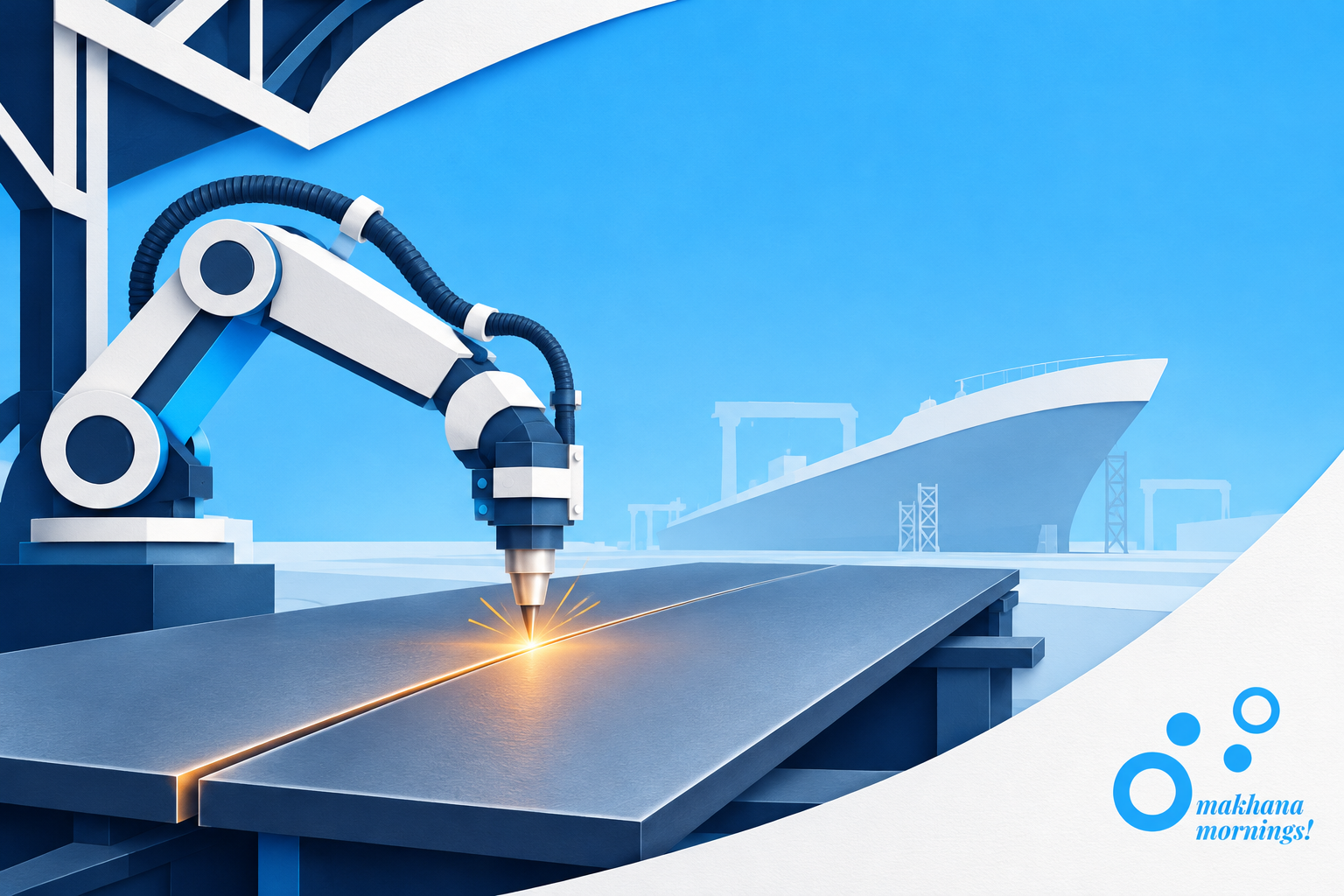
Cochin Shipyard and SFO Technologies have unveiled a jointly developed hybrid laser-arc welding system in Kochi. The November 11, 2026 announcement accompanied the opening of an advanced laser engineering and R&D facility at NeST Hitek Park in Kalamassery.
This is a manufacturing-technology development, not a new vessel order or evidence of a completed shipyard production upgrade.
Breakdown
The system brings together laser and conventional arc welding with robotics and automation. SFO says it developed the high-power fibre-laser source domestically.
Hybrid welding uses a laser and an electric arc together in the same pool of molten metal. The combination can offer the laser’s deep penetration while accommodating joint fit-up more readily than laser-only welding. Fit-up means how closely the pieces align before they are joined.
The process is already established internationally. The development here is a locally engineered system, rather than the invention of hybrid welding itself.
Why This Matters
For a shipbuilder, a fast weld is useful only if the finished joint meets the required quality and the surrounding steel remains within acceptable shape tolerances. Lower heat input can reduce distortion, potentially cutting subsequent correction and rework. That is why this technology attracts interest for long seams between plates and sections.
These are advantages the process can offer, not measured savings from the new Kochi system. Its actual performance will depend on the material, thickness, joint design and welding parameters.
The partners expect faster welding, deeper penetration and more consistent results. Their announcement does not provide comparative production trials, an independently verified productivity gain or a cost-per-weld benchmark.
The Big Picture
There are two separate questions here: can India develop the equipment, and can manufacturers use it economically at scale?
The new centre will focus on research, testing, validation and commercialisation. That leaves important work between the launch and routine factory adoption. Equipment and operator qualification, joint preparation, procedure specification, inspection and testing all feature in the international process framework for hybrid laser-arc welding. Nothing in the announcement establishes certification of this particular system.
For a prospective industrial buyer, the useful next evidence would be repeatable weld quality on relevant materials, performance in sustained production and the total cost of operating and maintaining the equipment. Domestic development creates an opportunity to build local capability; it does not by itself prove lower costs or eliminate imported components.
The Crunch
The next test is repeatable performance in sustained production, not another launch milestone.



Leave your thoughts