
A metro tunnel needs a boring machine before work can begin. A container terminal needs cranes before it can unload a ship. India’s latest manufacturing scheme is aimed at the businesses that make those machines and the parts inside them.
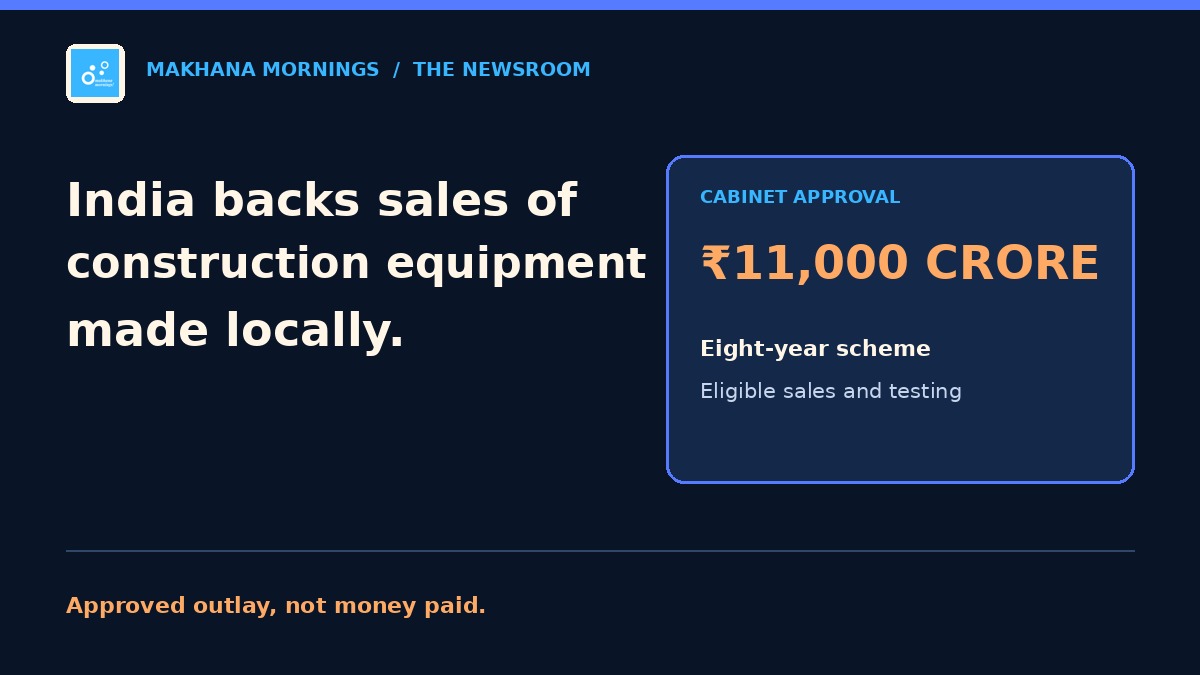
On 25 November, the Union Cabinet approved a ₹11,000 crore scheme for construction and infrastructure equipment. It backs two distinct steps: increasing sales of eligible equipment and components, and setting up a dedicated facility to test the machinery.
The sales incentive rewards growth, not the entire order book
Approved equipment makers and component suppliers can qualify for graded incentives ranging from 13% to 8% over five years. The rate applies to eligible incremental sales, not all sales. For illustration, if ₹10 crore counts as incremental sales under the eventual rules, a 13% rate would imply ₹1.3 crore before any other conditions or limits. The Cabinet summary does not spell out the baseline, the detailed product list or the application process.
The eight-year scheme sets aside FY2026–27 and FY2027–28 for setting up facilities. It then provides a five-year incentive period from FY2028–29 to FY2032–33, with FY2033–34 for settling incentives on the final year’s sales. The ₹11,000 crore is the scheme’s outlay, not a payout made on approval day.
Testing is a separate part of the plan
Up to ₹375 crore is earmarked in the form of a grant to help make a dedicated testing facility viable. That matters to more than the company selling a finished excavator. A component supplier needs evidence that its product can perform under the loads and conditions the machine will encounter. A domestic facility could make it easier to validate parts and finished equipment, depending on what it is equipped and accredited to test.
What manufacturers should watch next
The Cabinet names tunnel boring machines, ship-to-shore cranes, hydraulic excavators and off-highway trucks as examples. The detailed rules will tell manufacturers which models and components count, how sales growth will be measured, and what they must prove to claim the money. Those answers will determine whether a supplier can build a business case around the scheme. For equipment buyers, a separate test comes later: whether locally made machines and parts are available when projects need them.



Leave your thoughts