
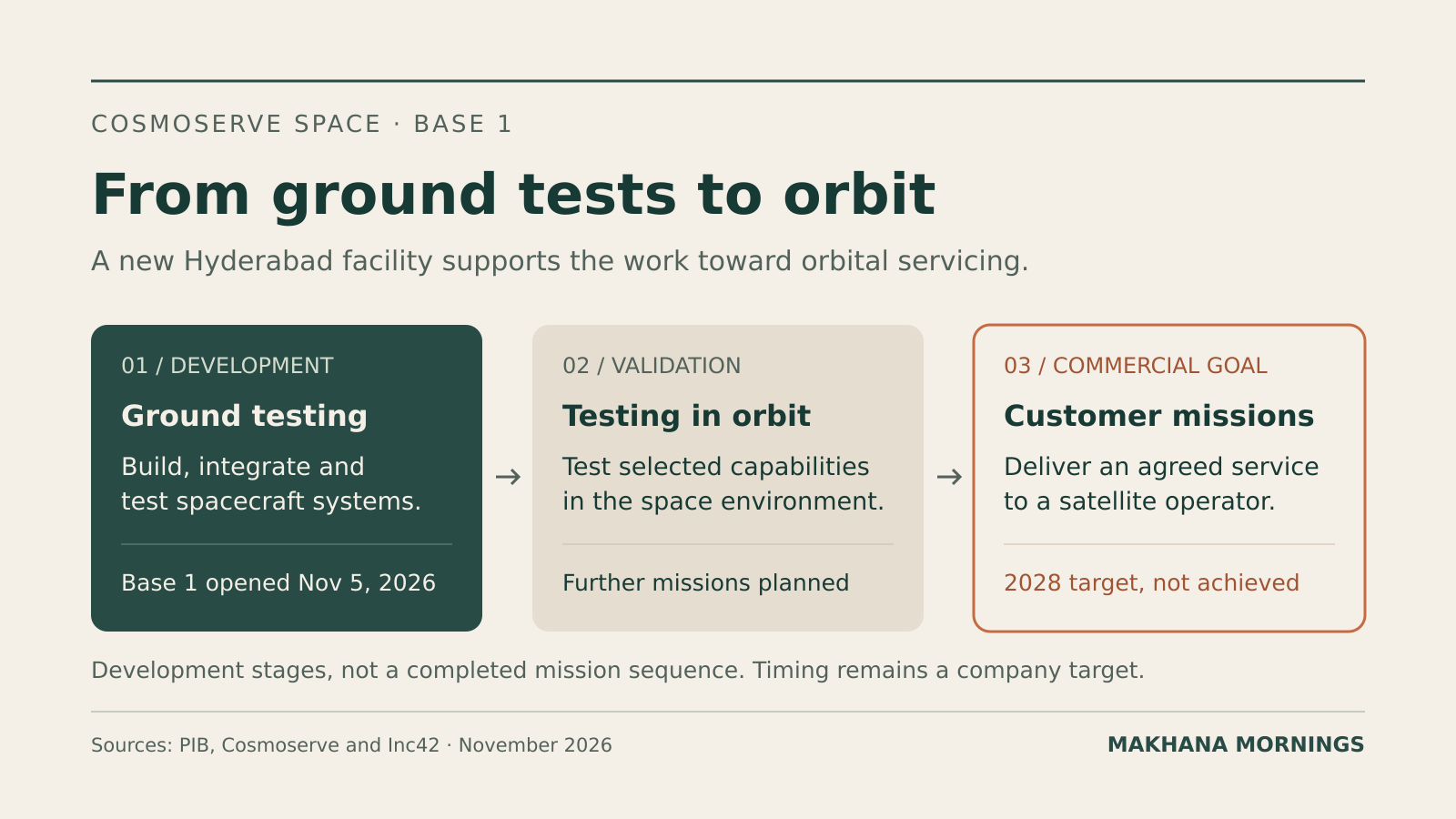
The next step in India’s space business is taking shape on the ground. Cosmoserve Space’s new Hyderabad facility brings together the laboratories and integration space needed to develop robots that could eventually service satellites and remove debris in orbit.
Base 1 opened on November 5, 2026. The Department of Space’s announcement describes an approximately 14,800 sq ft facility at Gachibowli, with rendezvous and capture labs, robotics development, microgravity simulation and satellite integration clean rooms. Union minister Jitendra Singh joined the inauguration virtually.
The commercial timetable remains ahead. The New Indian Express reports that the company aims to begin debris removal operations in early 2028, after technology demonstration missions. The new base provides infrastructure for that effort; it does not establish that a satellite removal service is already operating.
The Breakdown
Ground testing gives engineers a controlled setting to develop and rehearse parts of a mission. A capture lab can test how a robot approaches and grips a target, while integration space brings spacecraft hardware together. Flight demonstrations then test selected capabilities in the environment where they will have to work.
The distinction matters for Cosmoserve’s Mission Embrace. Its July launch announcement described an attempt to demonstrate soft robotic capture in orbit. The system is designed to grip objects that were not prepared for capture, such as defunct satellites without a convenient docking interface.
After the July flight, Cosmoserve told Inc42 that the payload had gathered useful data and survived launch conditions, but its robotic petals had not opened as intended. In Inc42’s November 5 report, founder Chiranjeevi Phanindra said the company had addressed potential release and temperature issues and was preparing an upgraded Embrace-2 mission. Those are the company’s reported development steps, rather than evidence of a completed debris removal operation.
From a test to a service
A full removal mission involves a longer chain of operations. The European Space Agency’s ClearSpace-1 description sets out the sequence: rendezvous with a target, capture it and bring it down for atmospheric reentry. A test of one component answers a narrower question than completing that sequence.
For a paying satellite operator, the practical questions extend to which objects a service can handle, how safely it can approach them, what the agreed mission delivers and at what cost. A facility opening helps establish where the engineering will happen. Demonstration results and customer missions will establish what the system can reliably do.
Cosmoserve has also announced $6 million in seed funding, with plans to support technology demonstrations, two upcoming missions and the Hyderabad facility. That gives the development programme resources. Its 2028 commercial target still depends on the work between those milestones.
What India’s 2030 ambition means
The facility also sits within a wider push to keep orbit usable. ISRO’s published debris-free mission initiative aims for government and private Indian space missions to avoid generating debris by 2030, including through safer design, collision avoidance and disposal after operations end. It does not promise to clear every existing piece of debris from space by that date.
The Crunch
Cosmoserve’s new base adds a place to build, integrate and test the machinery for orbital servicing. The next evidence to watch is what the upgraded capture system demonstrates in flight, followed by the scope and outcome of a customer mission. That is how a promising facility becomes a dependable service.
Leave your thoughts