
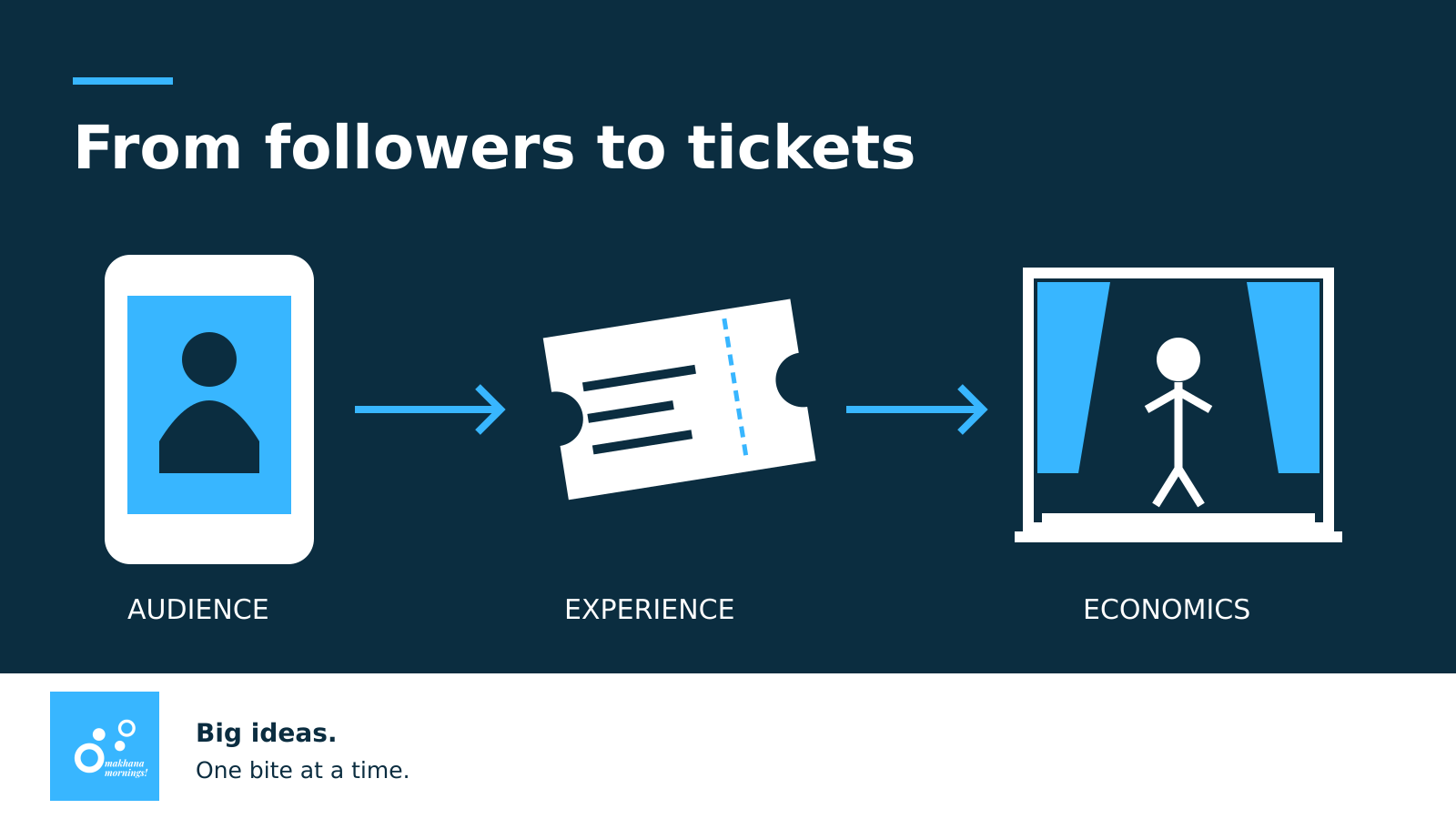
What makes an online audience willing to buy a ticket, and how should a creator assess the economics of a show?
A million followers can watch from anywhere. A ticket needs someone to choose a city, a date and a price. That is the business test behind taking an online audience into a live venue.
Zakir Khan’s Papa Yaar tour has travelled across cities, while Akash Gupta and Gaurav Kapoor also perform internationally. Alongside stand-up, creators are experimenting with live podcasts, conversations and interactive shows. These formats turn familiarity with a personality into a different product: time spent together in a room.
The Breakdown
The market backdrop needs a careful reading. FICCI-EY estimates that India’s organised live-events revenue grew 44% to ₹14,500 crore in 2025, including ₹2,500 crore of direct event-production business linked to the Kumbh. Those figures cover the wider organised events market, not comedy or creator shows alone.
Its research drew on more than 145 Indian event companies, over 100 marketers and industry discussions. The revenue estimates are gross of tax. They are not a census of every local show or informal event.
The report forecasts ₹14,000 crore for 2026, a slight decline as the Kumbh contribution falls away and concert activity adjusts. That is a forecast for the aggregate market, not evidence that creator tours are shrinking. It also means last year’s headline growth cannot simply be carried into a comedy business plan.
From a following to a show
Creator agencies and event operators describe opportunities beyond metros, but also warn that follower counts do not establish willingness to buy tickets. Venue hire, production, travel, staffing and marketing all sit between ticket receipts and profit.
Consider a hypothetical creator with fans spread across the country. A large total following could still leave too few interested buyers within travelling distance of one venue. A smaller, concentrated audience could be more useful for that particular show. The practical unit of demand is a city on a date, rather than the account’s national reach.
The format matters too. A podcast listener may value a conversation that cannot be heard online. A comedy audience expects a sustained set. A fan gathering needs a reason to attend beyond recognising the person on stage. Each promise calls for a different running time, production plan and ticket price.
Why This Matters
For a brand considering sponsorship, the useful questions include what the audience will experience, which rights the sponsor receives and how performance will be measured. Online views, tickets sold and people actually attending describe different things. Combining them into one impressive reach number can hide what the campaign bought.
The Crunch
A live format deserves its own product and budget. Audience familiarity can help open the door; a repeatable show has to justify the ticket. For India’s creator businesses, the opportunity is to build something people choose to attend, city by city.


Leave your thoughts