
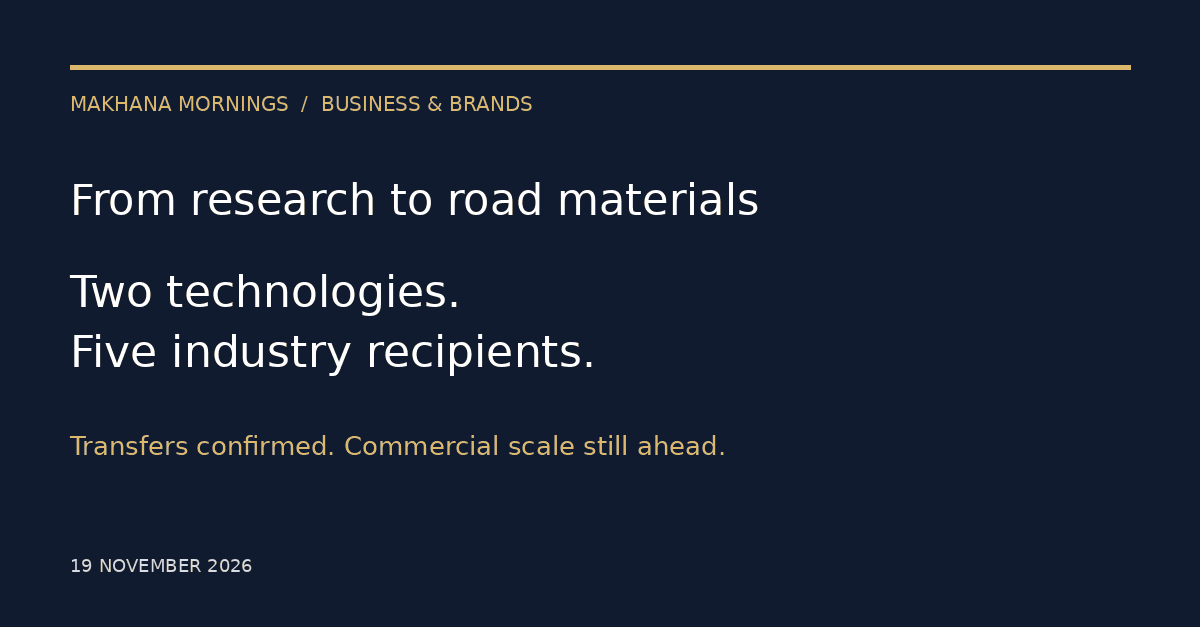
CSIR has transferred two different road-material technologies to named industry partners, opening routes towards commercial use without establishing that large-scale deployment has begun. A 19 November Science and Technology Ministry release describes transfers involving reclaimed asphalt and a biomass-derived alternative to part of conventional bitumen.
The first, MicroReAct-RAP, is a cold micro-surfacing technology incorporating up to 40% reclaimed asphalt pavement. The ministry names three recipients: Innovative Roadztech Private Limited, AVK BlackGold Infra Private Limited and Hindustan Colas Private Limited, also known as HINCOL.
The second is Bio-Bitumen, developed through collaboration between CSIR’s Central Road Research Institute and Indian Institute of Petroleum. The ministry says it uses agricultural residues, including rice straw, to produce material capable of partially replacing petroleum-based bitumen. It names RAACS Solutions Private Limited, identified as BioBhoomi, and SAR Parivahan Private Limited as recipients.
These are separate approaches, not percentages that can be added together. The 40% figure refers to reclaimed asphalt pavement in the first technology. The announcement gives no equivalent replacement percentage for the second. Nor does it establish that either approach replaces every material used to build a road.
The business question is what happens after a technology transfer. A recipient still has to connect material supply, production, project requirements and customer acceptance. The transfer announcement alone does not establish the cost of that chain or the volume of material that will pass through it.
The ministry presents the technologies as ways to reduce reliance on virgin inputs and use waste materials. Those are the stated purposes. The release does not disclose transfer fees, production capacity, procurement orders or field-performance results for these recipients, so it cannot establish realized savings or commercial scale.
A useful next set of milestones would be disclosed production, named projects and evidence from use. Until then, the concrete development is that specific firms have received the technologies. A route from laboratory research to industry has advanced; the operating and financial outcomes remain to be demonstrated.



Leave your thoughts