
A better battery ingredient has to prove itself inside a complete battery. Epsilon Advanced Materials’ latest launch puts that distinction at the centre of an Indian manufacturing opportunity: supplying materials that help cell makers improve performance, rather than simply adding more cells to a vehicle.
The company announced its Epsil silicon-graphite anode material on November 4. It projects up to 30% more vehicle range without enlarging the pack, while explicitly making that outcome dependent on the cell, pack and vehicle design. That is a development proposition for manufacturers, not an extra distance drivers can already expect from a car on sale.
The Breakdown
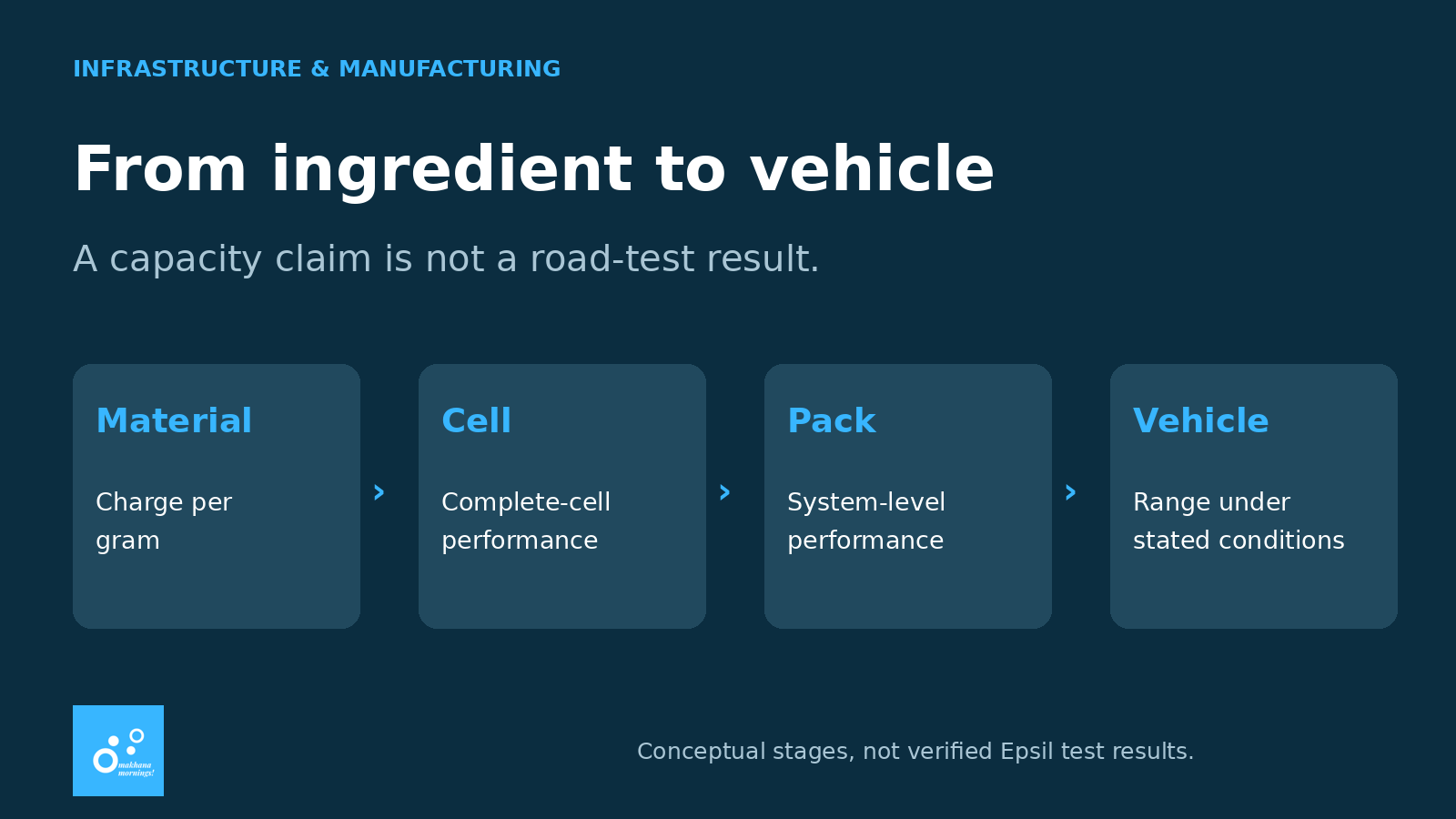
An anode is one of a battery cell’s two electrodes. Epsilon reports reversible capacity of 600–650 milliamp-hours per gram for Epsil, against 340–360 for conventional graphite. This measures charge stored per unit of anode material. It is not a measurement of energy per kilogram of an assembled battery, still less kilometres travelled by a car.
The distinction matters because the rest of the cell and pack still have to do their jobs. Comparing an ingredient’s capacity with a finished vehicle’s range skips the engineering between them. A useful purchasing comparison needs an agreed test boundary, not merely the larger number on a specification sheet.
Why This Matters
India already has a concrete, separate example of silicon-graphite cell development. In January 2024, ISRO reported a flight demonstration of VSSC’s 10 Ah cells aboard the POEM-3 platform. The battery powered a resistive load, and measured voltage, current and temperature matched predictions.
That was an actual demonstration in a specified application. It was not a test of Epsil, and a space experiment cannot establish how this new material will perform in an electric car. The comparison illustrates why qualification belongs alongside the chemistry in any assessment of progress.
The Big Picture
For Indian suppliers, the commercial question is whether a material can become a dependable part of a customer’s manufacturing process. Buyers need evidence of consistent output, performance over repeated use and acceptable cost, not just an attractive first specification.
Epsilon’s announcement leaves customer-specific validation central to the outcome. The next useful evidence would be results from identified cell configurations and eventual vehicle applications, with the conditions stated clearly enough to compare.
The Crunch
The opportunity is to improve what a battery can deliver for its size. Judge progress at each stage: material, complete cell, pack and vehicle. A promising ingredient earns its commercial value when the finished system performs reliably.
Related categories: Technology & AI; Business & Brands.



Leave your thoughts