
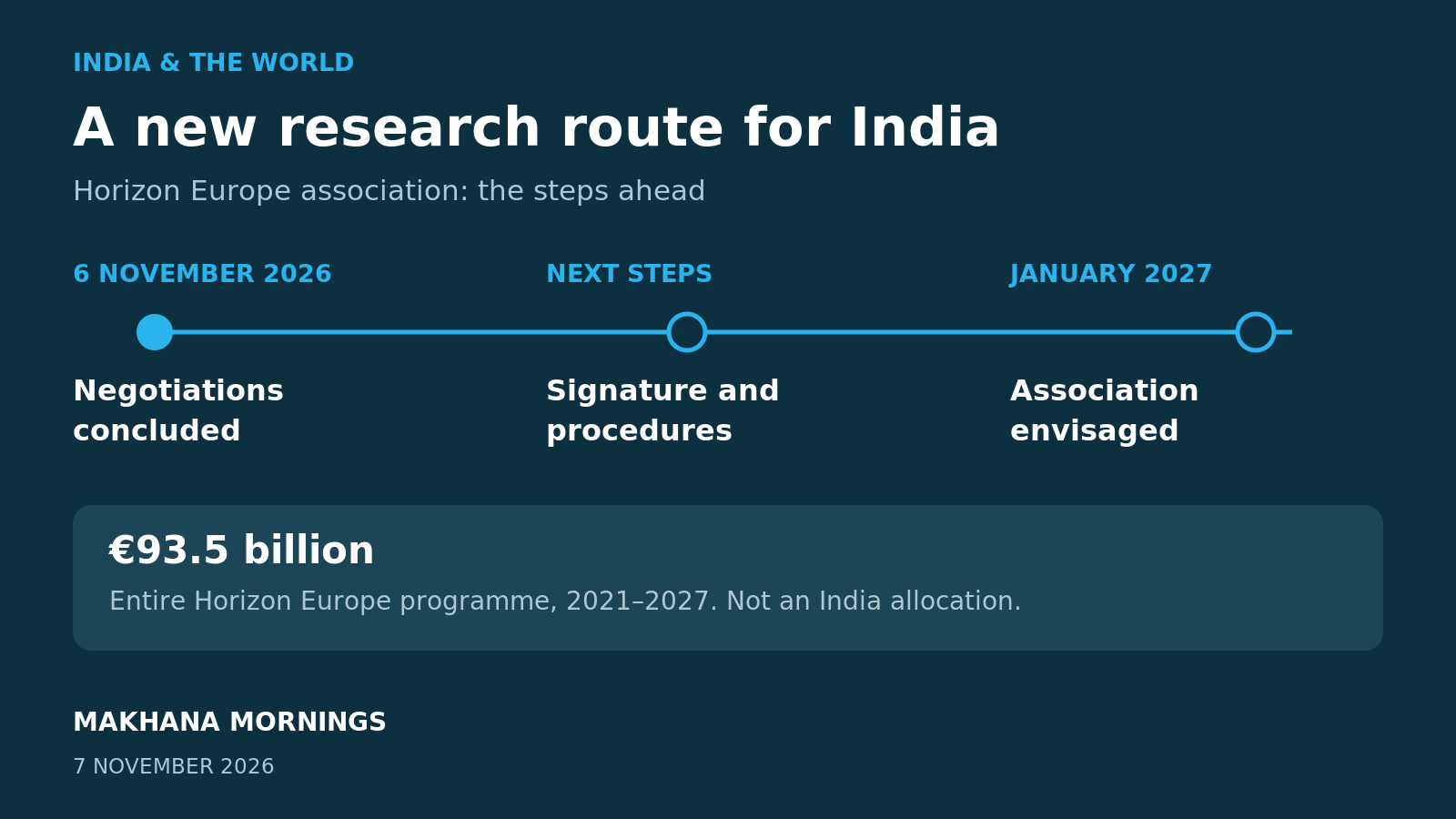
The European Commission and India concluded negotiations on India’s association with Horizon Europe on November 6. For Indian research organisations and businesses, the proposed arrangement would open a more direct route into multinational research projects.
The next step is to sign the agreement and complete the necessary procedures on both sides. Association is envisaged for January 2027, so the announcement does not make the new funding arrangements available immediately.
The Breakdown
Once those steps are complete, Indian participants would be able to receive Horizon Europe funding directly and lead collaborative projects under Pillar II, which covers global challenges and industrial competitiveness. Its areas include health, digital technology, industry, space, climate, energy and the bioeconomy.
Horizon Europe’s €93.5 billion budget covers the entire 2021–2027 programme. It is not an allocation to India. Associated countries contribute financially and participate on equal terms in the parts covered by their agreement; the announcement does not specify India’s contribution or a guaranteed funding total for Indian applicants.
A different way to organise research
The business significance lies in how a project can be put together. A university, a technology developer and an industrial partner may bring different pieces of the same problem: scientific knowledge, a working prototype and a place to test it. A shared funding framework can make that combination easier to organise.
Leading a project also carries work beyond the laboratory. A prospective coordinator needs partners with complementary skills, a credible delivery plan and clear arrangements for budgets, data and intellectual property. Access to a programme is only the beginning of that preparation.
For an Indian business, the useful question is whether a particular research call fits a problem it actually needs to solve. A larger international network can help, but joining a consortium takes time and resources. The value depends on the project and the terms on which its results can be used.
The Crunch
The conclusion of negotiations gives Indian organisations a reason to start mapping possible partners and relevant research areas. The immediate milestone to watch is completion of the agreement, followed by the detailed participation conditions for the calls they intend to pursue.
The opportunity is to help shape and deliver research alongside European partners. Its eventual scale will become clearer through funded projects and useful outcomes, rather than the headline size of the overall programme.



Leave your thoughts