
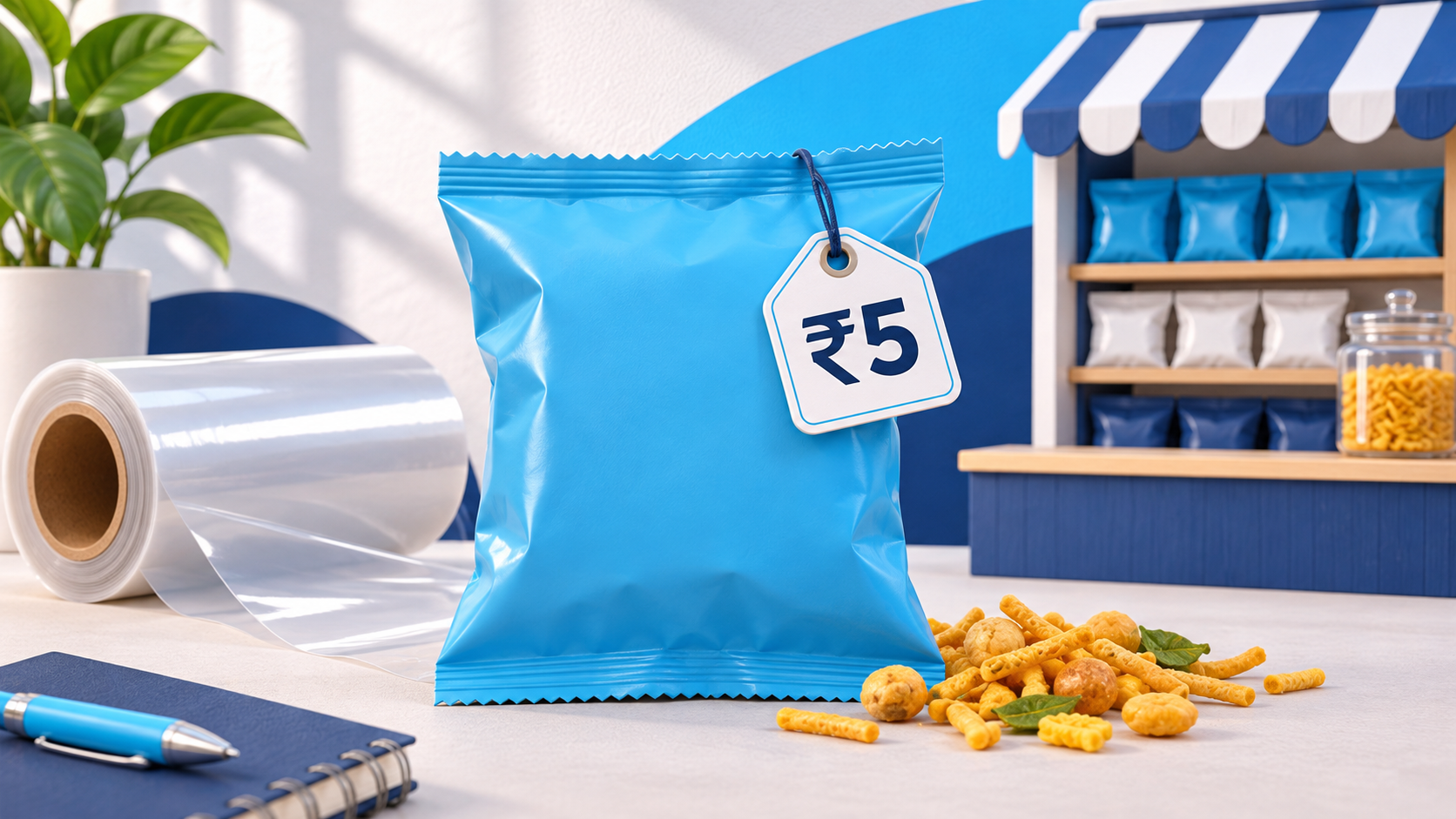
Original AI-generated conceptual illustration. The unbranded pack is not an actual product or a measured food quantity.
A shopper hands over a ₹5 coin. For the snack maker, that familiar price leaves a complicated question: how much food, packaging and distribution can the sale support?
Recent disclosures from Gopal Snacks and Prataap Snacks show companies using several answers at once. The choices reach beyond reducing the quantity inside a pouch. They include changing its dimensions, adjusting trade spending and selling a different mix of products.
The Breakdown
Keeping a pack at ₹5 preserves the amount a customer needs to spend today. Reducing its weight raises the price per gram, even though the checkout price stays unchanged. Moving the same customer towards a larger pack asks for more cash upfront. Those are different affordability decisions.
Gopal provides a useful check against treating every small pack as inherently unprofitable. On its May 13, 2026 earnings call, management said its ₹5 products had historically delivered margins comparable with, or better than, larger packs. It described adjusting grammage when those margins came under pressure. This was a company-specific historical statement, not a promise about every pack today.
Product mix also needs careful interpretation. In the same discussion, Gopal explained that a jar containing forty ₹5 wafer biscuits appeared in its system at a ₹200 price point. A change in reported pack mix can therefore reflect how products are grouped, as well as what an individual shopper pays.
Why This Matters
The wrapper creates another set of choices. In its November 3, 2026 call, Gopal said a review of packaging dimensions identified potential savings of ₹6.7 crore on an annualised basis. Smaller dimensions could also reduce carton and transport costs. Management cautioned that existing laminate stocks and the need for new printing cylinders would delay the full benefit, potentially into FY28.
That is a manufacturing transition rather than an immediate saving on every packet. Removing unnecessary packaging material can change costs without requiring the same reduction in food quantity. The practical limit is whether the redesigned pack still protects and presents its contents adequately.
Gopal also said decisions on grammage were being made product by product. It described stronger pricing power in gathiya than in some namkeen products. The business implication is straightforward: a brand cannot assume customers will accept the same adjustment across its entire range.
The Big Picture
Prataap, which sells Yellow Diamond and Avadh products, described another combination of responses in its October 30 results release: grammage rationalisation, selective changes to channel margins and trade schemes, and operating-cost reductions. These were selective company-level responses, rather than changes identified exclusively with ₹5 packs. It pointed to higher palm-oil and packaging-laminate costs, alongside fuel and logistics pressure.
These measures had not fully protected profitability. For the September quarter, Prataap reported income from operations of ₹540.95 crore, up 25.9% from a year earlier, while operating EBITDA fell to ₹12.90 crore from ₹22.90 crore.
Gopal’s November 2 presentation showed a different outcome over the same quarter: gross margin rose to 27.1% from 26.4% a year earlier, while EBITDA margin increased to 9.0% from 6.4%. These are whole-company measures. They do not tell us how many paise either business earned on a particular ₹5 packet. The latest packaging-savings and channel measures are also company-level disclosures, rather than a measured pack-cost breakdown or actions shown to apply exclusively to ₹5 packs.
Trade incentives matter because the shop is part of the economics too. The retailer’s earnings per sale, stock turnover and shelf space can influence which packs it wants to carry. Changing a scheme can improve a manufacturer’s realisation but also change a retailer’s willingness to stock or recommend the product.
There is no universal company policy here. In Mint’s November 5 report, Parle marketing chief Mayank Shah said the company had not reduced margins on smaller packs and continued to offer the same margin across sizes. That is an attributed executive statement, distinct from an industry-wide finding.
The Crunch
The most useful way to follow the ₹5 pack is to watch what changes around its printed price: net weight, wrapper dimensions, trade terms and the products a company sells through each channel.
A larger pack can spread some packaging and handling costs across more food, but it also requires the buyer to spend more. A smaller pack can preserve access for a cash-conscious shopper, while asking the manufacturer to make tighter choices elsewhere.
The business test is whether those choices sustain both repeat purchases and the economics of supplying the shelf. A familiar coin price alone tells us neither.




Leave your thoughts