
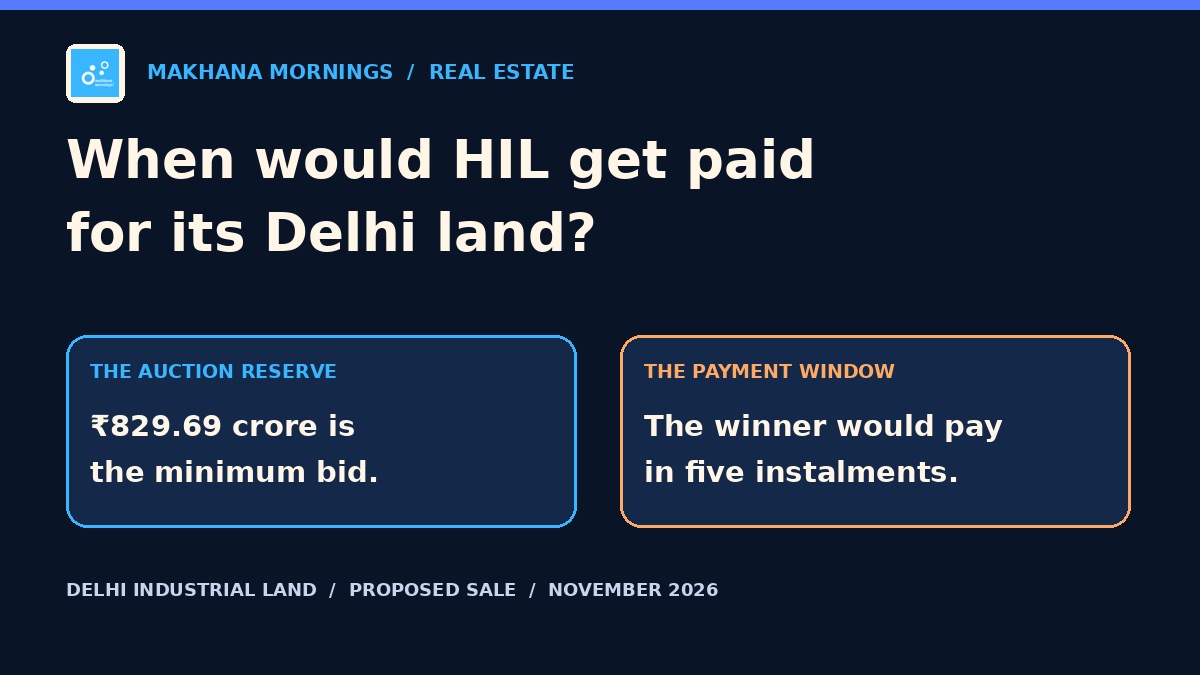
The published reserve for HIL (India) Limited’s 5.119-acre industrial plot at Zakhira, Delhi, is ₹829.69 crore. That is not an accepted price or cash in the seller’s account. The auction and the payment timetable are two different stages, and the payment clock does not start when technical bids close.
Monday’s deadline is to qualify, not to buy
Under the latest published timetable, registration, technical bids and bid security are due by 4 pm IST on Monday, 30 November. The e-auction for qualified bidders is scheduled separately for 14 December. The reserve is the stated minimum for the auction, not a prediction of the winning bid.
The winning bidder would pay in five instalments
The clock starts when HIL issues its Letter of Acceptance. The buyer owes 10% by day 10 and another 30% by day 60. The remaining three instalments are 20% each, due by days 120, 180 and 240. Eligible bid security is adjusted in the last instalment.
If the land sold at the reserve, the first payment would be about ₹83 crore and the total due by day 60 would be about ₹332 crore, before accounting for the final bid-security adjustment. Those are illustrations. A higher accepted bid would change every payment amount.
The first payment does not hand over the land
Under the revised terms, HIL can execute an Agreement to Sell once it receives the first 10%, not counting the bid security, and the applicable conditions are met. The agreement does not give the buyer title or possession. The balance still has to be paid.
The Crunch
Watch for three separate milestones: who qualifies, whether a bid is accepted, and when the seller actually receives the instalments. This is why a public property reserve or even a winning bid tells you less about cash timing than the payment schedule does. Read more about how public property proposals turn into proceeds.


Leave your thoughts