
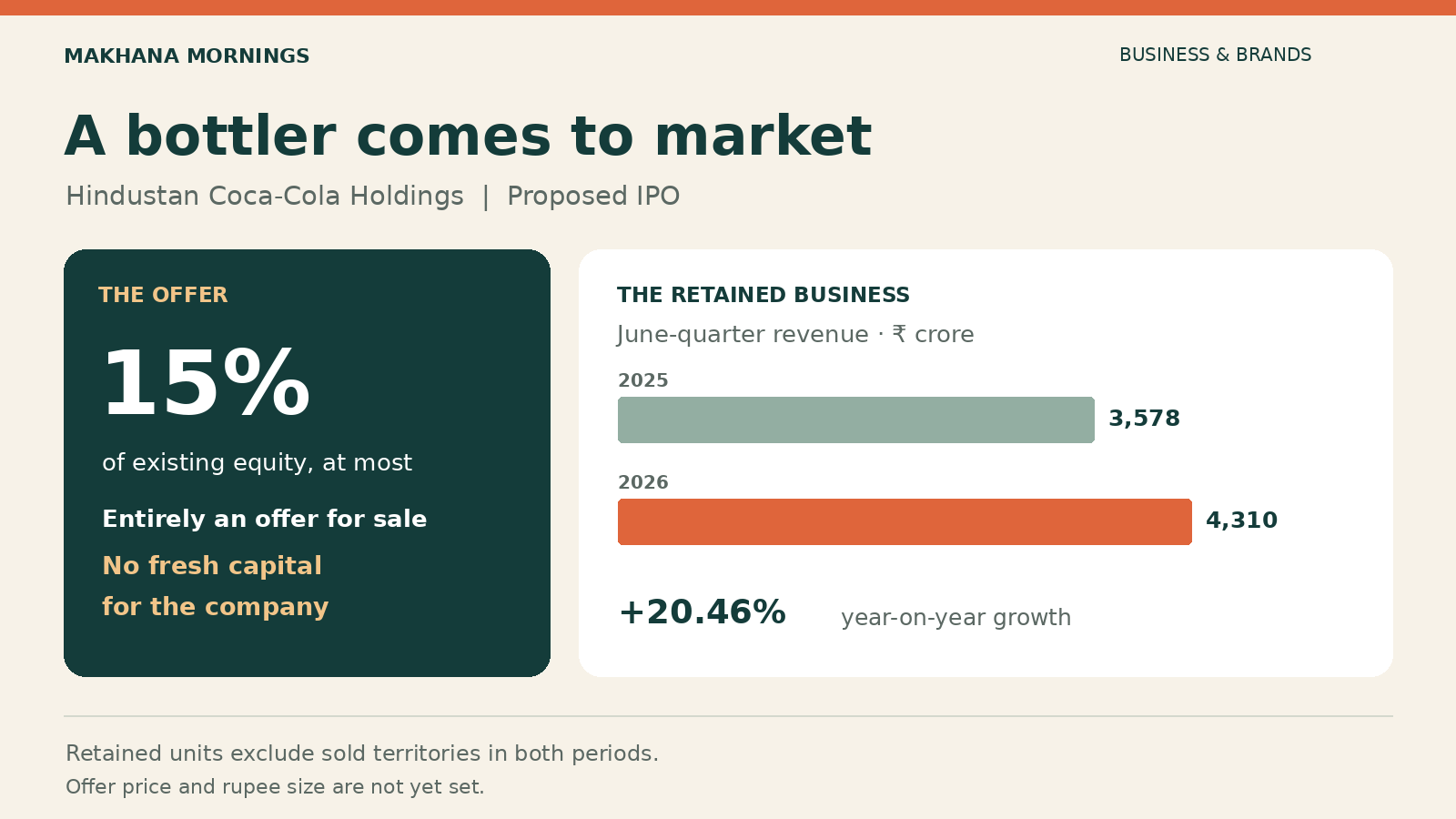
Hindustan Coca-Cola Holdings is preparing to take a reshaped Indian bottling business to the stock market. Its draft IPO papers, dated November 6, propose a sale of up to 99.75 crore existing shares, with no fresh shares issued and no offer proceeds going to the company.
The operating story needs a separate reading. Revenue in the business it has retained grew 20.46% in the June 2026 quarter, even as reported net profit fell sharply against a year-earlier period boosted by a large territory-sale gain. The listing brings both a recovering business and an unusually complicated set of comparisons.
The Breakdown
Hindustan Coca-Cola Overseas Holdings Pte. Ltd. is the selling shareholder. The maximum 997,461,456 shares on offer represent about 15% of the company’s existing equity. Proceeds, after the seller’s offer-related expenses, will go to that shareholder rather than fund new bottling capacity or repay company debt.
The draft leaves the offer price and rupee size blank. It proposes a listing on the BSE and NSE, but does not establish a valuation or an opening date. An IPO filing is a step towards a sale, not a completed offer.
The business operates through Hindustan Coca-Cola Beverages, or HCCB. Its exclusive territories cover all or parts of 10 states and four Union Territories, mainly in southern and western India. Familiar drinks including Thums Up, Sprite, Coca-Cola, Fanta and Maaza sit inside this bottling and distribution operation.
Why the historical sales figures need adjusting
Between FY24 and FY26, the group sold bottling businesses in Rajasthan, Bihar, Jharkhand, Northeast India, parts of West Bengal and North Gujarat to other Coca-Cola bottlers. That process, called refranchising, reduced the territory covered by its own business.
Reported consolidated accounts include those businesses until their respective transfer dates. Comparing successive years therefore mixes changes in demand with changes in what the company still owns.
In FY26, reported revenue from operations fell 9.43% to ₹11,548.58 crore. On the retained-unit basis, which removes the transferred businesses from every comparison period, revenue fell a smaller 2.65% to ₹11,438.52 crore. The remaining business still had a weaker year, but the headline decline makes that weakness look larger.
Retained-unit sales volumes were almost flat, rising 0.40%. Realisation per unit case fell to ₹166.2 from ₹171.8 as hydration products made up a larger share of volume. This distinction matters for a drinks business: selling more cases does not automatically mean earning more per case.
The June quarter shows a rebound, with a profit caveat
For the three months ended June 30, 2026, retained-unit revenue reached ₹4,310.17 crore, up from ₹3,578.21 crore a year earlier. Sales volumes grew 18.61%, while realisation per unit case increased to ₹171.3 from ₹169.9.
The retained-unit EBITDA margin, excluding other income and exceptional items, improved to 17.20% from 13.76%. EBITDA measures earnings before interest, tax, depreciation and amortisation. This company-defined retained-unit measure is useful for the operating comparison, but is not the same as consolidated net profit.
Reported net profit fell to ₹408.62 crore from ₹1,054.86 crore. The earlier quarter included an ₹890.19 crore exceptional gain from selling business territories; the latest quarter had no exceptional item. Profit before exceptional items and tax instead rose to ₹553.90 crore from ₹366.21 crore, an increase of about 51%.
The two movements are compatible. The company earned more before exceptional items and tax, while the disappearance of a large one-off gain pulled down the final profit figure. Treating the net-profit decline alone as evidence of a collapse in trading would miss that distinction.
The next test is consistency
A stronger summer quarter does not yet settle the annual growth story. Beverage demand is seasonal, with the January-to-June period typically stronger, and retained-unit revenue declined in the preceding full year. The improvement needs to hold across more than one quarter.
The eventual price will also matter. Until the offer is priced, investors cannot judge what they would pay for the retained business’s sales, margins and cash generation. The number of shares proposed for sale is not a substitute for an offer valuation.
The Crunch
Hindustan Coca-Cola’s proposed IPO would give public investors a stake in an established bottling operation, while allowing an existing shareholder to sell down. The useful questions are whether the retained business can sustain its recovery and what price the seller asks. Headline revenue and profit comparisons, without the refranchising and exceptional-gain adjustments, answer neither question well.


Leave your thoughts