
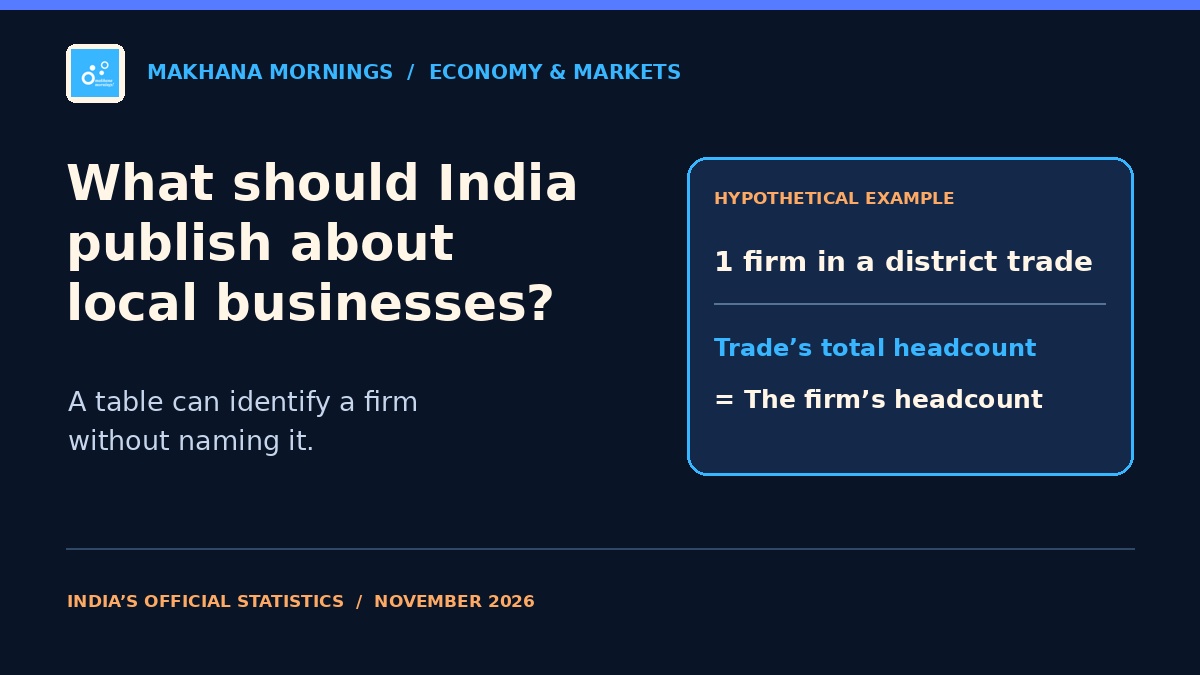
Imagine a district business table with just one registered firm in a particular trade. If the table publishes that trade’s total employment, it also gives away the firm’s headcount. No company name needs to appear. That is one reason why better access to business records does not always mean more detail in the statistics everyone can see.
On 25 November, India’s statistics ministry and the Data Security Council of India agreed to work on protocols for sharing data within and across agencies. The first planned output is a joint policy paper. The announcement does not establish a new public database or specify which records will be shared through this agreement.
A business register can improve surveys without becoming a public directory
There is already a concrete example of the kind of records the ministry wants to use. Under a separate September agreement, the Ministry of Micro, Small and Medium Enterprises and the statistics ministry set out how information on individual Udyam registrations could be exchanged to help build the National Statistical Business Register. One use of a register is to help statisticians identify which businesses could be selected for a survey. Registration records can help with that without being a complete count of all firms or a substitute for asking them questions.
Who sees the records is a different question from what the public sees
At the sharing stage, the question is which staff need access to which fields and why. At publication, the question is whether a very detailed table would reveal information about an identifiable person or business. Statistical agencies can respond to the second problem by combining categories or leaving some figures unpublished. That protects detail the public should not be able to infer, but can make the resulting statistics less useful for very local decisions. These are examples of ways to manage disclosure, not methods India has announced under the agreement.
The first useful thing to watch is the policy paper
Look for what it says about which records agencies can reuse, what they can use them for, and how they will decide which figures are safe to publish. A more complete list of businesses for sampling would be a real gain. A public table with more rows is a different outcome, and not always the right one.
Related reading: How India’s VISTAR plan aims to sharpen the local business map.
Related category: Business & Brands



Leave your thoughts