
Some research investments buy a better way to ask a question before they deliver a commercial answer.
India has committed more than €7 million over five years beginning in FY2026–27 to redevelop research beamlines at the Elettra synchrotron facility in Trieste, Italy. The commitment was announced during science minister Jitendra Singh’s November 13, 2026 visit and detailed in a November 14 government release.
It supports specialist research infrastructure and human-resource development. It is not an announcement that the money has all been paid or that the upgraded facilities are already operating.
Breakdown
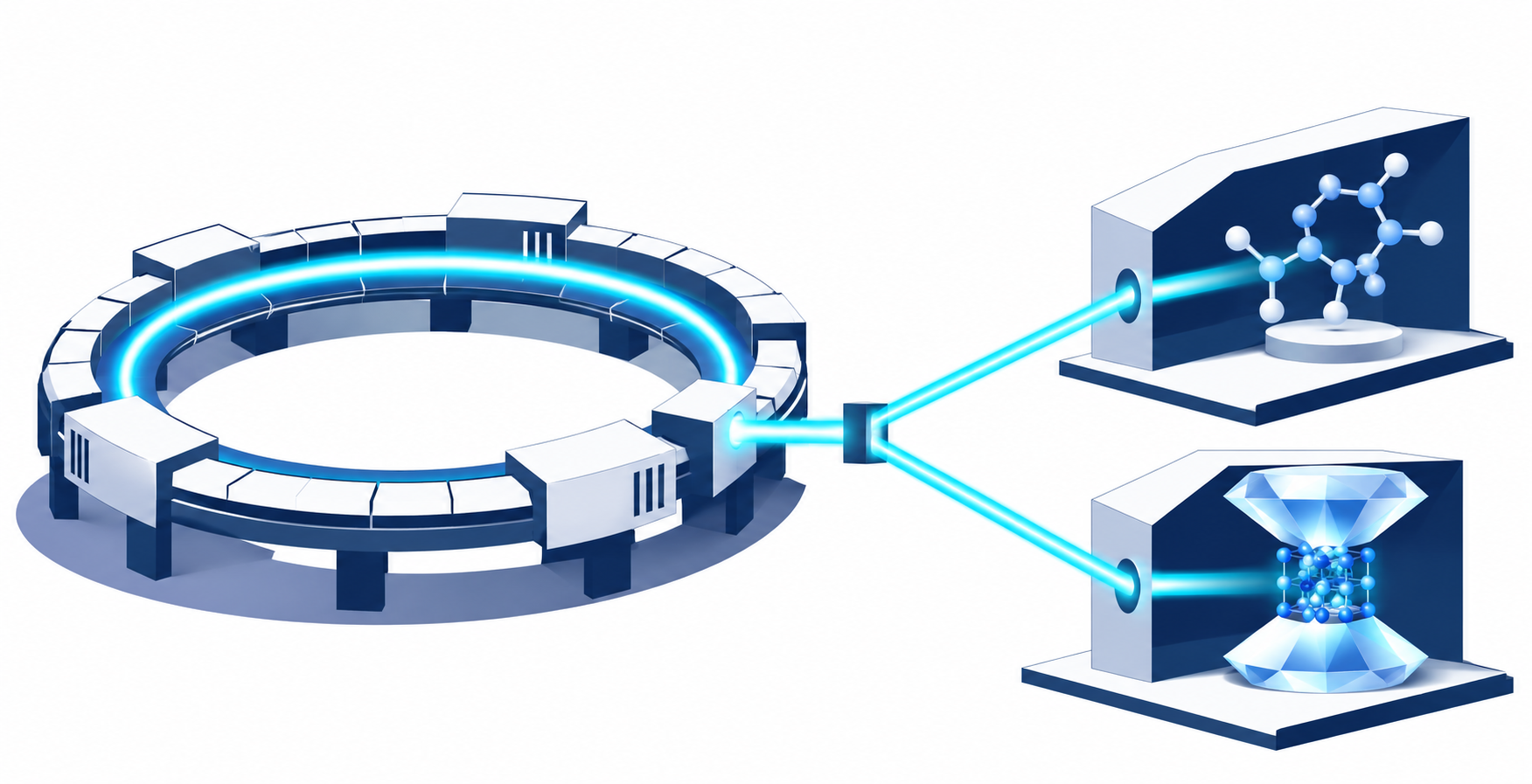
A synchrotron produces intense light, including X-rays, for examining matter. A beamline directs that light into specialised experimental equipment.
The India-linked upgrades cover two different questions. Micro-XRD is intended for macromolecular crystallography, which examines the structure of large biological molecules. Xpress Superbend is intended for high-pressure diffraction, used to investigate how materials behave under pressure.
This is a continuation, not the beginning, of the partnership. A letter of intent supporting participation in the beamline redevelopment had already been signed before the November visit. The existing XRD2 and XPRESS facilities were developed through collaboration involving the Indian Institute of Science (IISc) in Bengaluru.
Why This Matters
The value of this equipment is easier to understand through an experiment than an investment total.
In a 2021 study, an IISc team investigated how norepinephrine, a chemical messenger, and certain inhibitors interact with a transporter protein. Two of the six structures in the study used data collected at XRD2.
That is an example of an experimental capability. It was not a clinical trial, a newly approved treatment or a discovery produced by the November 2026 commitment.
The materials-science route is different. XPRESS uses diffraction experiments with samples compressed in diamond-anvil cells. Such measurements help researchers examine how structures change under extreme pressure.
The Big Picture
Access matters alongside the machine. Preparing suitable samples, obtaining experimental time and analysing the resulting data are separate parts of the research process.
There is also a transition to manage. The facility’s proposal page currently carries a suspension notice for Elettra beamlines during the Elettra 2.0 upgrade. Older instructions elsewhere on the site should not be read as proof that applications or experiments are available immediately.
The investment therefore concerns future research capability within an established international partnership. Its commercial value will depend on the work that follows, not on the funding announcement alone.
The Crunch
The meaningful milestones are upgraded equipment becoming usable, researchers gaining access and experiments producing reproducible results. A financial commitment helps build that route; it does not guarantee the discovery at the end.



Leave your thoughts