
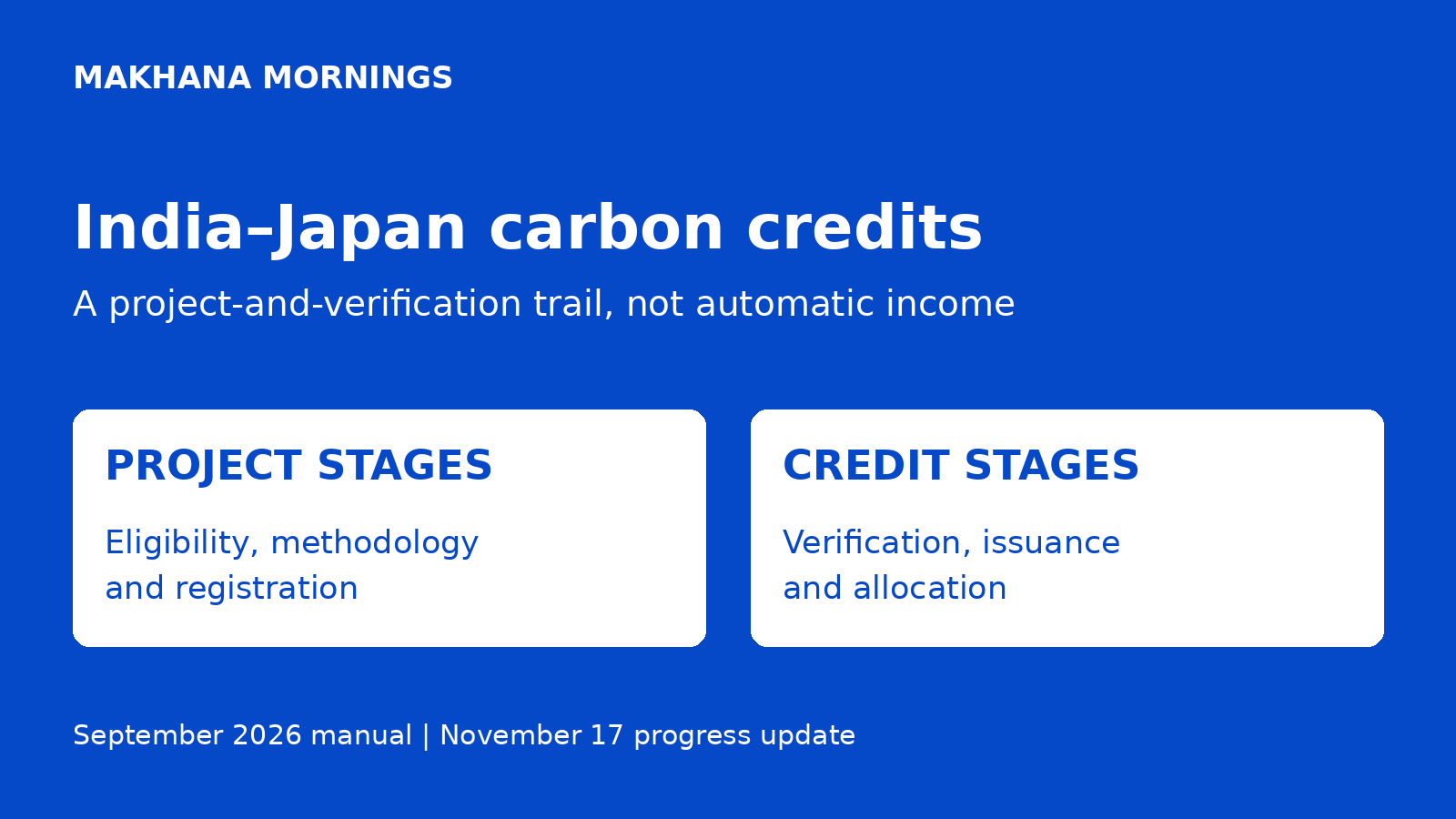
India’s latest update on its carbon-credit cooperation with Japan puts implementation in focus. The business question is how a proposed low-carbon project becomes an approved activity with verified outcomes, rather than whether a summit speech itself creates saleable credits.
A progress update, not a new rulebook
At COP31 on 17 November, environment minister Bhupender Yadav outlined the next steps for the India–Japan Joint Crediting Mechanism, according to the government’s release. Priorities include applications from independent checking bodies, proposed methodologies and project idea notes, alongside work to digitalise the process.
The dates matter. The cooperation agreement was signed in August 2025; implementation rules followed in June 2026. PIB dates the operational manual’s launch to 30 September 2026. The Japanese JCM portal lists publication of the manual and related forms on 29 October. The November speech is therefore not the unveiling of an entirely new manual.
The route from project to credit
The September 2026 manual limits eligibility to activities on India’s approved Article 6.2 list and projects whose operating start does not predate 7 August 2025. A broad claim to be “green” is not enough.
The process separates project proposals, methodologies, design and registration from later monitoring and credit issuance. An issuance request follows independent verification of emission reductions or removals and a positive assessment of the sustainable-development implementation report.
Credit sharing is decided by the Joint Committee with prior approval from both governments, considering technical and financial contributions and project economics. It is not an automatic equal split.
For Japan’s share, the manual sets out issuance in India’s registry, government authorisations, cancellation of that share in the Indian registry and issuance in Japan’s registry. Accounting adjustments are required to prevent double counting. Registration and international use are therefore distinct steps.
Our reading: evidence belongs in the business plan
For a company evaluating a project, the practical questions extend beyond equipment cost: who prepares the evidence, which outcomes can be measured, how verification is organised and how any eventual credits are allocated.
That is an analytical checklist, not a promise that a particular investment qualifies. A proposed project, a registered project, verified reductions and issued credits are different milestones. Potential credit proceeds should not be presented as cash already earned.
The minister also argued that success should be assessed through finance mobilised, technology transfer and domestic capabilities, not emissions alone. The cited update does not announce a quantified new funding award or an issued-credit total.
This is an explanation of selected requirements, not an exhaustive eligibility guide or confirmation that an application window is open. Project participants should check the current official procedures and applicable activity list before committing funds.




Leave your thoughts