A solar cell made in India can start with a wafer made abroad. India’s renewable energy ministry has finalised a model code that makes those two facts visible separately on its approved list of solar cells.
The November 25 order applies to List-II of the Approved List of Models and Manufacturers. It calls for the manufacturer’s brand name followed by a 12-character code, rather than the 14-character format discussed in the draft. New applications submitted after the order must use the code. Manufacturers and the National Institute of Solar Energy have three months from the order to update already-listed models and applications already submitted.
The first four letters separate the cell from its inputs
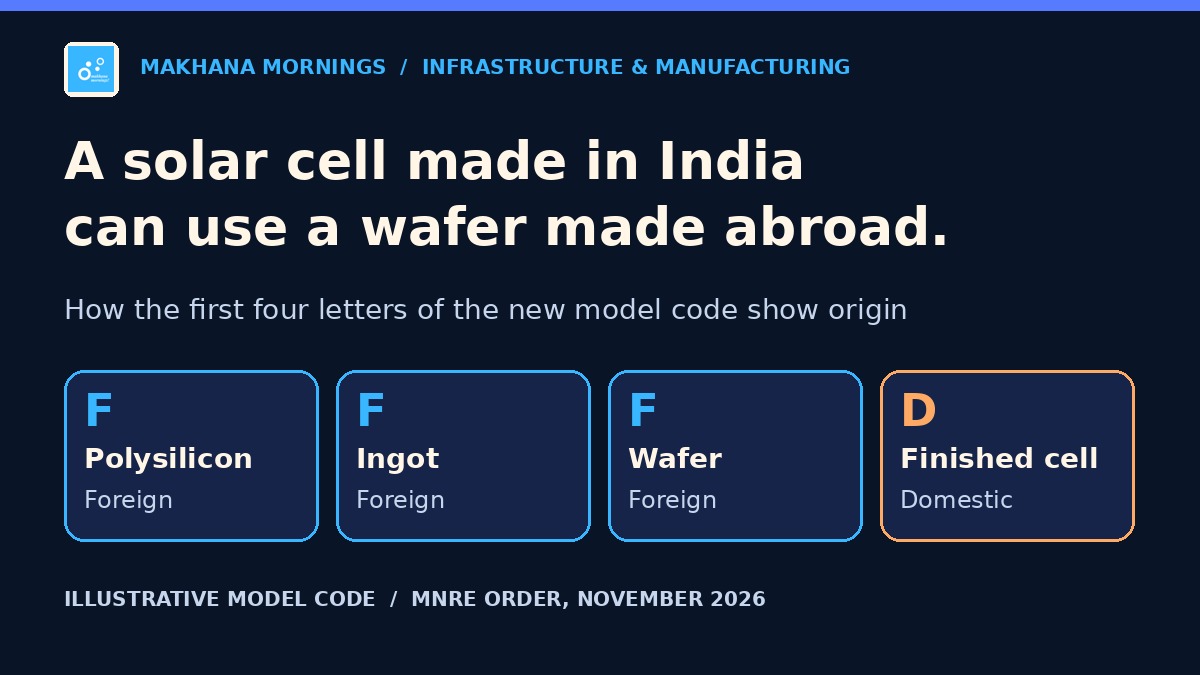
For a conventional silicon cell, the first four positions report whether the polysilicon, ingot, wafer and finished cell are domestic or foreign. Each position uses D or F. Polysilicon is the raw silicon material. An ingot is a solid block that can be sliced into thin wafers. Those wafers are then processed into cells. Thin-film and other technologies use the equivalents specified in the order.
Take the ministry’s example of a model whose first four letters are FFFD. It represents foreign polysilicon, a foreign ingot and a foreign wafer, but a cell made in India. The order sets a separate limit: making a cell from a blue wafer, which has already undergone a diffusion step, does not qualify that cell as domestically manufactured.
The code also describes the model, but not each shipment
Later positions identify the cell technology and wafer size, followed by an efficiency band. An efficiency code of 25, for example, spans 24.50% to below 25.50%; it does not mean every cell measured exactly 25%. The last two positions are reserved. Manufacturers can add their own suffix as long as the first 12 characters follow the standard.
This is a model identifier, not a batch-level serial number. Nor does it, by itself, settle whether a particular solar project meets its sourcing requirements. Buyers still need to check the relevant approved lists and the rules for their project. What the code makes easier is asking a more useful question than ‘Is the cell Indian?’: which stages of making it took place in India?