
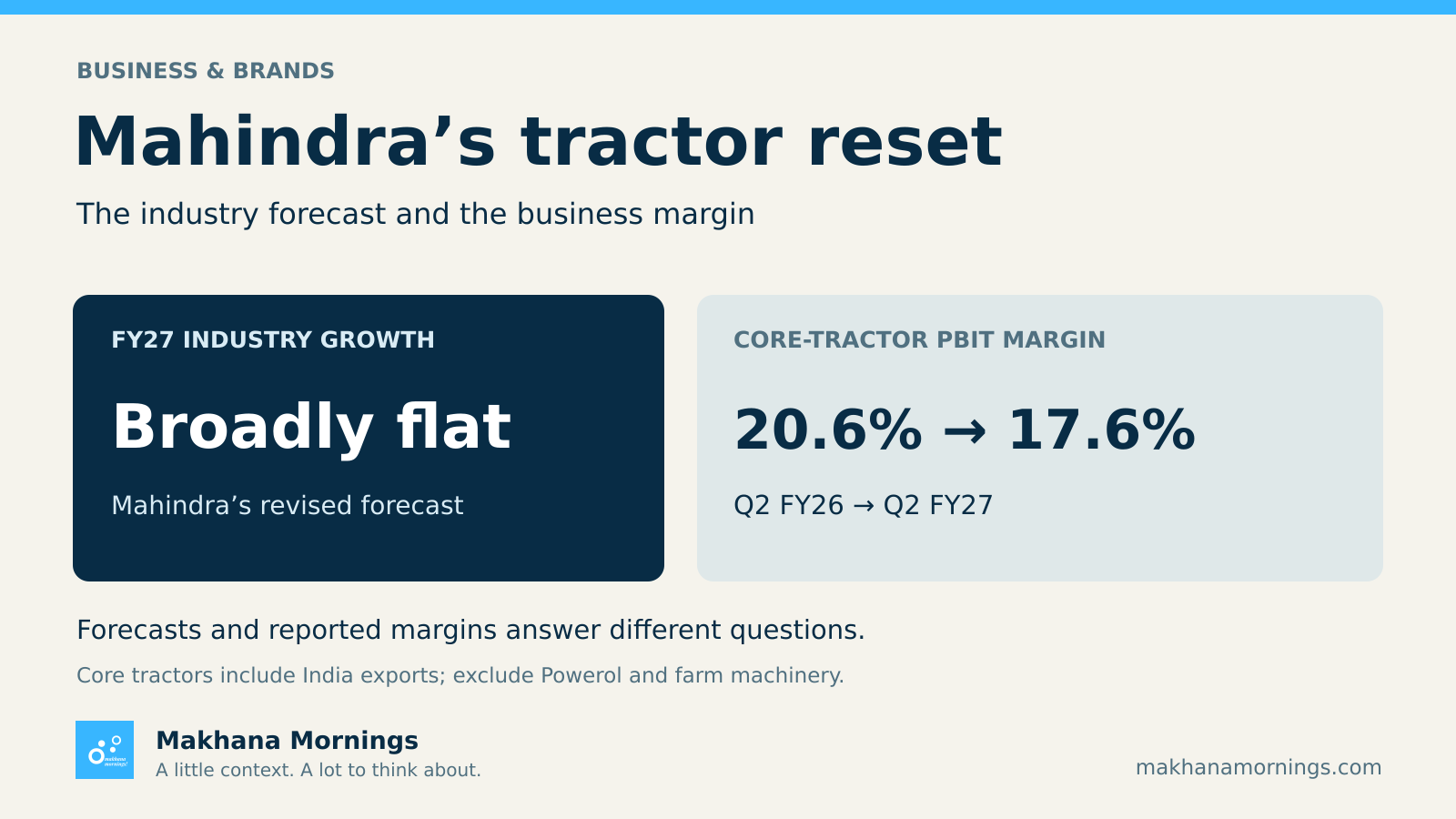
Mahindra & Mahindra has lowered its tractor-industry outlook to broadly flat growth for the financial year ending March 2027. The forecast, presented with its November 5 results, shows why strong sales in one part of India’s vehicle market cannot stand in for demand everywhere.
For the quarter ended September 30, the group reported consolidated revenue of ₹57,553 crore and profit after tax attributable to its shareholders of ₹4,588 crore, both up 25% from a year earlier. Within that total, the automotive business’s consolidated profit rose 55%. The farm business’s consolidated revenue fell 6% to ₹9,572 crore, while its profit fell 9% to ₹1,053 crore, according to the company’s results release.
The purchase depends on the farm’s cash flow
Mahindra’s investor presentation points to prolonged dry spells, weaker soil moisture and lower reservoir availability. It also cites a worsening trade-off for farmers, with input costs rising faster than retail prices. These are the company’s reasons for revising its industry forecast.
A tractor purchase ties up money for several seasons. The buyer has to consider the income a machine can help generate, the cost of running it and the repayment schedule. Pressure on crop income can therefore affect the timing of a purchase even when the need for equipment remains.
The latest quarter also needs a calendar check. Mahindra attributed part of the farm business’s decline to the shift in festive-season timing. That quarterly comparison and its full-year weather assessment describe different pressures.
Watch the business definition as well as the margin
The company’s core-tractor profit margin before interest and tax was 17.6%, against 20.6% a year earlier. This measure includes tractor exports from India and excludes Powerol and the farm-machinery business. It should be compared with the same measure over time.
Management expects further core-tractor margin pressure in the third quarter, improvement in the fourth and normalisation in FY28, the year ending March 2028. That is its outlook, with the eventual result still dependent on demand, costs and execution.
The useful next check
For dealers, suppliers and lenders, the practical questions are how quickly stock is selling, whether customer cash flows support repayments and which regions are seeing orders recover. A group earnings headline cannot answer those local questions. Mahindra’s update makes the case for reading the farm business on its own terms.




Leave your thoughts