
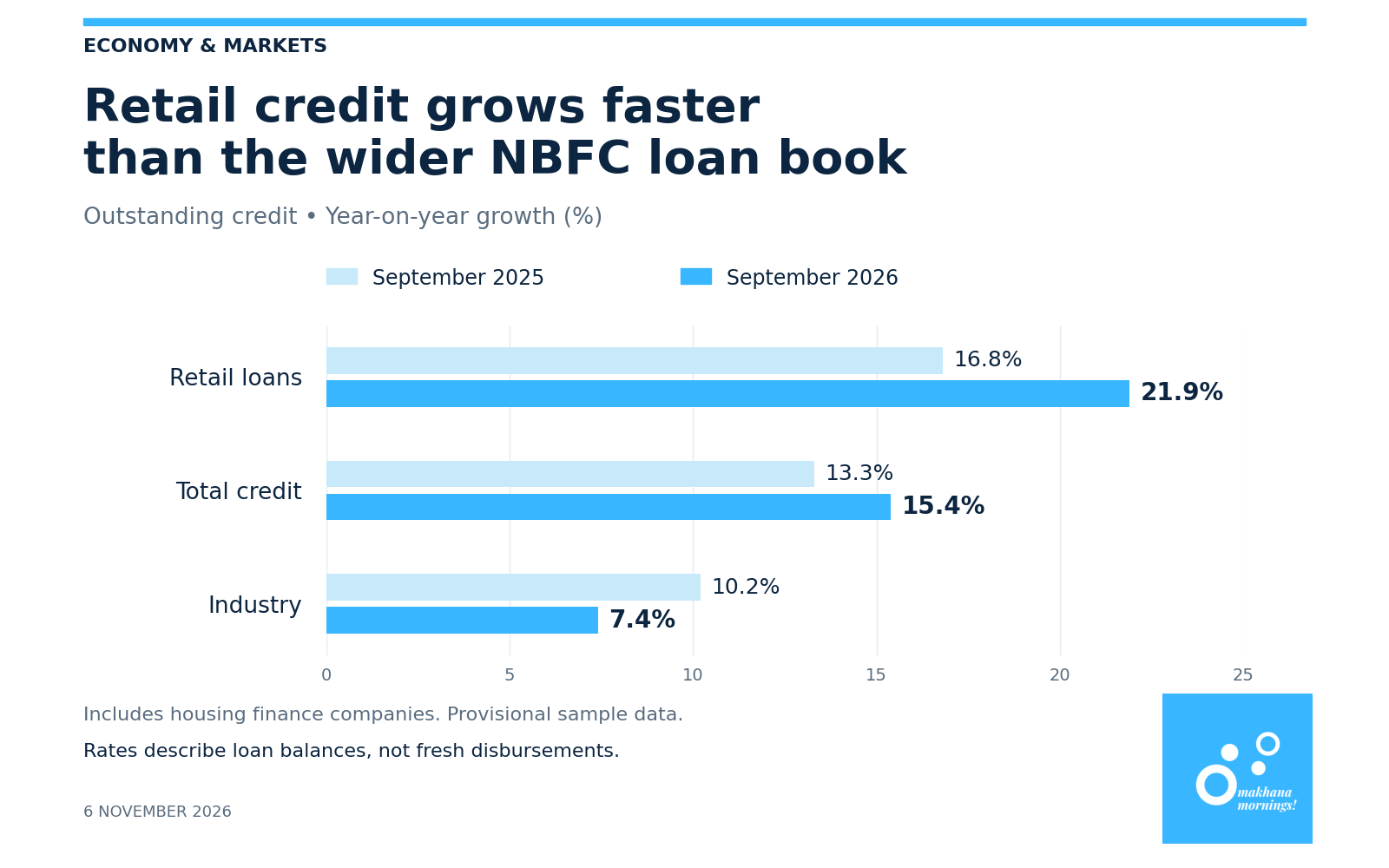
Retail loans outstanding at non-bank lenders grew 21.9% from a year earlier in September 2026, ahead of the 15.4% expansion in their overall credit. The figures, released on November 6, show how differently parts of the same lending market can behave.
The Breakdown
Retail’s annual growth rate was higher than the 16.8% recorded in September 2025. Credit to industry grew 7.4%, below its year-earlier rate of 10.2%. Overall NBFC credit growth was above the 13.3% recorded a year earlier.
The gap between retail and industry’s growth rates widened to 14.5 percentage points, from 6.6 points. Housing loans, loans against gold jewellery and vehicle loans all recorded faster annual growth than a year earlier within the retail category.
Growth rates need a starting balance
A faster-growing loan category does not necessarily receive more additional money. Consider two hypothetical portfolios: a ₹100 loan book growing 20% adds ₹20, while a ₹1,000 book growing 10% adds ₹100. The slower-growing book adds more rupees because it starts larger.
The same distinction matters when comparing retail and industrial credit. Their growth-rate gap alone cannot establish which added more outstanding loans in rupee terms. It also cannot show that lenders moved money from industrial borrowers to retail customers.
The August comparison is different
August’s previously reported annual growth rates were 15.8% for total NBFC credit and 22.0% for retail loans. September’s corresponding rates were slightly lower.
Each rate compares a month-end balance with its own year-earlier balance. A lower annual growth rate in September does not, on its own, mean that credit outstanding fell between August and September. Measuring that change requires the two months’ balances on a comparable basis.
What the figures cover
These are provisional month-end figures for a sample of Upper- and Middle-Layer NBFCs and housing finance companies. The sample accounted for about 87% of credit against a September 2025 benchmark.
Outstanding credit measures what remains owed after new lending, repayments and other changes. It does not directly count fresh disbursements, successful loan applications or easier approval terms. Growth also needs to be considered separately from how reliably borrowers repay.
The Crunch
The aggregate number is a starting point for understanding financing conditions. A business seeking credit needs to look at its own borrowing category and the terms available to it. When assessing a lender, the next questions concern the balances behind its growth, its funding costs and the quality of those loans.

Leave your thoughts