
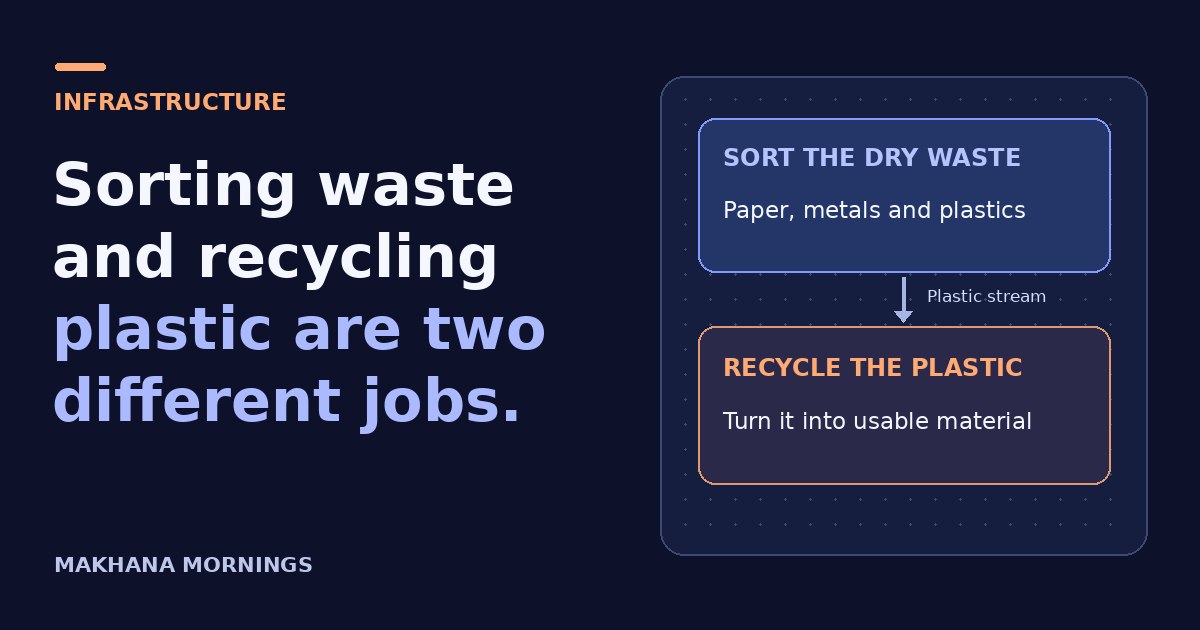
A truck arrives with a load of dry waste. It might contain cardboard, drink bottles and metal cans. A sorting centre has to separate what came in before a recycler can turn any of it into a new material. Weighing the truck tells you how much waste arrived. It doesn’t tell you how much plastic anyone recycled.
That difference is easy to miss in NEPRA’s expansion. The Private Infrastructure Development Group said on 19 November that it had committed ₹110 crore in equity through InfraCo. The money is meant to support new sorting facilities, more plastic recycling and working capital, as well as strengthen existing operations. A commitment is not proof that the money has all been drawn or that the new capacity is already running.
The two capacity figures measure different stages
The investor puts NEPRA’s dry-waste processing capacity at about 900 tonnes a day today, with plans to raise it to 1,880 tonnes a day. It separately puts plastics-recycling capacity at 6,200 tonnes a year, with plans to raise that to about 18,000 tonnes a year.
The first figure refers to a broader stream that can include paper, glass or metals alongside plastic. The second refers to plastics-recycling capacity. The units differ, but putting both on an annual basis still wouldn’t give you a recycling rate. The announcement doesn’t say how many days the sorting facilities will run, how much plastic comes in, or what share of it becomes material a buyer can use.
A sorting centre can only separate what it receives
A sorted load can supply several buyers. Paper may go one way, metals another, and a bale of sorted plastic to a recycler. Some material may have no viable recycling route. Keeping dry waste separate in the first place makes it easier to recover useful material; a larger sorting centre does not make dirty or mixed material automatically saleable.
NEPRA has described sourcing dry waste from local bodies, waste pickers, collectors and aggregators, among other sources. India’s 2026 solid-waste rules also distinguish dry waste from other household waste and direct it to material recovery facilities for sorting. More equipment can help, but the expansion still needs a regular supply of separate dry waste and buyers for what the facilities recover.
Track what leaves the facility, not only what arrives
Installed capacity is useful for planning. For results, look for what the facilities actually accept, what they recover by material and what is sent for recycling or other treatment. A tonne of paper sold to a mill is useful recovery. It still isn’t a tonne of plastic recycled.


Leave your thoughts