
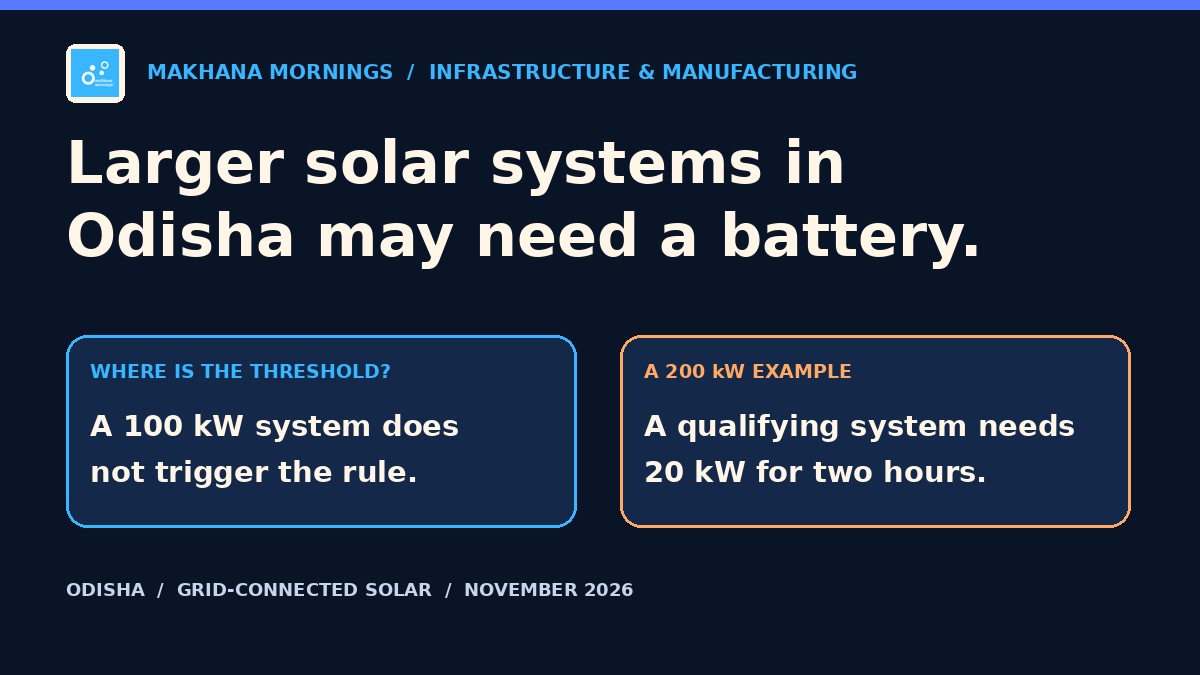
An Odisha business planning a 200 kW grid-connected solar system may need to budget for more than the panels. Under the state electricity regulator’s final rules, a qualifying system of that size needs a battery rated at least 20 kW and capable of supplying that level for at least two hours. That is 40 kWh in this example. The two units answer different questions: kW is how much power the battery can supply at once, and kWh is how much energy it can deliver over time.
Who has to add a battery?
The requirement covers eligible consumers with solar photovoltaic systems above 100 kW under Odisha’s grid-interactive distributed renewable energy rules. A system rated at exactly 100 kW does not trigger it. Irrigation, pumping and agriculture consumers are exempt. Existing systems and projects that already had distribution-company connectivity approval are also exempt unless the consumer applies to expand and the resulting capacity exceeds 100 kW.
The final threshold is higher than the one proposed
The August draft proposed requiring batteries above 10 kW and applying different percentages at different plant sizes. The final rule instead applies above 100 kW, with a minimum battery power rating equivalent to 10% of the plant’s installed capacity and a minimum storage duration of two hours. The regulator says batteries should charge during solar hours and preferably discharge during peak hours.
The dates apply to different parts of the rule
The regulation came into force on publication in the Odisha Gazette on 20 November 2026. The rules separately give electricity distributors until the end of the financial year to adapt their billing systems, with the new energy-accounting arrangements effective from 1 April 2027. That later date is not the start of the battery requirement.
The Crunch
For a project near the threshold, check the combined solar capacity after any proposed expansion and whether the distributor has already approved connectivity. And when comparing battery quotes, check both the power rating and the energy it can deliver. A battery can meet one number and still miss the other.




Leave your thoughts