
OPmobility has opened a fuel-system plant at Kharkhoda in Haryana. It is the company’s sixth Indian factory and its second in northern India through the joint venture with Maruti Suzuki and Suzuki Motor Corporation.
The location connects a component supplier’s growth to a specific customer hub. Understanding the investment means separating the factory that has opened from the capacity it is intended to reach.
The Breakdown
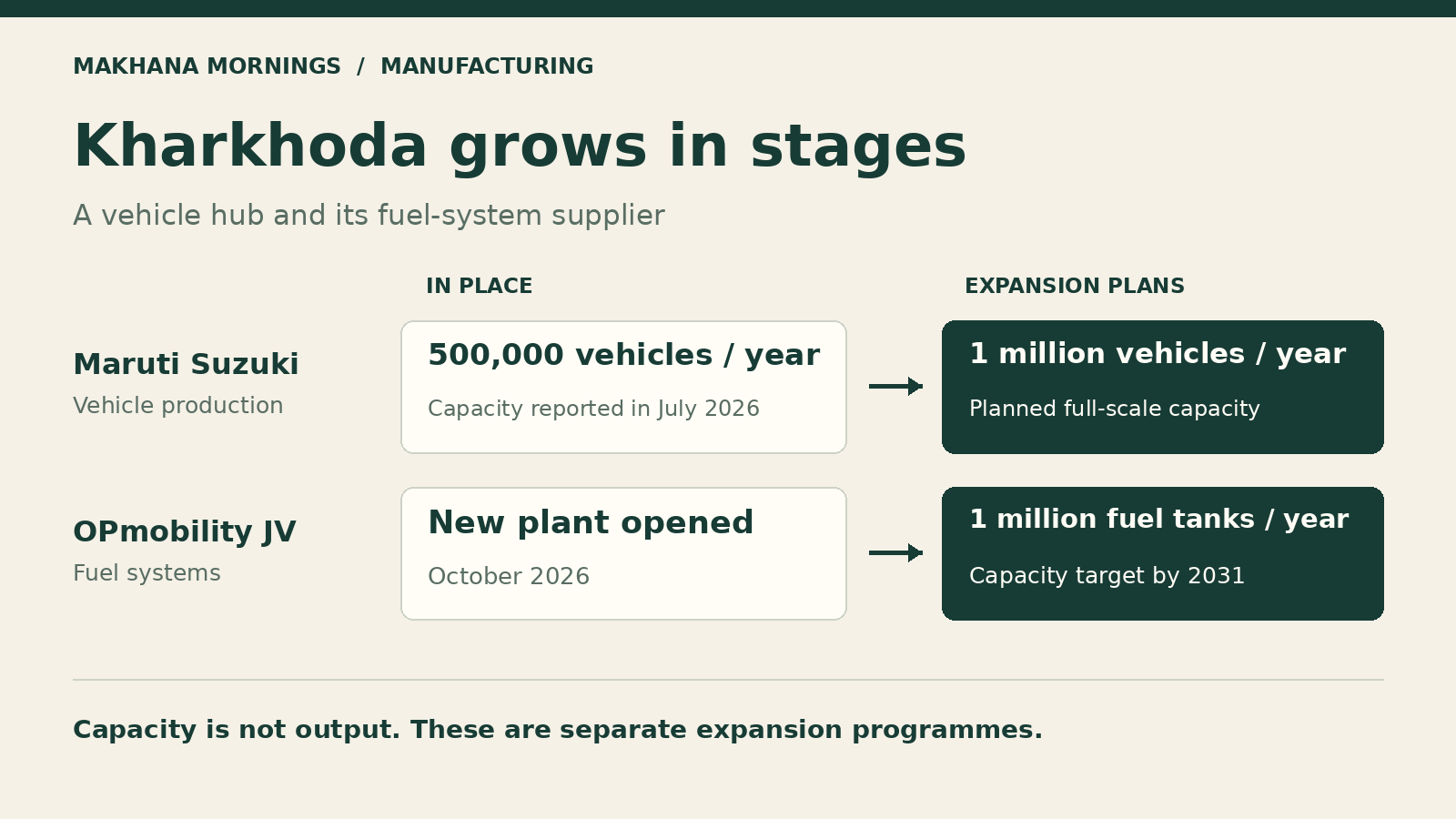
The plant’s annual capacity is expected to reach one million fuel tanks by 2031. The announcement does not disclose starting capacity or a year-by-year ramp-up, so that target cannot establish near-term production or revenue.
The wider expansion has other milestones. OPmobility’s November update sets an ambition of operating ten sites in India by 2030 and increasing its engineering workforce from 400 to 1,500 by then. These are future goals.
Maruti Suzuki started commercial production at its second Kharkhoda vehicle plant in May, bringing the location’s annual capacity to 500,000 vehicles. In July, it outlined a further increase to one million vehicles annually at full scale.
The two manufacturers measure different products and follow separate expansion programmes. Their capacity figures do not establish actual output or a disclosed one-for-one supply contract.
Why This Matters
A vehicle factory needs a supplier network that can grow with it. Locating component production in the same manufacturing hub can make deliveries, engineering changes and production planning easier to coordinate.
That relationship also creates an operating dependency. A supplier’s utilisation follows customer production schedules and the models it supplies. Filling a new factory requires sustained orders, reliable production and coordination with the customer’s assembly lines.
The engineering ambition adds another dimension. Development teams close to customers can help resolve design and manufacturing issues as new models take shape. The practical benefit depends on which work those teams handle and how effectively they work with the factories.
The Crunch
The question now is how the new operation ramps up as its customer expands. Order volumes, production consistency and progress towards the announced capacity would show more than another factory count. Those operating measures will determine how much value the investment delivers.



Leave your thoughts